
Greek policy treats dual nationality as an ethnic entitlement rooted in ius sanguinis, yet that entitlement stalls at the municipal level. Citizenship by descent exists the moment a qualifying birth occurs, but the Greek Ministry of Foreign Affairs confirms it only becomes usable once a Dimotologio registers it. That gap between legal right and administrative recognition is the real story of Greek dual citizenship today.
TL;DR:
Most diaspora applicants face delays because municipal records often lack the necessary marriage transcriptions or civil entries from generations ago.
Registration barriers are amplified by inconsistent documentation requirements and the need for certified translations, leading to significant extra costs and time.
The primary obstacle is incomplete civil records, not eligibility, with missing links in family registries causing indefinite delays in many cases.
Greece’s citizenship law remains rooted in ethnic descent, but administrative recognition depends on municipal registry entry, which is often incomplete or slow.
The key to improving diaspora recognition lies in administrative reforms like digitizing records and creating dedicated registration pathways, not legislative change alone.
Table of Contents
-
Diaspora Descent Claims Versus Naturalization for Non-Ethnic Applicants
-
Access Hellenism Watch Research and Fellowship Opportunities
Dual Citizenship Greece: The Current Legal Framework
Greek nationality law rests on jus sanguinis: citizenship transmits through a Greek parent regardless of birthplace, a principle largely undisturbed since the modern state’s founding. What has changed is the machinery around that principle, and the changes have been neither linear nor complete.
The 1998 abrogation of Article 19 was the pivotal moment. That provision had allowed the state to strip citizenship from non-ethnic-Greek nationals who left the country, a mechanism critics called ethnically discriminatory. Its repeal signaled a shift toward formal equality in nationality law, even as ethnic descent remained the primary channel for diaspora recognition. Subsequent amendments through the 2010s introduced limited ius soli elements for children of long-term migrant residents, briefly narrowing the gap between ethnic and civic paths to citizenship.
That narrowing did not hold. Scholarly work on Greek citizenship reforms documents a partial retrenchment after 2015, with later criteria reintroducing more conservative eligibility tests. The pattern reads less like a coherent reform trajectory and more like a state adjusting to European Union pressure without fully abandoning its ethnic self-conception.
Key markers in that legal timeline:
-
1998: Abrogation of Article 19 ends the ethnicity-based revocation clause.
-
2010: Reforms extend limited ius soli rights to second-generation migrant children.
-
2015: Amendments further ease naturalization pathways for long-term residents.
-
2020 and after: Later adjustments reassert more restrictive, property- and residence-linked criteria.
Ministry of Interior guidance describes these changes in administrative terms, but the practical uptake depends entirely on how municipalities implement them, which is where the analysis turns next.
Ethnic Belonging Versus Civic Membership in Greek Law
Greek citizenship policy has never fully resolved whether nationhood is an inheritance or a contract. That unresolved question is not academic trivia. It explains why the law tightens and loosens in cycles rather than moving steadily in one direction.
Research on Greek citizenship and belonging frames this as a contest between liberal property theory, which ties membership to residence and civic investment, and a more conservative, ancestry-based model that treats ethnic Greeks abroad as members-in-waiting regardless of where they were born. The 2015 reforms leaned toward the civic model; the walkback afterward leaned back toward ancestry and property criteria.
Two turning points illustrate the oscillation:
-
The abrogation of Article 19 in 1998, which removed an explicitly ethnicized punitive mechanism from the books.
-
The 2015 to 2020 reform cycle, which added and then partially withdrew ius soli elements for migrant-origin residents.
For diaspora Greeks, this oscillation rarely changes their formal eligibility, since ancestry-based claims sit outside the ius soli debate entirely. What it does change is the administrative climate: a state uncertain about the civic status of long-term migrants tends to under-invest in the registry infrastructure that diaspora applicants also depend on.
Why Municipal Registration Blocks Diaspora Recognition
Consular authorities verify documents and forward files. They do not decide who is a Greek citizen. That authority sits with the local Dimotologio, the municipal civil registry, and ultimately with the Ministry of Interior. The MFA’s own guidance is explicit on this point: citizenship by descent exists by operation of law, but it is formally recognized only once a municipality enters it into the registry.
The problem is what that registration demands. Municipalities typically require an unbroken chain of civil records, parents’ marriage transcription, birth entries, and in many cases male-registry documentation going back generations. Diaspora applicants frequently lack one link in that chain, often because a village registry was never digitized or a marriage was never formally transcribed in Greece even though it took place there.
Three chokepoints recur most often:
-
Missing marriage transcriptions for ancestors who married in Greece but whose records were never forwarded to a Dimotologio.
-
Incomplete male-registry entries, historically tied to military conscription records rather than birth alone.
-
Village-level archival gaps in regions where record-keeping was inconsistent before mid-century administrative consolidation.
Pro Tip: Start the registry search at the ancestral village’s Dimotologio directly, not through the consulate. Consular staff can request records, but they have no authority to resolve gaps. Direct correspondence with the municipality, ideally through a local intermediary, cuts months off the timeline.
What Bureaucratic Friction Costs the Diaspora and the State
Registration barriers do more than delay individual applicants. They function as an unintended filter on diaspora engagement at scale. Every family that abandons an application because a village clerk can’t locate a 1920s marriage record represents a lost tie, one less potential voter, remitter, investor, or advocate for Greek interests abroad.
The demographic argument sharpens this. Greece faces population aging and years of outward migration among its own young professionals. A diaspora numbering in the millions, concentrated heavily in North America, Australia, and Western Europe, represents a demographic and economic resource that friction-heavy registration effectively idles.
Consider the downstream effects:
-
Reduced diaspora political participation, since dual citizens who never complete Dimotologio registration cannot vote in Greek elections.
-
Weaker remittance and investment channels, which depend partly on formalized legal ties to the state.
-
Uneven access along socioeconomic lines: applicants who can afford genealogical researchers or Greek-based lawyers clear the registry hurdle; those who cannot, don’t.
That last point deserves more attention than it typically gets. A citizenship regime that is formally open to all ethnic Greeks but practically navigable only by those with money or connections is not a neutral bureaucratic accident. It’s a de facto class filter layered on top of an ethnic entitlement, and it undermines the state’s own stated interest in diaspora reconnection.
The Hellenism Observatory’s Approach to Diaspora Research
Alexios Donas founded Hellenism Watch to build a systematic, independent record of the pressures and opportunities facing Greek communities across the Balkans and the Eastern Mediterranean. The research initiative operates independently, which matters directly for citizenship policy analysis: institutional actors describing their own administrative bottlenecks have limited incentive to document them candidly.
Every claim published is sourced and checked against primary material, including consular guidance and scholarly literature. The research initiative works with contributors from fields such as migration law and diaspora studies, policy analysis of governmental reform announcements, and diaspora community members reporting on registration experiences.
That combination enables triangulation of official statements against the practical experience diaspora applicants actually report.
Fixing the Registration Bottleneck: Policy Options
The single most actionable reform is procedural, not statutory. Ministry of Interior officials have already acknowledged the problem: General Secretary Dimitrios Karnavos described diaspora access as a critical framework requiring reflection and action, with digital transformation floated as a remedy.
Four operational fixes follow directly from the barriers documented above:
-
Create a standalone diaspora registration pathway separate from general Dimotologio processing, staffed specifically to handle ancestral-record verification.
-
Digitize and centralize archival records so municipal clerks aren’t searching paper ledgers for entries that may span multiple villages.
-
Standardize consular training on documentation requirements, since practice currently varies by post.
-
Clarify in statute that registration is recognition, not creation, of citizenship already held by descent, removing the ambiguity that lets processing stall indefinitely.
Pro Tip: Diaspora organizations tracking their own members’ processing times have real leverage. A published dataset of average registration delays by consulate or region turns anecdote into a policy brief the Ministry of Interior can’t easily dismiss.
Advocacy groups can support these fixes by systematically collecting delay and rejection data rather than relying on individual complaints, then packaging that data into targeted policy briefs aimed at specific bottlenecks rather than the system as a whole.
Who Qualifies and What Documents the Process Requires
Eligibility for Greek citizenship by descent generally requires proof of a Greek parent or grandparent, though the exact evidentiary chain depends on how far back the ancestral link sits. The core documentation package typically includes the applicant’s birth certificate, the qualifying ancestor’s Greek birth or baptismal record, marriage certificates linking each generation, and proof of the ancestor’s own Greek registration where it exists.
Applicants whose ancestors emigrated before formal civil registration was standardized often face a heavier burden, since church records or military registry entries have to substitute for civil documents that were never created. Documents issued outside Greece typically require an apostille and certified Greek translation before any municipality will accept them.
Naturalization for non-ethnic applicants runs on an entirely different track, requiring years of legal residence, language proficiency, and an integration examination, none of which apply to descent-based claims. That distinction matters for policy discussion because the two populations face structurally different eligibility tests even though both eventually appear in the same citizenship statistics.
Documentation gaps are the leading cause of stalled applications, not eligibility disputes. Most rejected or indefinitely pending files involve applicants who are unambiguously eligible on paper but whose supporting chain of civil records has a missing link somewhere in the preceding generation.
How an Application Moves Through the System
The process begins with document collection, which for diaspora applicants is usually the longest phase, sometimes stretching years when ancestral records require archival research in Greece. Once the applicant assembles birth, marriage, and ancestral registration documents, they’re submitted either through a Greek consulate abroad or directly to the relevant Dimotologio in Greece.
Consular staff review submissions for completeness and forward them to the appropriate municipality, but they hold no decision-making authority over the outcome. The municipality checks the documentation against existing civil registry entries and either approves registration or requests additional evidence to close a gap in the record.
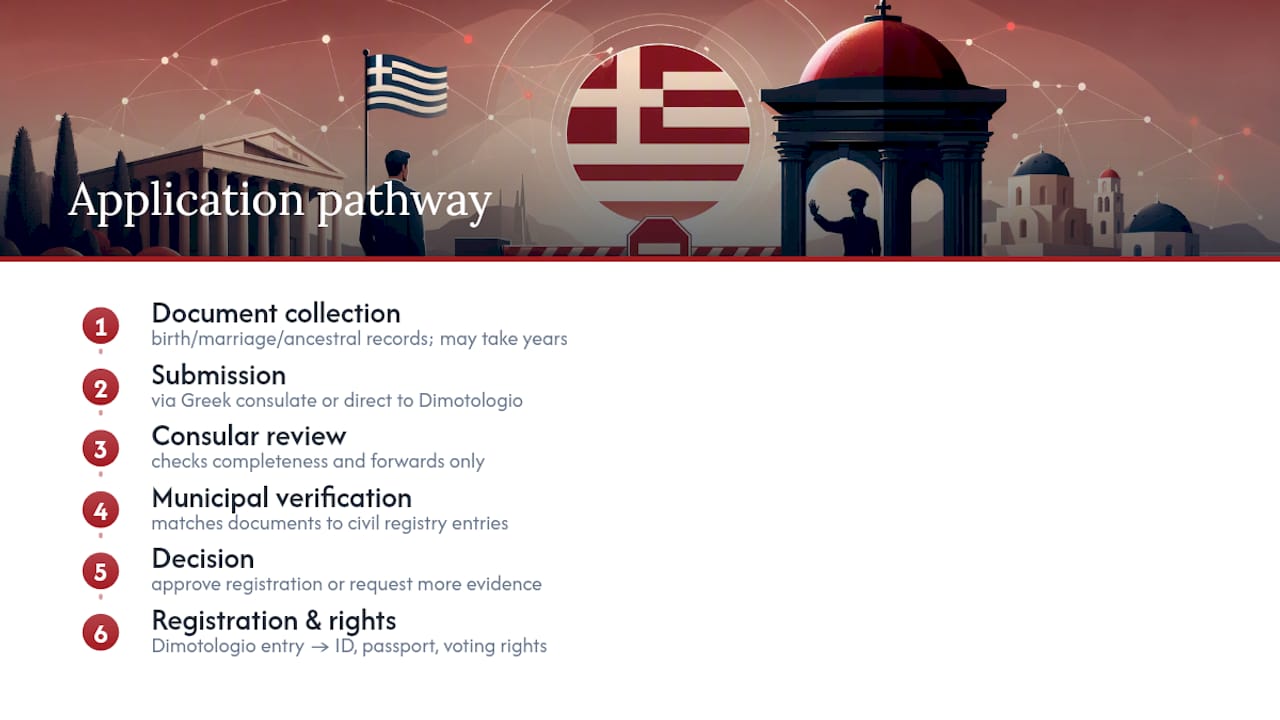
Approved applications result in entry into the Dimotologio, at which point the applicant can request a Greek birth certificate and identity documents. Only after this registration step can the applicant apply for a Greek passport, register to vote, or exercise other citizenship rights tied to state recognition rather than the underlying legal status.
Processing timelines vary enormously by municipality and by how complete the initial file is. A straightforward case with intact records can resolve in months; a case requiring judicial correction of a registry gap can take years. There’s no unified, published timeline the state guarantees, which is itself one of the more common diaspora complaints documented in recent reporting.
What Dual Nationals Can and Cannot Do Under Greek Law
Greece imposes no formal restriction on holding a second nationality alongside Greek citizenship, unlike some states that require renunciation. A dual citizen retains full Greek civil rights, including the right to vote in Greek elections, own property without the restrictions some non-EU nationals face, and access Greek public services on the same terms as any citizen residing there.
Male dual citizens historically faced potential military service obligations, though Greece has scaled back enforcement against diaspora citizens who never resided in the country, and exemptions or deferrals are available through consular application. This obligation applies regardless of whether the citizen ever exercises other rights tied to Greek nationality, which surprises some new registrants who assumed distance from Greece exempted them automatically.
Tax obligations attach only to Greek-source income or Greek tax residency, not to citizenship status alone. Holding a Greek passport does not by itself create a Greek tax filing requirement for someone who lives and earns entirely abroad.
Dual citizens also inherit the full set of civic obligations that come with Greek nationality, including eligibility for jury service in some administrative contexts and standing to bring certain civil actions unavailable to non-citizens. The rights are real and immediately usable once Dimotologio registration completes. The obligations are narrower than many applicants assume but not nonexistent.
Why EU Citizenship Is the Real Prize for Many Applicants
For many diaspora applicants, the practical motivation for pursuing Greek citizenship isn’t sentiment about ancestry. It’s the European Union passport that comes with it. Greek nationality automatically confers EU citizenship, which grants the right to live, work, and study in any of the EU’s member states without a visa, along with consular protection from any EU member state’s embassy when traveling outside the bloc.
That EU dimension changes the strategic calculus for applicants outside Europe, particularly those in North America and Australia weighing the multi-year registry process against the payoff. A single successful registration does not just restore a family’s Greek legal status. It opens labor mobility across roughly two dozen EU economies for the applicant and, in many cases, their direct descendants.
This is also where the Europeanization pressure on Greek nationality law becomes visible in practice. Reforms adopted partly to satisfy EU norms around non-discrimination and free movement mean that a diaspora applicant’s Greek citizenship carries weight far beyond Greece’s own borders. The state’s citizenship policy, in effect, functions as an access point to a much larger legal and economic space than Greek nationality alone would suggest.
Common Obstacles That Derail Otherwise Valid Claims
The most frequent pitfall isn’t ineligibility. It’s an incomplete documentary chain that a municipality won’t accept, and applicants often don’t discover the gap until they’re already deep into the process. A missing marriage transcription from three generations back can freeze an otherwise straightforward case indefinitely.
Language and translation errors compound this. Documents issued abroad require certified Greek translation, and inconsistent transliteration of names, a grandfather registered as “Yiannis” in one document and “John” in another, can trigger requests for additional proof of identity continuity that take months to resolve.
Applicants also underestimate variability between consulates and municipalities. Practice differs enough from one post to another that advice from a relative who registered successfully through one consulate may simply not apply to someone working through a different jurisdiction. This inconsistency isn’t officially documented anywhere, which means new applicants often learn it the hard way.
Cost is a quieter but real barrier. Archival research, certified translations, apostilles, and in some cases legal representation to petition for a judicial correction of a registry gap can run into thousands of dollars before an application is even complete. That cost burden falls disproportionately on applicants with the most fragmented ancestral records, typically those whose families emigrated earliest and before Greek civil registration was standardized.
Finally, some applicants discover male-registry obligations only after registration completes, when a military service notice arrives unexpectedly. Understanding that obligation before registering, rather than after, avoids an unpleasant surprise.
Diaspora Descent Claims Versus Naturalization for Non-Ethnic Applicants
Greek policy runs two entirely separate citizenship tracks, and conflating them is a common source of confusion in both public debate and casual reporting. Descent-based claims for diaspora Greeks rest on jus sanguinis and require no residence in Greece, no language test, and no integration examination, only a documented ancestral link and successful Dimotologio registration.
Naturalization for non-ethnic applicants, typically long-term migrants and their Greece-born children, follows the civic model debated in the scholarship on ethnic and civic tensions in Greek nationality. It demands years of legal residency, demonstrated Greek language ability, and passage of an integration test covering Greek history and civic institutions.
The administrative burden also differs in kind, not just degree. Diaspora applicants struggle with historical record continuity; naturalization applicants face a forward-looking bureaucratic test of integration that has nothing to do with archival research. Greece’s status as a frontier state within EU migration governance adds another layer here: naturalization policy for long-term migrants is shaped partly by border and asylum pressures that have nothing to do with diaspora descent claims at all.
The practical result is a citizenship system that looks unified on paper but operates as two distinct regimes with different evidentiary standards, different processing bodies in practice, and different political constituencies advocating for reform on each side.
Rethinking What Reconnection Actually Requires
Greek policy has spent three decades adjusting citizenship law to satisfy European norms without confronting the registry system underneath it. That’s the real finding here: statutory liberalization means little when a Dimotologio clerk in a small municipality is the actual gatekeeper. Fixing that requires less legislative drama and more investment in unglamorous administrative infrastructure. Scholars and diaspora researchers are welcome to help document that gap with evidence.
— Alexios
Access Hellenism Watch Research and Fellowship Opportunities
If this analysis raised more questions about your own family’s registration path or Greece’s broader diaspora strategy, This resource exists to document the systemic patterns behind registration processes, independent of ministry talking points and free of commercial incentive to oversimplify.

The Observatory publishes evidence-backed research on diaspora policy, institutional reform, and Hellenism across the Balkans and Eastern Mediterranean, all reviewed against primary sources rather than press releases. Academics, analysts, and diaspora members with firsthand registration experience are invited to contribute data through the Observatory’s open fellowship. Visit the Hellenism Watch homepage to read current publications, download research, or apply to join the scholarly network shaping this work.
Where This Research Comes From
-
Cambridge’s Nationalities Papers analyzes the ethnic and civic tension shaping Greek nationality law.
-
PhilPapers traces how property theory and conservatism shaped post 2015 reform reversals.
-
The Journal of Gender, Race, and Justice situates Greece within EU frontier migration governance.
-
GreekReporter documents diaspora registration barriers and official responses.
-
The Greek MFA provides the governing procedural guidance on descent and registration.
Sources
FAQ
Does Greece Require Renouncing Other Citizenships?
No. Greek law places no restriction on holding multiple nationalities alongside Greek citizenship.
Who Actually Decides a Greek Citizenship Claim?
The relevant municipal Dimotologio and the Ministry of Interior decide, not the consulate, which only verifies and forwards documents.
Why Do Diaspora Applications Take So Long?
Most delays trace to incomplete ancestral civil records, particularly missing marriage transcriptions or male-registry entries, rather than eligibility disputes.
Does Greek Citizenship Automatically Include EU Rights?
Yes. Greek nationality confers EU citizenship, including the right to live and work across EU member states without a visa.
How Can Researchers Contribute to This Kind of Analysis?
Academics and diaspora members can contribute data and analysis through the Hellenism Watch fellowship, which operates independently of government funding.