
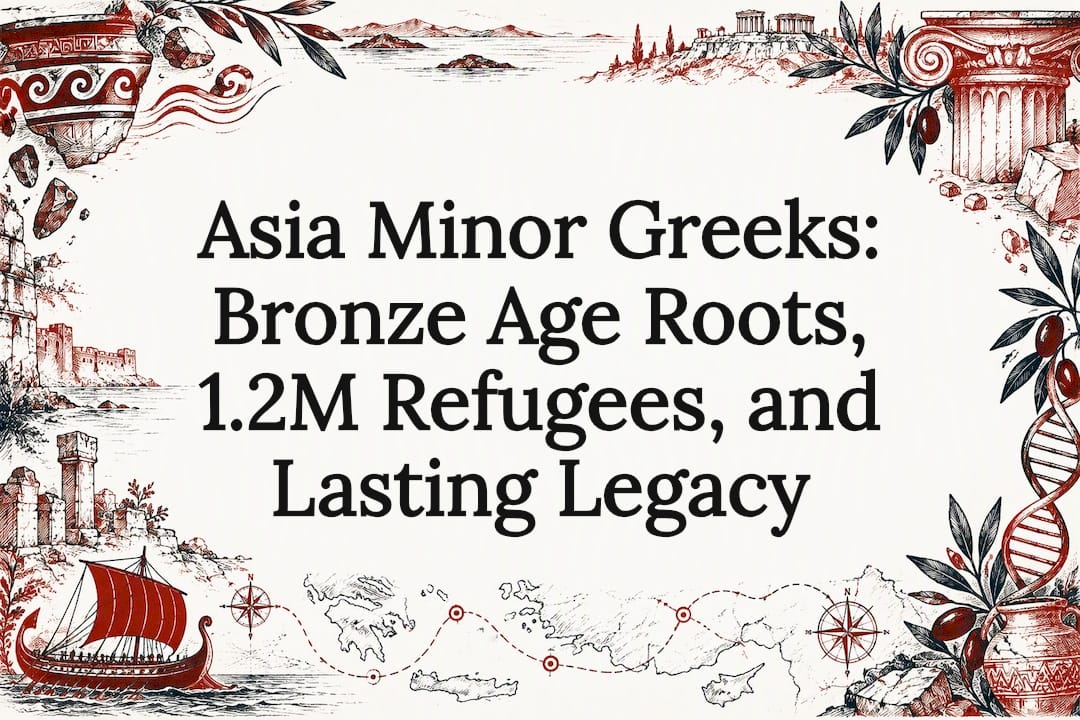
Asia Minor Greeks were Greek-speaking Orthodox Christian communities who lived across Anatolia for millennia, from the Aegean coast to the interior highlands of Cappadocia and the Black Sea region of Pontus. Their world collapsed during the Greco-Turkish War of 1919 to 1922 and the compulsory population exchange that followed, which uprooted a very large number of people. Their language, faith, and customs survive today in Greece and across the diaspora.
TL;DR:
- The population exchange was based on religion rather than language, forcing around 1.2 million Orthodox Christians to leave Anatolia for Greece in 1923.
- Greek communities in Anatolia included diverse groups like Pontic, Cappadocian, and Smyrniote Greeks, each with distinct dialects, customs, and regional identities.
- Genetic research shows modern Greeks have substantial continuity with Bronze Age Mycenaean and Minoan populations from western Anatolia and the Aegean.
- Smyrna’s destruction in 1922 and the subsequent refugee crisis marked the symbolic end of the once cosmopolitan port city and its Greek population.
- The memory of these events remains politically sensitive, with ongoing debates about classification, recognition, and the importance of preserving oral and archival histories.
Table of Contents
- From Bronze Age origins to the eve of catastrophe
- The Asia Minor Catastrophe of 1919 to 1922
- The 1923 Lausanne exchange and its aftermath
- Pontic, Cappadocian, and Smyrniote communities and their traditions
- Resettlement and integration in twentieth-century Greece
- Remembrance, recognition, and contested history
- What genetics tells us about ancient origins
- How the Hellenism Observatory supports this research
- Why preserving this memory still matters
- Hellenism Watch: free resources for researchers and descendants
- FAQ
- Sources
From Bronze Age origins to the eve of catastrophe
The Greek presence in Anatolia did not begin with the Ottomans or even the Byzantines. Genetic evidence shows that Bronze Age Minoan and Mycenaean populations drew most of their ancestry from Neolithic farmers of western Anatolia and the Aegean, and that modern Greeks show substantial continuity with those populations. Greek city-states, then Byzantine rule, kept a continuous Greek-speaking Christian presence across Anatolia for over two thousand years, through the Ottoman conquest and into the 19th century.
By the late 1800s, that long coexistence was fraying:
- Rising nationalism across the Balkans unsettled the multiethnic Ottoman order.
- The Balkan Wars of 1912 to 1913 hardened mistrust between Ottoman Muslims and Christian minorities.
- The Young Turk government’s wartime policies targeted Greek, Armenian, and Assyrian communities with deportations and forced labor, setting the stage for the crisis to come.
The Asia Minor Catastrophe of 1919 to 1922
Greek forces landed at Smyrna in May 1919 with Allied backing, opening a military campaign that pushed deep into Anatolia before collapsing under a Turkish nationalist counteroffensive. The sequence of events that followed defines what Greek historiography calls the Asia Minor Catastrophe:
- Greek troops advance from Smyrna toward Ankara through 1920 and 1921, reaching their furthest point near the Sakarya River.
- Turkish nationalist forces under Mustafa Kemal launch a decisive counteroffensive in August 1922, routing the Greek army.
- Smyrna falls in September 1922, followed by widespread fires that destroyed the city’s Greek and Armenian quarters and killed an unknown number of civilians.
- Hundreds of thousands flee to the waterfront, where foreign ships and relief workers, including the American Asa Jennings, help evacuate refugees from Smyrna in the following weeks.
- Survivors scatter toward Greek islands, Piraeus, and other mainland ports over the following months.
The destruction of Smyrna remains the single most defining image of the Catastrophe: a cosmopolitan port city reduced to ashes within days, its Greek population largely displaced almost overnight.
The 1923 Lausanne exchange and its aftermath
The Treaty of Lausanne formalized what the war had already begun. Negotiators built the exchange around religion rather than language or self-identification, meaning Orthodox Christians from Anatolia and Muslims from Greece were compelled to relocate regardless of whether they spoke Greek or Turkish at all.
- The exchange was compulsory, not voluntary, and applied retroactively to people already displaced by the war.
- Academic estimates place the refugee influx at around 1.2 million people arriving in Greece, a country of roughly five million at the time.
- Greece faced an immediate rehabilitation crisis: housing, land redistribution, and public health systems all strained under the sudden population surge.
- Scholars including Renée Hirschon frame Lausanne as a watershed that diplomats hailed as a peacemaking success even as it legalized mass displacement on an unprecedented scale.
Pontic, Cappadocian, and Smyrniote communities and their traditions
Asia Minor Greeks were never a single uniform group. Three broad communities shaped the collective identity now remembered under one name:
- Pontic Greeks lived along the Black Sea coast and inland highlands, preserving Pontic Greek, a distinct dialect that retained archaic features lost elsewhere.
- Cappadocian Greeks inhabited the volcanic interior of central Anatolia, where centuries of isolation produced Cappadocian Greek, heavily influenced by Turkish in vocabulary and syntax.
- Smyrniote Greeks formed the cosmopolitan merchant and professional class of Smyrna and the Aegean coast, closer in speech and outlook to mainland Greek culture.
The Orthodox Church anchored community life everywhere, running parish schools and maintaining Greek-language liturgy even where everyday speech had shifted toward local dialects. Music, embroidery, and regional cuisines from these communities still define entire neighborhoods and festivals in Greece today.
Resettlement and integration in twentieth-century Greece
Refugees arrived with almost nothing and settled wherever land and housing could be found. New neighborhoods sprang up in Piraeus, parts of Attica, and islands like Lesvos, often named after the lost Anatolian towns their residents had fled.
- Early settlement camps were overcrowded and under-resourced, and rehabilitation programs took years to provide permanent housing.
- Refugees brought trade skills, craftsmanship, and entrepreneurial networks that reshaped urban commerce and contributed to Greece’s textile, tobacco, and culinary industries.
- Over decades, refugee identity shifted: some descendants treated their heritage as a marker of distinct regional belonging, while others blended fully into mainstream Greek society.
Remembrance, recognition, and contested history
September 14 is observed in Greece as a day of remembrance for the Asia Minor genocide, marking the anniversary of Smyrna’s destruction. Commemorative events include memorial liturgies, museum exhibits, and public ceremonies organized by refugee-descendant associations.
- Several national parliaments and the Hellenic Ministry of Foreign Affairs document the deportations and killings and recognize them in formal resolutions.
- Historians continue to debate how the Catastrophe should be classified and taught, which keeps the memory politically active rather than purely historical.
What genetics tells us about ancient origins
Ancient DNA research addresses a question many descendants ask directly: were Greeks always native to this region, or did population movements erase earlier inhabitants? Genome-wide data from Bronze Age skeletons show that Minoans and Mycenaeans derived most of their ancestry from Neolithic farmers already settled in western Anatolia and the Aegean, with modern Greek populations showing meaningful genetic continuity with those ancient groups.
Continuity in population genetics does not mean an unbroken, unchanged lineage. It means successive populations in a region share substantial ancestry despite migrations, intermarriage, and political upheaval. Genetic data complements, rather than replaces, the documentary and archaeological record of Greek presence in Anatolia.
How the Hellenism Observatory supports this research
We are an independent, non-profit initiative that monitors the state of Greek diaspora communities across the Balkans and Eastern Mediterranean. We publish free research, monitoring reports, and invite scholars worldwide to contribute data and analysis to a growing record of Hellenism.
Why preserving this memory still matters
Family memory fades faster than archives. Recording an oral history, photographing a parish record, or donating a letter preserves what institutions alone cannot. We encourage scholars and descendants to collaborate carefully, since testimony about displacement and loss deserves sensitivity, not just documentation.
— Alexios
Hellenism Watch: free resources for researchers and descendants
Our platform is built around the principle that every claim published carries a source, and conclusions are not shaped by government or political parties. Visitors to Hellenism Watch find publications, monitoring reports, and open calls for scholarly contributions on Greek diaspora communities including Asia Minor Greeks.
If you hold family records, oral histories, or research relevant to Hellenism, we invite you to reach out through our landing page and join our network of contributing scholars.
FAQ
Are Greeks native to Asia Minor?
Greek-speaking communities lived continuously across Anatolia from antiquity through the early 20th century, and genetic evidence shows that Bronze Age Aegean populations share substantial ancestry with modern Greeks. The region was home to Greek city-states and Byzantine communities long before Ottoman rule, making the Greek presence there one of deep historical duration rather than recent settlement.
Who are Greeks most genetically related to?
Ancient DNA studies show that Minoans and Mycenaeans drew most of their ancestry from Neolithic farmers of western Anatolia and the Aegean, and modern Greek populations show meaningful genetic continuity with these Bronze Age groups. This continuity reflects shared regional ancestry over millennia rather than an unchanged, isolated lineage.
What happened to the Greeks in Asia Minor?
Following the Greco-Turkish War and the destruction of Smyrna in 1922, the 1923 Treaty of Lausanne enforced a compulsory population exchange based on religion, sending roughly 1.2 million Orthodox Christian refugees from Anatolia to Greece. The Hellenic Ministry of Foreign Affairs documents the deportations and killings that preceded this exodus, which several parliaments have formally recognized.
How dark skinned were the ancient Greeks?
Historical and genetic sources describing Bronze Age Aegean populations focus on ancestry and population movement rather than skin pigmentation, and no reliable study in the available record quantifies this trait. Depictions in ancient art varied by region, period, and convention, so any firm claim about skin tone goes beyond what the genetic and archaeological evidence actually establishes.