

7 Steps to an Evidence Grade Diaspora Incident Log for Hellenism
Diaspora incident documentation means creating verifiable, evidence-backed records of events affecting Hellenism, from physical threats to administrative exclusion, built to survive academic, policy, or legal scrutiny. Done right, it produces a usable incident record: dated, sourced, corroborated against public institutional data, and ready to hand to a researcher or a reporting body. What follows is the workflow, the template, and the reporting map that make that record defensible rather than anecdotal.
TL;DR:
- Most documented incidents involve physical attacks, property seizures, administrative exclusion, disinformation campaigns, or civic discrimination affecting Greek communities.
- Evidence must be primary, including official documents, media with metadata, witness statements, and social media with provenance, all verified through triangulation and file integrity checks.
- An incident log requires standardized fields like date, location, incident type, evidence links, witnesses, verification status, and recommended follow-up actions to maintain consistency.
- Different incident types should be routed to appropriate bodies, such as OSCE for hate crimes, EEAS for disinformation, and the European Court of Human Rights for property disputes.
- Cross-border evidence sharing is hampered by inconsistent standards, language barriers, and jurisdictional confusion, but adopting a uniform log schema from the outset can mitigate these issues.
Table of Contents
- What Counts as a Diaspora Incident Worth Documenting?
- What Evidence Should You Collect and How Do You Verify It?
- How Do You Build a Working Incident Log?
- Where Should You Report a Documented Incident?
- Why Does Cross-Border Evidence Sharing Break Down, and What Fixes It?
- What the Hellenism Observatory Brings to This Work
- Submit Documentation or Explore Hellenism Watch’s Published Research
- Primary Sources Worth Bookmarking
- Sources
- FAQ
What Counts as a Diaspora Incident Worth Documenting?
Not every grievance belongs in a formal record, and treating every complaint as equally weighty dilutes the ones that matter. Diaspora incident documentation, in the sense used across this guide, covers events affecting Hellenism in the Balkans and Eastern Mediterranean that carry evidentiary weight: something happened, at a specific place and time, to specific people or institutions connected to Greek identity.
Five categories cover most of what analysts and community documenters encounter:
- Physical attacks or intimidation against individuals identified as Greek, including vandalism of churches, monuments, or cultural centers.
- Property seizures or blocked restitution affecting Greek families, associations, or the Church, particularly in occupied or post-conflict territories.
- Administrative or legal exclusion, such as boundary redrawing or registration barriers that reduce the visibility of Greek communities in official data.
- Foreign information manipulation and interference (FIMI), meaning coordinated disinformation targeting diaspora identity or political standing.
- Discrimination in civic processes, from school curricula to municipal services, that disadvantages Greek-speaking residents.
A synthetic example for the third category: a municipality merges with three neighboring towns, and the new census tract reports a Greek-speaking population at a fraction of the prior count, not because people left, but because the boundary changed. That is a documentable incident even though nobody was harmed physically. One caution: this guide has nothing to do with technical documentation for diaspora software products. If a search led you here expecting an API reference, this is the wrong page.
What Evidence Should You Collect and How Do You Verify It?
Strong incident documentation rests on primary evidence, not summary or hearsay. Collect, in order of durability: official documents (court filings, gazette notices, land registry extracts), photos and videos with intact metadata, written witness statements, media clippings, and social media posts captured with full provenance.
For every item, record five things at minimum: who provided it, what it shows, when the underlying event occurred, where, and the exact source URL or physical location of the original. Digital files need a file hash and, where available, device metadata, since a hash lets a later reviewer confirm the file has not been altered after collection.
Verification separates a documented incident from a reported rumor. Three techniques do most of the work:
- Triangulate against public institutional data. If you are logging a hate incident, check whether it appears in OSCE ODIHR’s hate crime reporting for Greece, which recorded 87 incidents in 2024 and openly notes that Greece still lacks comprehensive national hate-crime data, a gap that makes independent documentation more valuable, not less.
- Check timestamps and file integrity. A photo dated after the claimed event, or a video with a hash that doesn’t match the original upload, needs a second look before it goes in the record.
- Corroborate witness accounts independently. Two witnesses who haven’t spoken to each other and describe the same sequence of events strengthen a record far more than one detailed statement.
Preservation is not optional. Keep original files untouched in a separate archive folder, export social media pages as timestamped HTML or PDF snapshots rather than screenshots alone, and note the capture date on every export.
Pro Tip: When archiving a social media post tied to a disinformation incident, capture the surrounding conversation and the poster’s account history, not just the post itself. Amplification patterns often matter more to researchers than the original post’s content.
The OSCE ODIHR gap on Greek national data is a useful reminder: international bodies rely heavily on documentation submitted by exactly the kind of careful, independent record this guide describes.
How Do You Build a Working Incident Log?
A documentation effort without a consistent record format collapses under its own weight within a few months. The workflow that holds up across academic, policy, and community use runs in seven steps.
- Intake. Log the initial report the moment it arrives, even in raw form.
- Triage. Assign a severity level and flag anything involving physical safety for immediate handling.
- Evidence capture. Gather documents, media, and statements using the checklist above.
- Verification. Apply the triangulation and integrity checks described in the previous section.
- Record creation. Convert verified material into the standard log format.
- Reporting. Route the record to the appropriate body (covered in the next section).
- Archive. Store the finalized record with all linked evidence in a searchable, backed-up location.
The incident log itself needs a fixed set of fields so records stay comparable across time and across contributors:
- Unique incident ID
- Date and time of the event (not the reporting date)
- Geographic location, ideally with coordinates
- Incident type (matching one of the categories above)
- One-paragraph summary
- Evidence list, with links or file hashes for each item
- Witness names or anonymized identifiers, with contact consent noted
- Verification status (unverified, partially corroborated, fully corroborated)
- Recommended next step (archive only, refer to legal counsel, escalate to an international body)
| Log Field | What It Captures | Why It Matters |
|---|---|---|
| Verification status | Corroboration level reached | Tells reviewers how much weight the record can bear |
| Evidence list | Links, hashes, file locations | Makes the record auditable, not just descriptive |
| Recommended next step | Archive, legal referral, escalation | Prevents severe cases from sitting untriaged |
Community groups without dedicated staff can run this workflow with a shared spreadsheet and a simple online form. For preserving WhatsApp evidence, export the chat with media before a phone changes hands or an app updates, since exports lose embedded metadata over time and forwarded messages often strip the original sender’s information entirely.
Where Should You Report a Documented Incident?
Different incident types route to different bodies, and sending a property dispute to a hate-crime desk (or vice versa) wastes time both institutions could spend on the right cases. The mapping below reflects how these bodies actually process submissions.
- Hate incidents and bias-motivated attacks go to OSCE’s ODIHR, which aggregates national reporting and, as its 2024 Greece data shows, often has more complete figures than state agencies.
- Disinformation and FIMI incidents belong with the EEAS’s stratcom and FIMI reporting channels, which track how foreign narratives get picked up and amplified by domestic actors, and with EUvsDisinfo for public debunking and archiving.
- Minority rights and administrative exclusion cases, including boundary or registration issues, fit the Council of Europe’s Parliamentary Assembly and advisory monitoring processes.
- Property and association claims, particularly those tied to occupation-era disputes, ultimately involve the European Court of Human Rights, often after the Immovable Property Commission process in Northern Cyprus, since domestic and specialized remedies generally have to be exhausted first.
Each report should include the incident log export, primary documents, witness statements, and a plain summary of verification steps taken, since institutions triage faster when the corroboration work is already visible. Expect delays measured in months, not weeks. ECHR property cases in particular can stretch for years once domestic and IPC channels are exhausted, and the Court has directly noted that Türkiye should expedite property proceedings brought by Greek Cypriots, an acknowledgment that the current pace is itself a documented problem. Before filing anything, confirm witness consent and consider anonymizing identifying details when personal safety is a concern.
Why Does Cross-Border Evidence Sharing Break Down, and What Fixes It?
Documentation efforts that span the Balkans, Cyprus, and the wider diaspora hit a structural problem fast: evidence collected in one jurisdiction rarely transfers cleanly to another. National data-protection regimes differ, institutional reporting formats don’t match, and a record built for a local community group often lacks the metadata a European body needs to act on it.
Three friction points recur most often. First, inconsistent evidence standards mean a witness statement acceptable to a local association may not meet the corroboration bar an international body expects. Second, language and translation gaps introduce errors exactly at the point where precision matters most, in dates, names, and legal terminology. Third, jurisdictional uncertainty over which body has authority (a national ombudsman, the Council of Europe, or the ECHR) leads to records sitting unrouted for months.
The EEAS’s own FIMI reporting infrastructure points toward a workable answer: structured information-sharing platforms, such as the mechanisms behind its 2024 activities report on countering FIMI, work because they standardize the intake format before evidence crosses borders. Applying that same logic to diaspora incident documentation means using a consistent log schema (the fields outlined earlier) from the moment of intake, regardless of where the incident occurred, so a record from a village association in Albania and one from a Cypriot property claim can sit side by side in the same dataset without a translation team reconstructing them first.
What the Hellenism Observatory Brings to This Work
An independent observatory exists to provide a documentation mechanism free of government or party control. Every claim published through such observatories ideally traces back to credible sources, such as international data, reporting, or jurisprudence, rather than assertion alone.
That sourcing discipline is what turns a collection of incident reports into something academics and policymakers can cite with confidence. The Observatory runs on contributions from a global network of scholars, and it welcomes data submissions and fellowship applications from researchers with regional expertise. Confidentiality for sensitive submissions is respected, and contributed material is expected to meet the same citation standards the Observatory applies to its own published work.
— Alexios
Submit Documentation or Explore Hellenism Watch’s Published Research
If you’ve built an incident record using the workflow above, Hellenism Watch is where that documentation can do the most good. The Observatory is the alternative to scattered, one-off community reports. It is a single, independent repository that turns individual incident logs into research, policy briefs, and advocacy material, without any government or party filter shaping what gets published.
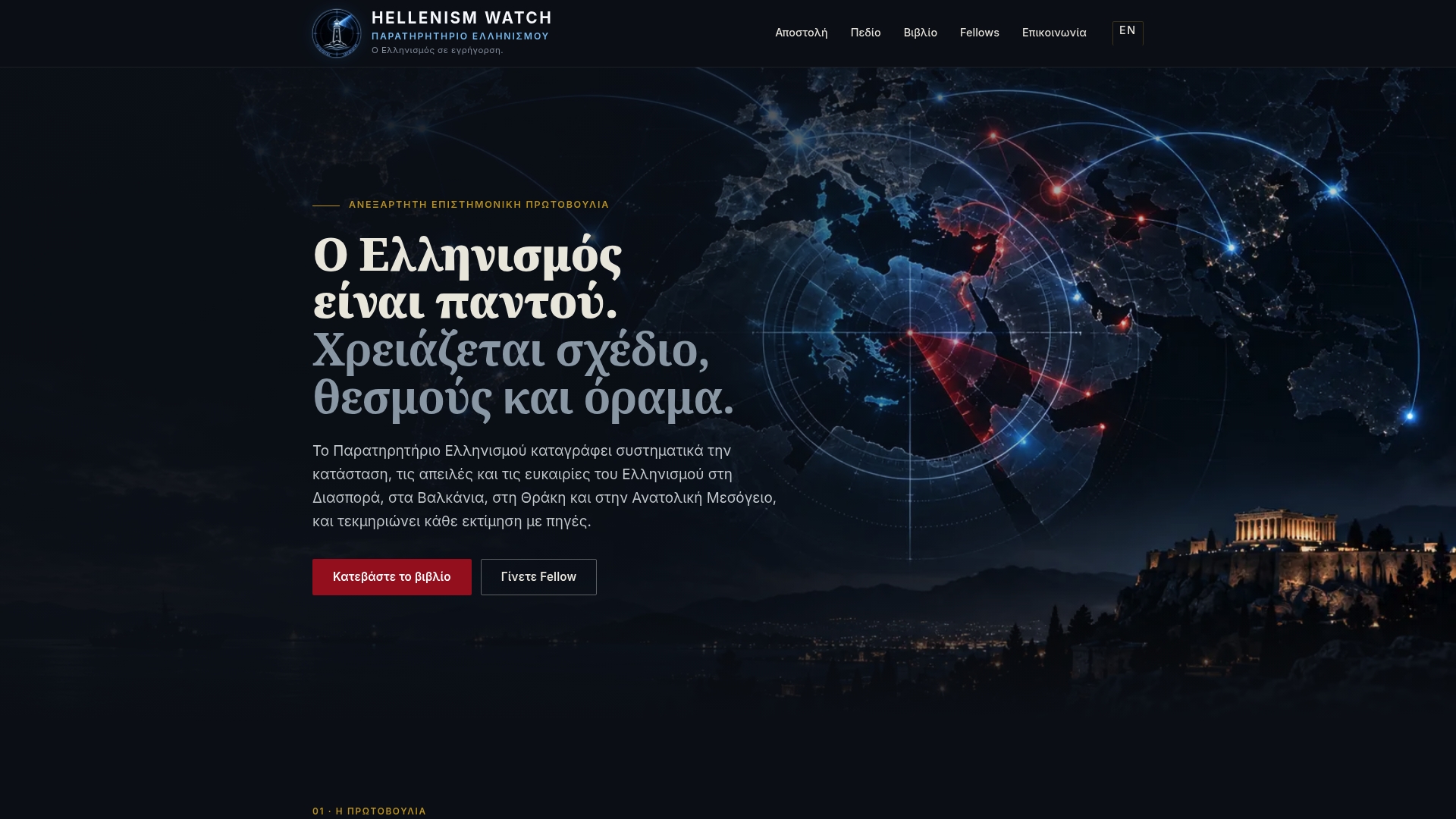
Submitted documentation feeds directly into the Observatory’s evidence-backed assessments and its broader analysis of Hellenism in the Balkans and Eastern Mediterranean. Every submission is expected to meet the same sourcing bar the Observatory holds itself to, so use the incident-log fields covered earlier as your starting format. Visit Hellenism Watch’s publications page to review current research, find submission guidance, and see how to apply for the Observatory’s open scholar fellowship.
Primary Sources Worth Bookmarking
Five institutional sources cover most verification and reporting needs described in this guide:
- OSCE ODIHR’s hate crime reporting tracks bias-motivated incidents by country, including Greece.
- EEAS stratcom and FIMI reports document disinformation patterns across the Western Balkans.
- Council of Europe Parliamentary Assembly reports cover minority rights and administrative disputes.
- EUvsDisinfo offers public debunking and an archive for disinformation cases.
- The ECHR database holds jurisprudence relevant to property and association claims.
Match the source to the incident type: hate incidents to ODIHR, disinformation to EEAS/EUvsDisinfo, and property or minority-rights disputes to the Council of Europe or ECHR.
Sources
- OSCE ODIHR — Hate Crime reporting: Greece 2024
- EEAS — Report on Stratcom activities and FIMI (2021)
- EEAS — Tackling disinformation and FIMI (EUvsDisinfo)
- European Court of Human Rights — Judgment and commentary on property proceedings
FAQ
What Makes an Incident Record “Verified” Rather Than Just Reported?
Verification means the record has been triangulated against at least one independent source, such as OSCE ODIHR data or a corroborating witness account, and the evidence files carry intact metadata and hashes. A reported incident with no corroboration should stay marked “unverified” in the log until that work is done.
How Long Does It Take for an International Body to Act on a Documented Incident?
Timelines vary widely by body and incident type, but property and association claims routed through the ECHR after domestic remedies typically take years, not months, partly because the Court itself has flagged that Türkiye should expedite Greek Cypriot property proceedings as an ongoing problem. FIMI reports to the EEAS tend to move faster since they feed existing monitoring pipelines.
Can Community Groups With No Legal Background Use This Documentation Process?
Yes. The workflow and log template are built for non-specialists: a shared spreadsheet, a simple intake form, and consistent metadata capture cover most of the work, with legal or policy referral reserved for cases that clear the triage threshold.
Where Can I Submit a Documented Incident for Research or Policy Use?
Hellenism Watch accepts documentation submissions from scholars and community members that meet its sourcing standards, feeding into its published research and policy analysis. Submissions should follow the incident-log format outlined in this guide, with verification status and evidence links included.
Why Does Greece’s Official Hate-Crime Data Look Incomplete Compared to Independent Reports?
Greece does not yet publish comprehensive national hate-crime statistics, which is why OSCE ODIHR’s 2024 figure of 87 reported incidents relies heavily on independent and civil-society documentation rather than state systems alone.