
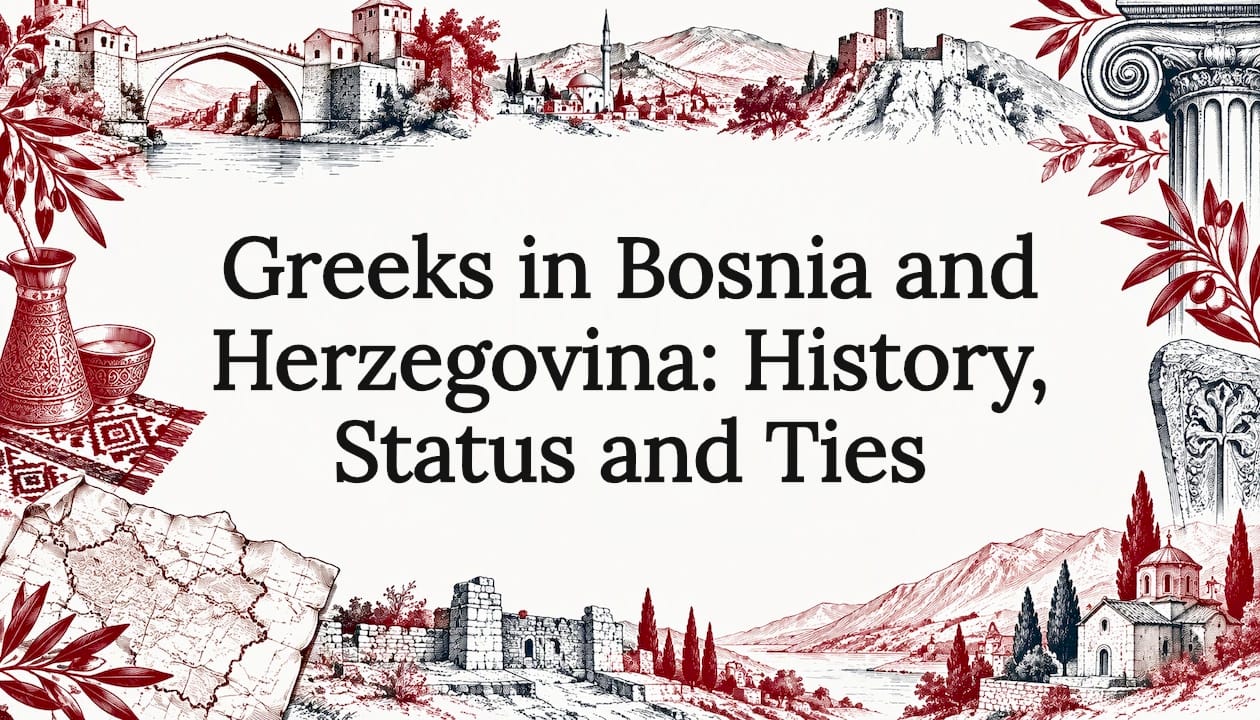
Greeks in Bosnia and Herzegovina: History, Status and Ties
There is no large, organized Greek community in Bosnia and Herzegovina. The Greek story there is made of three separate threads: ancient Hellenistic settlement, small Greek groups that arrived under Ottoman and Austro-Hungarian rule, and a modern relationship shaped by diplomacy, thin trade and one painful episode from the 1990s war. This article sets out what is documented about each, and says plainly where the evidence stops.
TL;DR
- Greek presence in the territory is old: the Hellenistic town of Daorson, near Stolac, is cited as a settlement founded and inhabited by Greek communities between 300 and 50 BC.
- Greeks are not among the 17 officially recognized national minorities of Bosnia and Herzegovina, and Greek is not listed under the European Charter for Regional or Minority Languages for the country.
- Today’s ties run mainly through diplomacy and EU integration support. Greek trade and investment are small: total Greek FDI from 1995 to 2020 was only €2.2 million.
- Up to about 100 Greek volunteers fought with Bosnian Serb forces in the 1990s. Their role around Srebrenica is documented in a Dutch state report, academic work and investigative journalism.
Table of Contents
- Who are the Greeks in Bosnia and Herzegovina?
- A long history: from Daorson to the Habsburg era
- Legal status and representation today
- Greece and Bosnia and Herzegovina: the modern relationship
- The Greek volunteers of the 1990s war
- Perspective
- Research gaps worth filling
- Contribute to the research
- FAQ
- Sources
Who are the Greeks in Bosnia and Herzegovina?
The honest answer starts with a limit. Nothing in the evidence we reviewed gives a reliable count of people of Greek descent living in the country. The 2013 census, run by the Agency for Statistics of Bosnia and Herzegovina, covered all 142 municipalities and 24,319 census units and recorded the population by ethnic affiliation. It is the reference point for any serious estimate. Any figure for Greeks that does not trace back to it, or to another official count, should be treated with caution.
What can be said is that Greek communities here have never resembled those in Albania, North Macedonia or the Black Sea region. A research paper on Greeks in the Balkans from the LSE Hellenic Observatory notes that there are thousands of Greeks across the region today, but it gives no specific figure for Bosnia.
The word Omogenia (Ομογένεια) is the Greek term for communities of Greeks living outside Greece and Cyprus. In Bosnia and Herzegovina it describes a scattered presence, not a settled, institution-rich diaspora.
A long history: from Daorson to the Habsburg era
Hellenistic roots
The oldest Greek thread is archaeological. In 2014 the Greek ambassador to Sarajevo pointed to Daorson, near Stolac in Herzegovina, as a Hellenistic town founded and inhabited by Greek communities between 300 and 50 BC. He presented it as an example of long contact between the two peoples. It is a statement by a diplomat, so read it as the Greek official view of a heritage site, not as a demographic claim about modern Greeks.
Migration under Ottoman and Habsburg rule
The second thread is migration. According to the Institute for Mediterranean Studies, Greeks moved into former Yugoslav lands from the 17th century, above all in the 18th. The first privilege to Orthodox Balkan migrants, mainly Serbs but also Greeks and Vlachs, was conferred by Leopold I on 26 April 1690. Those were mostly merchants and craftsmen moving along trade routes in the wider Habsburg and Ottoman space.
The Austro-Hungarian period, which began with the 1878 occupation, left a smaller local trace. A publication on the national minorities of Tuzla records that Greeks settled in Tuzla during that era, coming from areas outside Austro-Hungarian administration. It is a modest detail, but it shows that small Greek groups lived in Bosnian towns long before the 20th century.
A note on “Greek Catholic”
Search results for this topic can mislead because of one word. “Greek Catholic” refers to Eastern Catholic churches that follow the Byzantine rite and accept papal authority. It does not mean ethnic Greeks. Academic work on the Greek Catholic population in Bosnia records more than 8,000 Ukrainian Greek Catholics from Galicia who settled mainly around Prnjavor, Bosanska Gradiška, Laktaši, Čelinac, Derventa, Prijedor and Banja Luka before World War I. The Catholic Near East Welfare Association describes the church’s Bosnian faithful as part of the Eparchy of Křižević, which counts about 18,260 people across Croatia, Slovenia and Bosnia and Herzegovina. These are Ukrainian, Rusyn and other communities, not Hellenic ones. Keep that distinction in mind when reading statistics.
Legal status and representation today
Bosnia and Herzegovina’s constitutional order was built at Dayton around three constituent peoples: Bosniaks, Croats and Serbs. In the 2013 census, Bosniaks were recorded at 50.11%, Serbs at 30.77% and Croats at 15.42%, according to the official census publication.
Everyone else falls into a second category. Minority Rights Group lists 17 officially recognized national minorities: Albanians, Czechs, Germans, Hungarians, Italians, Jews, Macedonians, Montenegrins, Poles, Roma, Romanians, Russians, Ruthenians, Slovaks, Slovenes, Turks and Ukrainians. Greeks are not on the list. The same source notes that the label “Others”, which covers all non-constituent groups, is problematic because it implies exclusion.
Language protection tells the same story. The Council of Europe’s table of languages covered by the European Charter does not list Greek for Bosnia and Herzegovina, while it does list it for Armenia, Hungary, Romania and Ukraine.
The practical meaning is simple. People of Greek origin in the country have no formal minority status of their own, and no dedicated representation under the minority framework. For a diaspora that depends on schools, churches and cultural centers, that is a structural gap. It is also an open research question: who identifies as Greek, where, and through which associations. We are not aware of an authoritative public register that answers it.
Greece and Bosnia and Herzegovina: the modern relationship
Diplomacy
The relationship today is mostly official. According to the Hellenic Ministry of Foreign Affairs, Greece recognized Bosnia and Herzegovina in April 1992, together with the other EU members. The Greek Embassy in Sarajevo was established in 1996 and includes a Consular Office, an Economic and Commercial Affairs Office and a Defence Attaché’s Office. The Bosnian embassy in Athens has operated since 1998.
The same page says Greece supports the country’s European and Euro-Atlantic course. The two states cooperate in regional formats such as the SEECP and the RCC, and signed a 2013 Memorandum of Cooperation under which Greece provides expertise to speed Bosnia and Herzegovina’s EU integration. In 2014 the embassy described its work as assisting reconstruction, promoting bilateral relations and backing the European perspective.
Trade and investment
The economic footprint is small. The LSE Hellenic Observatory’s GreeSE Paper 169 says Greek trade with Bosnia and Herzegovina was negligible from 1995 to 2008, because of the weakened post-war economy and minimal cultural, historical and commercial ties. According to the country’s Foreign Investment Promotion Agency, total Greek FDI between 1995 and 2020 was €2.2 million. The paper counts roughly 15 Greek companies active in the country, the most important being Coca-Cola Hellenic Beverages Bosnia and Herzegovina in Sarajevo and Alumil.
What this means for soft power
Put together, the evidence points to a clear pattern. Greek influence in Bosnia and Herzegovina works through embassies, EU accession diplomacy and regional forums. It does not work through a large diaspora or a dense business presence. For analysts studying Greek soft power in the Balkans, that makes Bosnia a case of low-density influence, quite unlike the Greek communities of Albania or North Macedonia.
The Greek volunteers of the 1990s war
This is the part of the topic that dominates search results, and it deserves careful treatment: what is documented, by whom, and what remains contested.
What the sources document
According to a research note by Hikmet Karagözlü, the first Greek volunteers arrived in Bosnia in 1993. In March 1995, at the request of General Ratko Mladić, the Greek Volunteer Guard (GVG) was formed, based in Vlasenica and fully integrated into the Drina Corps of the Bosnian Serb army. The note links the unit to Greek intelligence agencies and says the Greek embassy in Belgrade monitored its activities.
The Guardian, reporting on a 7,000-page Dutch state report on Srebrenica, wrote that Greece sent light arms and ammunition to the Bosnian Serb army between 1994 and 1995. It put the unit at around 100 men, led by Serb officers, with its own insignia, and said at least four members received the White Eagle medal of honor from Radovan Karadžić.
The flag episode is described in the same academic note: after Srebrenica fell, Serb and Greek soldiers raised four flags on the town’s Orthodox church, the Serbian, the Greek, the Byzantine and the Vergina flag. Karagözlü adds that Greek television station MEGA interviewed a volunteer the same day.
What remains disputed
Numbers and legal responsibility are the unsettled points. Balkan Insight reported in July 2023 that ten Greek nationalist fighters are believed to have been with Bosnian Serb forces when they seized Srebrenica, and that up to 100 fought in the war overall, mostly in the GVG. Greek prosecutors investigated, but the case was closed, which has fed continuing suspicion of a cover-up.
Two cautions matter for anyone citing this material. First, the fact that Greek volunteers were present in a unit that took Srebrenica is not the same as a court finding about individual conduct, and the sources above are careful on that point. Second, Karagözlü’s note argues that the volunteers reflected a wider current of opinion in Greece at the time, while also noting that many belonged to an extremist organization. Both observations are part of the record, and neither should be flattened into a single slogan.
For a Greek research initiative, this episode is not a footnote to avoid. It is part of how Greece is perceived in Bosnia and Herzegovina, and it shapes the very question forum posts ask, whether Greek visitors will be welcome in Sarajevo or Srebrenica. A documented, calm account serves Greece’s own interests better than silence.
Perspective
We built Hellenism Watch because the Greek presence in the Balkans is usually discussed through slogans, either inflated pride or avoidance. Bosnia and Herzegovina shows why that fails. There is no large community here to romanticize, and there is a chapter of recent history that cannot be wished away.
What the country needs from those of us who study Hellenism is method: count what can be counted, cite what can be cited, and say plainly where no evidence exists. A Greek presence that is small, scattered and without formal minority status is still a legitimate subject, and so is the damage done to Greece’s reputation by a few hundred volunteers at most.
We are independent of any government or party, and every claim we publish is tied to a source. That is the only footing from which a national perspective on Greek identity and strategy can be credible, in Sarajevo as much as in Athens. It is also why we invite scholars from every region to add their data and their corrections.
Alexios
Research gaps worth filling
Bosnia and Herzegovina is under-studied from a Greek perspective, and several questions are open:
- Population: how many residents identify as Greek or hold Greek citizenship, and where they live, drawn from the 2013 census microdata and later official counts.
- Institutions: whether any Greek cultural associations, church parishes or language classes operate, and under what legal form, given that Greeks sit outside the recognized minority list.
- Historical communities: the Greek merchants and craftsmen of Tuzla and other towns in the Habsburg period, for which only brief references appear in the sources.
- War-era accountability: the closed Greek investigation, the Dutch report’s findings and the ongoing debate about official acknowledgment.
Each of these is a task that a local scholar with archive access can do far better than a remote analyst.
Contribute to the research
Hellenism Watch is a non-profit, independent initiative that publishes free, source-backed research on Hellenism and the Greek diaspora across the Balkans and the Eastern Mediterranean. If you work on Bosnia and Herzegovina, whether in archives, field research, census data or diplomatic history, our open fellowship is built for you. You can see who already contributes on the fellows page, or browse our publications on the Hellenism Watch homepage.
Everything we publish is free to read, and every assessment links back to its evidence.
FAQ
Are Greeks an officially recognized minority in Bosnia and Herzegovina?
No. Minority Rights Group lists 17 recognized national minorities, and Greeks are not among them. Greek is also not listed for Bosnia and Herzegovina under the Council of Europe’s regional or minority languages charter.
Is there an old Greek history in the territory?
Yes. The Hellenistic town of Daorson near Stolac is cited as a settlement founded and inhabited by Greek communities between 300 and 50 BC. Later, small groups of Greek migrants moved through Habsburg and Ottoman lands, and Greeks are recorded in Tuzla in the Austro-Hungarian period.
What was the Greek Volunteer Guard?
It was a unit of about 100 Greek volunteers formed in March 1995 at Ratko Mladić’s request and integrated into the Bosnian Serb army’s Drina Corps. A Dutch state report, academic research and press investigations document its role around Srebrenica. Greek prosecutors investigated, but the case was closed.
How close are Greece and Bosnia and Herzegovina today?
Officially, relations are cordial. Greece recognized the country in April 1992, opened an embassy in Sarajevo in 1996 and supports its EU path, including through a 2013 cooperation memorandum. Economic ties remain small, with total Greek FDI of €2.2 million between 1995 and 2020.
Sources
- Bosnia and Herzegovina census 2013, final results (Agency for Statistics of BiH)
- Greece – traditional friend of Bosnia and Herzegovina (The Srpska Times)
- Greek Migration to Europe, 15th to 19th c.: Yugoslavia (Institute for Mediterranean Studies)
- Tuzla national minorities (UGIP Tuzla)
- Greek Catholic population in Bosnia and Herzegovina (Hrčak)
- The Greek Catholic Churches of the former Yugoslavia (CNEWA)
- Bosnia and Herzegovina (Minority Rights Group)
- Languages covered by the European Charter (Council of Europe)
- Bosnia and Herzegovina bilateral relations (Hellenic Ministry of Foreign Affairs)
- GreeSE Paper 169 (LSE Hellenic Observatory)
- A Capitalist Diaspora: The Greeks in the Balkans (LSE Hellenic Observatory)
- Fear Not, For You Have Brothers in Greece: a research note (USF Digital Commons)
- Greece faces shame of role in Serb massacre (The Guardian)
- Enjoying Impunity, Greek Pro-Serb Fighters Still Brag about Srebrenica (Balkan Insight)