
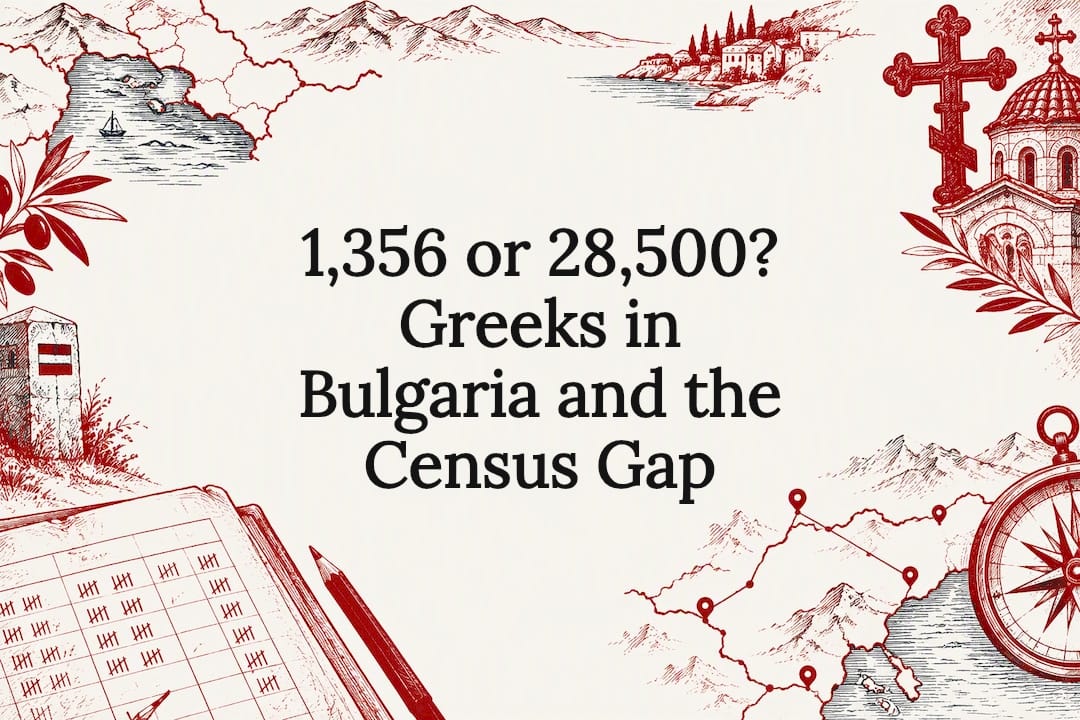
Bulgaria’s 2021 census counted just 1,356 people who identified as ethnically Greek, while Greek government and diplomatic estimates put the real figure between roughly 15,000 and 28,500. The gap reflects who gets counted: long-settled families, Karakachani pastoral groups, and thousands of transient students and professionals who never register as an ethnic minority. Most live in Sofia, Plovdiv, and a scatter of coastal towns.
TL;DR:
- The official Bulgarian census counts only 1,356 ethnic Greeks, but estimates from Greece and community sources range between 15,000 and 28,500, due to underreporting and unregistered residents.
- Greek communities in Bulgaria are mainly sustained through religious parishes, language classes, and cultural festivals centered in Sofia, Plovdiv, and along the Black Sea coast.
- The Greek minority includes distinct groups like Karakachani and Sarakatsani with pastoral roots, as well as refugee descendants and transient students, making population figures highly variable.
- Historical state agreements and border shifts, such as the 1919 emigration convention and post-World War refugee movements, significantly shaped the demographic composition of Greeks in Bulgaria.
- Contemporary Greek presence is largely driven by student populations, with approximately 4,000 Greek students enrolled in Bulgarian universities, mostly studying medicine and veterinary sciences.
Table of Contents
- A history that stretches from ancient colonies to Cold War refugee flows
- What the census numbers show and why they diverge
- How Greek culture stays visible in Bulgarian cities
- Karakachani, Sarakatsani, and other strands within the community
- Diplomatic agreements and border shifts that shaped migration
- Where the Greek community stands today
- How the Hellenism Observatory documents this community
- Notable figures with Greek roots in Bulgarian public life
- Identity, representation, and the pressures facing a small minority
- How Greeks fit alongside Bulgaria’s other minority communities
- Why Orthodox parishes anchor community life
- Why the numbers gap still matters for research
- Where to track ongoing reporting on Greek communities abroad
- Sources
- FAQ
A history that stretches from ancient colonies to Cold War refugee flows
Greek presence in the lands that became Bulgaria did not start with a modern border. Ancient Greek colonies dotted the Black Sea coast, and medieval trade and church networks kept Greek-speaking communities embedded in the region for centuries afterward. Under Ottoman rule, religious jurisdiction did much of the work that ethnicity does today: falling under the Greek Patriarchate or the Bulgarian Exarchate shaped how families identified, sometimes more than language or ancestry did.
The 19th and early 20th centuries turned that flexible identity into a political liability. As Balkan nationalism hardened and the Balkan Wars redrew borders, Greeks and Bulgarians alike faced pressure to pick a side. Scholarly work on this period, including Theodora Dragostinova’s study of nationality and emigration among Bulgaria’s Greeks, documents how people shifted national loyalties depending on which allegiance offered safety or opportunity, particularly between 1900 and 1949.
That fluidity collided with formal state policy after World War I, when a bilateral emigration convention and a Mixed Commission tried to sort populations by nationality. The postwar decades brought a second wave of displacement, this time driven by the Greek Civil War and the aftermath of World War II, which pushed refugees across the border in both directions.
Key phases that shaped today’s community:
- Ancient and medieval settlement along the Black Sea coast and inland trade routes
- Ottoman-era church jurisdiction dividing identity between Patriarchate and Exarchate loyalties
- Balkan Wars-era nationalization forcing sharper ethnic self-definition
- Interwar population exchange attempts under a bilateral emigration convention
- Mid-20th-century refugee movements tied to the Greek Civil War and World War II
What the census numbers show and why they diverge
Bulgaria’s National Statistical Institute puts the ethnic Greek population at 1,356 people in the 2021 census, a self-declared figure based on the same ethnicity question used for every minority group in the country. Greek government and ambassadorial estimates run far higher, generally cited between about 15,000 and 28,500, because they count students, seasonal workers, and Karakachani communities who may not mark “Greek” on a national ethnicity form.
Roughly 28,500 people is the upper estimate cited by Greek government figures for 2025, against an ambassadorial estimate closer to 15,000 and the official census count of 1,356. The spread illustrates a common pattern in minority statistics: self-identification on a census form rarely matches the broader population a government or diaspora organization considers part of its diaspora.
| Source | Figure | What it counts |
|---|---|---|
| Bulgarian NSI, 2021 census | 1,356 | Self-declared ethnic Greeks only |
| Ambassadorial estimate | approximately 15,000 | Residents plus long-term community members |
| Greek government estimate, 2025 | approximately 28,500 | Broadest count including students and Karakachani |
Part of the discrepancy comes from how the census separates ethnicity, mother tongue, and religion, a methodology explained in the NSI’s detailed ethnos report, which shows that people can report Bulgarian ethnicity while still speaking Greek at home or attending Greek Orthodox parishes tied to Hellenic tradition.
How Greek culture stays visible in Bulgarian cities
Greek cultural life in Bulgaria runs mostly through schools, parishes, and community associations rather than large public institutions. Sunday school programs and Greek-language classes operate in Sofia, Plovdiv, Sliven, and Veliko Tarnovo, often organized by local cultural associations rather than the Bulgarian state. These programs give children of mixed or diaspora families a structured way to keep the language beyond casual home use.
Cultural associations also organize seasonal events, and Karakachani communities in particular hold folkloric gatherings that draw participants from across the country. Orthodox parishes double as community centers in towns with smaller Greek populations, hosting name-day celebrations and informal gatherings that a purely religious space would not typically carry.
Student networks add another layer. Thousands of Greek students living in Bulgaria for university studies form informal associations, share housing, and organize their own cultural events, which keeps Greek language and customs circulating even where the permanent resident population is thin.
- Greek-language Sunday schools and classes in Sofia, Plovdiv, Sliven, and Veliko Tarnovo
- Karakachani folkloric festivals and national conventions, notably in Sliven
- Orthodox parishes functioning as informal community centers
- Student associations sustaining language use outside formal institutions
Karakachani, Sarakatsani, and other strands within the community
The label “Greeks in Bulgaria” covers several groups with different histories and different relationships to Greek identity. Karakachani are a Greek-speaking pastoral population with their own dialect and traditions, concentrated in areas like Sliven and Karlovo, where the Karakachani community held its 32nd national convention in 2025. Sarakatsani, a closely related but distinct pastoral group, are often counted alongside Karakachani in popular estimates, which is one reason population figures vary so widely between sources.
Descendants of political refugees from the Greek Civil War form another strand, generally more integrated into Bulgarian society by now, with weaker day-to-day ties to Greek language than the pastoral communities. Student and professional populations are the most visible group today: transient by definition, but large enough to shape which cities have active Greek cultural life at all.
- Karakachani: distinct dialect, pastoral roots, concentrated around Sliven and Karlovo
- Sarakatsani: closely related pastoral identity, often merged with Karakachani in estimates
- Refugee descendants: more integrated, weaker daily language use
- Students and professionals: transient but numerically dominant in cities
Pro Tip: When comparing population figures for Greeks in Bulgaria, check whether the source counts Karakachani and Sarakatsani separately or merges them, since that single choice can shift a total by thousands.
Diplomatic agreements and border shifts that shaped migration
The modern Greek community in Bulgaria owes its shape to a handful of state-level decisions as much as to organic settlement. A 1919 convention on the emigration of minorities set out a framework for population exchange between the two countries, administered through a Mixed Commission that tracked departures and arrivals through the interwar years. Academic analysis of that period, including research on the emigration of minorities between Bulgaria and Greece from 1919 to 1941, shows the exchange fell well short of its planners’ expectations, leaving many families in ambiguous legal and national positions.
World War II and the Greek Civil War that followed added another wave, pushing refugees north into Bulgaria under very different political circumstances than the interwar exchanges. Today, the relationship looks nothing like that turbulent history. Greece’s Ministry of Foreign Affairs describes bilateral relations with Bulgaria as mature and cooperative, built on shared EU and NATO membership that removes most practical barriers to movement, study, and residence.
- 1919 convention establishing a framework for minority emigration between Greece and Bulgaria
- Mixed Commission overseeing exchange logistics through the interwar period, with mixed results
- Greek Civil War and World War II driving a second, distinct refugee wave
- Current EU and NATO cooperation easing cross-border movement and integration
Where the Greek community stands today
Sofia and Plovdiv remain the two centers of Greek life in Bulgaria, with smaller pockets active along the Black Sea coast. The most visible segment by far is the student population: Ambassador Liberopoulos put the number of Greek students in Bulgaria at roughly 4,000 in 2025. Most are enrolled in medicine or veterinary programs across Sofia, Plovdiv, Veliko Tarnovo, and Stara Zagora.
About 4,000 Greek students were reported living in Bulgaria as of the 2024 to 2025 academic reporting cycle, concentrated heavily in medical and veterinary faculties. Beyond students, Greeks in Bulgaria work in education, small trade, and business, with a modest civic footprint reflected in cultural associations rather than formal political representation. Cultural transmission today runs mainly through Sunday schools and seasonal festivals rather than large public institutions, a pattern that mirrors how thin the permanent resident population remains next to the transient student body.
How the Hellenism Observatory documents this community
The Hellenism Observatory, known as Hellenism Watch, was founded by Alexios Donas as an independent, non-profit initiative tracking the state of Greek diaspora communities across the Balkans and Eastern Mediterranean. It operates without government or party funding, publishing reports and datasets built on sourced evidence rather than assumption.
Its work includes documentation on diaspora institutions, population monitoring, and open contributions from a global network of scholars invited to add expertise on specific regions or subgroups. That sourcing standard, every claim tied to a credible reference, is what allows researchers to check figures like the ones in this article against primary data rather than repeating secondhand estimates.
Notable figures with Greek roots in Bulgarian public life
Individuals of Greek origin have contributed to Bulgarian commerce, education, and cultural institutions across generations, often in cities with long-standing Greek presence such as Plovdiv and coastal trading towns. Many descend from merchant families who settled during the Ottoman period and stayed through the nation-building era, gradually blending into Bulgarian civic life while retaining ties to Orthodox parishes and, in some cases, Greek-language schooling for their children.
Contemporary contributions tend to come through education and cultural associations rather than national politics, given how small the officially counted Greek population is. Teachers running Sunday school programs, organizers of Karakachani cultural events, and small business owners in Plovdiv and Sofia represent the practical, community-level leadership that keeps Hellenic identity visible in Bulgarian public life, even without prominent national figures publicly claiming Greek heritage. This local, institution-based influence is consistent with a minority whose numbers are small on paper but whose cultural footprint, through schools, parishes, and festivals, remains active in specific cities.
Identity, representation, and the pressures facing a small minority
A community of a few thousand officially counted people, spread across student cohorts, pastoral groups, and long-settled families, faces an uphill climb on cultural preservation. Language use tends to concentrate in Sunday schools and family settings rather than public life, and each generation further from the original settlers or refugees tends to identify more with Bulgarian civic identity than Greek heritage.
Political representation is essentially absent at the national level, a direct consequence of population size rather than any formal barrier. Discrimination is not a dominant theme in available reporting on this community, but the practical challenge is closer to invisibility: a group too small to register in most public data risks losing the institutional support that larger minorities can secure. Karakachani communities have pushed back against this by organizing national conventions and folkloric festivals that keep their specific identity distinct from the broader “ethnic Greek” category on the census.
The core tension is generational. Border proximity to Greece does not guarantee cultural continuity on its own, and recent efforts such as Sunday school programs exist precisely because informal exposure has not been enough to sustain language and tradition across generations.
How Greeks fit alongside Bulgaria’s other minority communities
Bulgaria is home to several ethnic minorities, including Turks, Roma, and smaller groups like Armenians and Greeks, and relations among them are generally shaped by shared civic life rather than active conflict. Greeks in Bulgaria do not occupy a politically contested position the way some larger minorities do, largely because of their small official numbers and their concentration in cities and student communities rather than distinct rural enclaves.
Karakachani and Sarakatsani communities sometimes have closer day-to-day contact with rural Bulgarian populations, given their pastoral traditions and specific regional concentrations around Sliven and Karlovo. Student populations, by contrast, interact with Bulgarians mostly through university life, sharing classrooms and housing with domestic and international peers rather than integrating into long-term local social structures. Overall, the Greek minority’s relationship with other ethnic groups in Bulgaria tends to be low-friction, shaped more by shared EU-era civic norms than by historical grievances that still color some other minority relationships in the region.
Why Orthodox parishes anchor community life
Greek Orthodox parishes function as the connective tissue for a community too dispersed and too small in official numbers to sustain standalone civic institutions. Name-day celebrations, seasonal liturgical calendars, and informal gatherings around parish life give scattered Greek families and long-term residents a recurring reason to reconnect. In towns without a large enough population for a dedicated cultural association, the parish often absorbs that role entirely.
This matters most for families outside the two main hubs of Sofia and Plovdiv, where a Greek-language school or cultural center may not exist but a parish with historic Greek ties often does. The overlap between religious and cultural identity is not unique to Greeks in Bulgaria, but it is especially load-bearing here given how thin the formal institutional network otherwise is. Orthodox practice, shared broadly with the Bulgarian majority population, also lowers social friction: religious commonality gives Greek families an easy point of connection with their Bulgarian neighbors even where language and ethnic self-identification diverge.
Why the numbers gap still matters for research
Reconciling a census count of 1,356 with estimates ten to twenty times larger is not a bureaucratic detail. It shapes how policy makers, cultural funders, and researchers judge whether this community needs dedicated support or counts as statistically negligible. Open questions remain around Karakachani and Sarakatsani subgroup counts and long-term generational retention. Scholars with regional data are welcome to contribute findings to the Observatory.
— Alexios
Where to track ongoing reporting on Greek communities abroad
Hellenism Watch publishes independent, sourced monitoring of Greek diaspora communities across the Balkans and Eastern Mediterranean, free of government or party influence. Readers who want continued reporting on Greeks in Bulgaria, or who hold relevant data, can review its publications and fellowship opportunities at the Hellenism Watch landing page.
Sources
- Census 2021 — Population and housing, Bulgaria (NSI)
- There are 4000 Greek students in Bulgaria, most of them studying medicine, says Ambassador Liberopoulos - Radio Bulgaria in English
- Greece — bilateral relations: Bulgaria (Hellenic Republic MFA)
- Between Two Motherlands: Nationality and Emigration among the Greeks of Bulgaria, 1900–1949 — Theodora Dragostinova
FAQ
Do Greeks and Bulgarians have good relations?
Yes, Greece’s Ministry of Foreign Affairs describes bilateral relations with Bulgaria as mature and cooperative, supported by shared EU and NATO membership. That framework makes travel, study, and long-term residence for Greeks in Bulgaria straightforward.
What country has the most Greeks?
Greece itself is home to the largest Greek population by a wide margin, since it is the country’s national homeland. Outside Greece, diaspora communities exist across the Balkans, Western Europe, North America, and Australia, with sizes that vary widely depending on how each country defines and counts ethnic Greek residents.
Who are Greeks genetically closest to?
Population genetics is a specialized field, and this article does not cover genetic ancestry data. For the historical and cultural connections between Greeks and neighboring Balkan populations, including Bulgarians, the clearest evidence comes from centuries of shared settlement, trade, and Orthodox religious practice rather than genetic studies.
Which country is Greece’s best friend?
Greece maintains close, cooperative relationships with several countries through the EU and NATO, and its ties with Bulgaria specifically are described by the Hellenic Ministry of Foreign Affairs as mature and cooperative. No single country is officially designated as Greece’s closest ally, since diplomatic priorities shift across different regions and issues.