
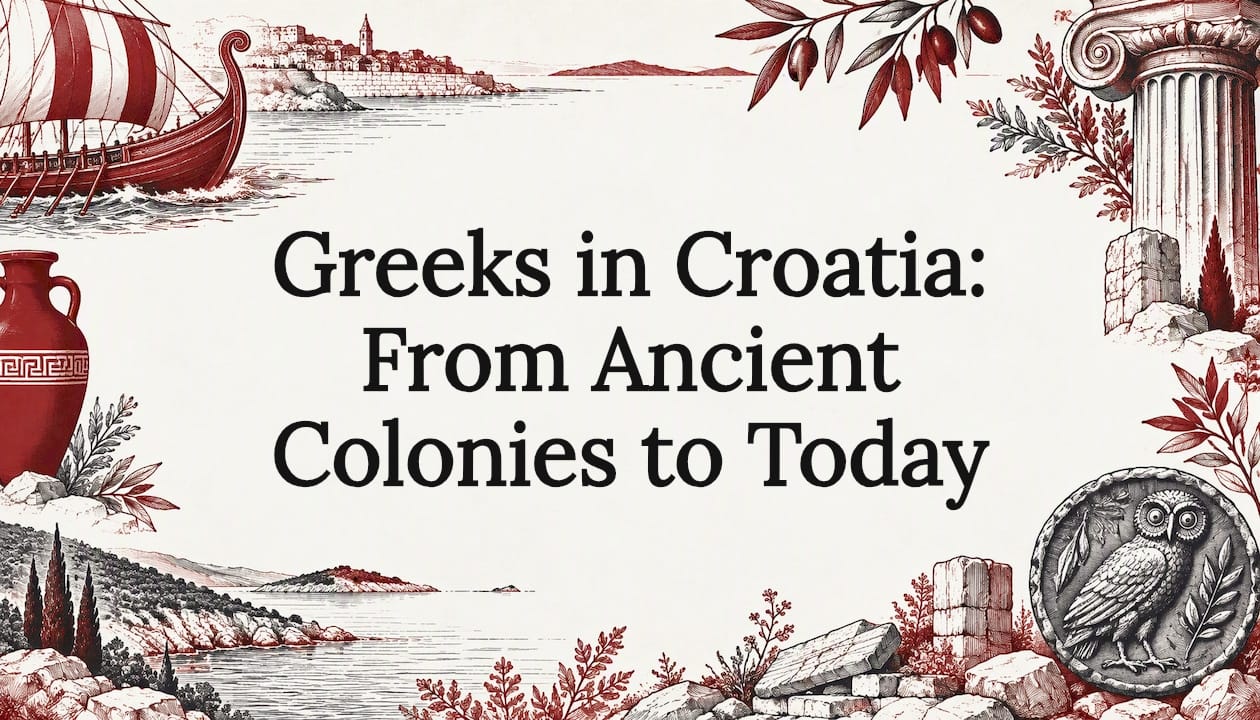
Greeks in Croatia: From Ancient Colonies to Today
Greeks have been part of the Croatian Adriatic for more than 2,400 years. Greek settlers founded Issa on the island of Vis and Pharos on Hvar in the early 4th century BC. Today the community is very small: Croatia’s 2011 census counted 105 people who declared themselves Greek. The living Greek presence now lies mostly in diplomacy, education and cultural exchange, not in a large diaspora.
This guide separates three layers that search results often blur: the ancient colonies, the medieval and early modern contacts, and the modern Greek community and state relations.
TL;DR
- Greek colonists founded Issa (Vis) and Pharos (Stari Grad, Hvar) in the early 4th century BC, and the cities minted their own coins.
- Medieval contact ran through the Church and the rivalry between Rome and Byzantium, not through settlement.
- The 2011 census recorded 105 Greeks in Croatia, so the community is tiny and any larger figure needs a clear definition.
- Croatia and Greece have had diplomatic relations since 1992 and a cultural agreement since 1995; Greek is taught at the universities of Zagreb and Zadar.
- Careful work on this topic separates ancient Hellenic heritage from the modern community and cites every claim.
Table of Contents
- Greek colonies on the Croatian coast
- From Rome to Byzantium: the medieval layer
- How many Greeks live in Croatia?
- Where Greek language and culture live on in Croatia
- Croatia–Greece relations today
- Visiting the Greek layer of Croatia
- Our perspective
- Contribute to the research
- How to research Greeks in Croatia responsibly
- FAQ
- Sources
Greek colonies on the Croatian coast
Greek mariners and traders were sailing deep into the Adriatic by the 7th century BC, according to the Croatian Encyclopedia entry on Greek colonization of the Adriatic. Organized settlement came later. The same entry dates the foundation of Issa, on the island of Vis, to the years between 397 and 390 BC, under Dionysius the Elder, the ruler of Syracuse. He also prompted Greeks from Paros to found Pharos in 385–384 BC. Pharos is today’s Stari Grad on Hvar.
These were not isolated outposts. The poleis of Issa, Pharos, Heraclea and Korkyra (the last on the island now called Korčula) formed a cluster of Greek communities on the eastern Adriatic. Their position made sense: islands gave sheltered harbors, defensible sites and access to the Illyrian coast and its hinterland, while the trade route ran up the Adriatic toward the Italian and Balkan markets.
Coins as evidence of a local economy
The strongest proof that these were functioning states is money. A study published through the Croatian scholarly portal Hrčak describes how Pharos, Issa, Heraclea and Korkyra issued bronze and silver coinage from the 4th to the 2nd century BC. The coins formed a regional monetary system until Roman Republican coinage replaced them.
The numismatist Tomislav Bilić points out in the same study that the term “Greek-Illyrian coinage” is technically imprecise. He still finds it a useful label for the coins of Greek and Illyrian communities that interacted closely in the late Classical and Hellenistic periods. That caution is worth keeping in mind: the coastline was a mixed world, and ethnic labels from antiquity were never as tidy as modern ones.
Earlier contact, before the colonies
Colonization was not the first meeting. The Archaeological Museum in Zagreb, in its guide to Greeks on the eastern Adriatic coast, traces contact with the Greek world back to prehistoric times. The evidence is archaeological finds, above all pottery, along with Greek myths tied to sites on the Croatian coast.
From Rome to Byzantium: the medieval layer
After the Roman conquest, the Greek poleis lost their independence and their coinage. Greek presence did not vanish, but it changed character. A study in the journal Balkan Studies on Croatian–Greek connections argues that ancient contacts were mainly colonial and commercial. Medieval relations were shaped instead by religion and politics, in particular the tension between the papacy and the Byzantine Empire.
The same article offers a vivid example from the 7th century. Pope John IV, a native of Dalmatia, sent money to Dalmatia and Istria to redeem captives. It was also the period when Emperor Heraclius invited Croatians to settle in Illyricum. For anyone tracing “Greeks in Croatia” through the early Middle Ages, the useful lens is therefore imperial and ecclesiastical influence. A resident Greek population is not what the sources show.
How many Greeks live in Croatia?
The only hard number comes from the census. Croatia’s Central Bureau of Statistics, in its 2011 census table on population by ethnicity, recorded 105 people as Greeks. That is a count of people who declared a Greek ethnicity on the form.
That figure has limits worth stating plainly when you use it:
- It measures self-declared ethnicity. It does not count Greek citizens working or studying in Croatia, Greek tourists or property owners, or Croatian citizens with Greek ancestry who declare a different identity.
- It is a snapshot. It dates from 2011, and later census results should be consulted on the Croatian Bureau of Statistics site for any current analysis.
- It says nothing about institutions. A community of a hundred or so people does not look like the Greek communities of Albania, North Macedonia or the Black Sea coast, which have schools, churches and associations built over generations.
For a researcher, this matters because the phrase “Hellenism in the Balkans” covers very different situations. Croatia is a case where heritage is deep and the present community is small.
Where Greek language and culture live on in Croatia
Greek culture in Croatia survives mainly through education and state-level cultural exchange. The Greek Ministry of Foreign Affairs describes the picture on its page about cultural relations and the Greek community in Croatia:
- The universities of Zagreb and Zadar have Departments of Classical Philology, where Ancient Greek and modern Greek are taught.
- Two public classical secondary schools, in Zagreb and Rijeka, include Ancient Greek language, history and civilization as main subjects.
- The bilateral Cultural Agreement, signed in Athens on 10 March 1995, is the legal framework for cultural affairs. It is carried out through triennial executive programs covering academic exchange, fellowships, summer seminars on language and culture, and cooperation on libraries and archives.
This tells us something about how Greek identity is maintained in Croatia. It rests less on a community passing a language between generations and more on academic study, school curricula and bilateral programs. The reader looking for a Greek Orthodox parish life or a network of diaspora clubs, in the way these exist elsewhere in the region, should treat that as a separate question requiring local verification. Neither the census nor the official sources above document such a network.
Croatia–Greece relations today
Modern state relations are warm and unremarkable in the best sense. The Greek Ministry of Foreign Affairs summarizes the relationship as good-neighborly, with regional cooperation at a particularly good level. Economic cooperation centers on energy, tourism and infrastructure. Greece supported Croatia’s accession to NATO, the EU, the Schengen area and the eurozone.
The same page gives the key dates:
| Milestone | Date |
|---|---|
| Diplomatic relations established | 20 July 1992 |
| Croatian Embassy in Athens | 1993 |
| Greek Embassy in Zagreb | November 1994 |
| Bilateral Cultural Agreement | 10 March 1995 |
Both countries also work together in the EU’s southern grouping, the Med9. The 2024 Paphos Declaration records Croatia and Greece meeting as Med9 participants to coordinate on shared challenges, including the conflict in the Middle East.
For policy readers, the takeaway is that Greece’s influence in Croatia works through ordinary channels: embassies, EU and NATO membership, trade, tourism and education. It does not work through a diaspora lobby, because there is no large diaspora to speak of.
Visiting the Greek layer of Croatia
If you are traveling and want to see the story on the ground, two island stops matter most. Stari Grad on Hvar sits on the site of ancient Pharos, founded by settlers from Paros. Vis town occupies the area of ancient Issa. Both fit neatly into a Dalmatian island itinerary, and the Archaeological Museum in Zagreb gives useful background beforehand through its Greek collections.
When reading local signage and guidebooks, keep the distinction from this article in mind. “Greek” on a Dalmatian island almost always refers to the ancient colonists. It rarely refers to a living community.
Our perspective
Croatia is a useful test case for how we think about Hellenism. A great deal of public writing treats Greek presence in the Balkans as one story of an unbroken diaspora. The record shows several different stories, and Croatia belongs to the one where ancient heritage is rich and the contemporary community is very small.
That is exactly why we insist on documentation. When a 2011 census figure of 105 is placed next to claims of a large Greek population, the gap is not a minor detail. It is the difference between analysis and assumption. Every claim we publish is tied to a credible source, and we have no ties to any government or party.
We also believe no single institution can cover the Greek world from the Adriatic to the Eastern Mediterranean. This is why we invite scholars with local knowledge, whether archaeologists in Dalmatia, historians of the Church, or demographers, to contribute data and analysis as fellows. A national perspective on Greek identity and strategy is only as good as the evidence collected from places like Vis and Zagreb.
Alexios
Contribute to the research
Hellenism Watch is an independent, non-profit observatory that publishes free, source-backed research on the Greek diaspora, Hellenism and the institutions that represent it across the Balkans and Eastern Mediterranean. If you work on Croatia, Dalmatia or any neighboring community, you can read the latest work on our main site or see the researchers and experts in our fellowship, which is open to scholars worldwide who wish to contribute data and analysis.
How to research Greeks in Croatia responsibly
A few habits prevent most errors on this topic:
- Name the period. Ancient colonies, medieval Byzantine contact and the modern community are separate subjects with different evidence.
- Define the group. Say whether you mean self-declared ethnicity, citizenship, ancestry or cultural affiliation, and cite the count that matches.
- Prefer primary and official sources. Census tables, ministry pages, museum guides and peer-reviewed studies come first. Travel blogs and encyclopedia-style summaries are for orientation only.
- Use Croatian-language scholarship. The Hrvatska enciklopedija and the Hrčak portal hold much of the best work, and much of it is written in Croatian.
- Date your figures. A 2011 census count is a 2011 count.
FAQ
Were there Greek colonies in Croatia?
Yes. Issa on Vis was founded by Dionysius the Elder of Syracuse between 397 and 390 BC, and Greeks from Paros founded Pharos on Hvar in 385–384 BC, according to the Croatian Encyclopedia. Other Greek cities, including Heraclea and Korkyra, also existed on the eastern Adriatic and issued their own coins.
How many Greeks live in Croatia?
The 2011 census recorded 105 people who declared themselves Greek. This counts self-declared ethnicity only, so it excludes Greek citizens living or working in Croatia who did not declare it, and it predates more recent data.
When did Croatia and Greece establish diplomatic relations?
Modern diplomatic relations began on 20 July 1992, according to the Greek Ministry of Foreign Affairs. The Croatian Embassy in Athens followed in 1993 and the Greek Embassy in Zagreb opened in November 1994.
Can you study Greek in Croatia?
Yes. The universities of Zagreb and Zadar teach Ancient and modern Greek in their Departments of Classical Philology. Public classical secondary schools in Zagreb and Rijeka also include Ancient Greek language, history and civilization, as the Greek foreign ministry describes.
Sources
- Grčka kolonizacija na Jadranu, Hrvatska enciklopedija
- Greek-Illyrian coinage of the central Adriatic region, Hrčak
- Grci na istočnoj obali Jadrana, Archaeological Museum in Zagreb
- Croatian–Greek connections, Balkan Studies
- Population by ethnicity, 2011 Census, Croatian Bureau of Statistics
- Cultural Relations and Greek Community, Greek Ministry of Foreign Affairs
- Croatia, Hellenic Republic Ministry of Foreign Affairs
- Paphos Declaration, Med9 2024