
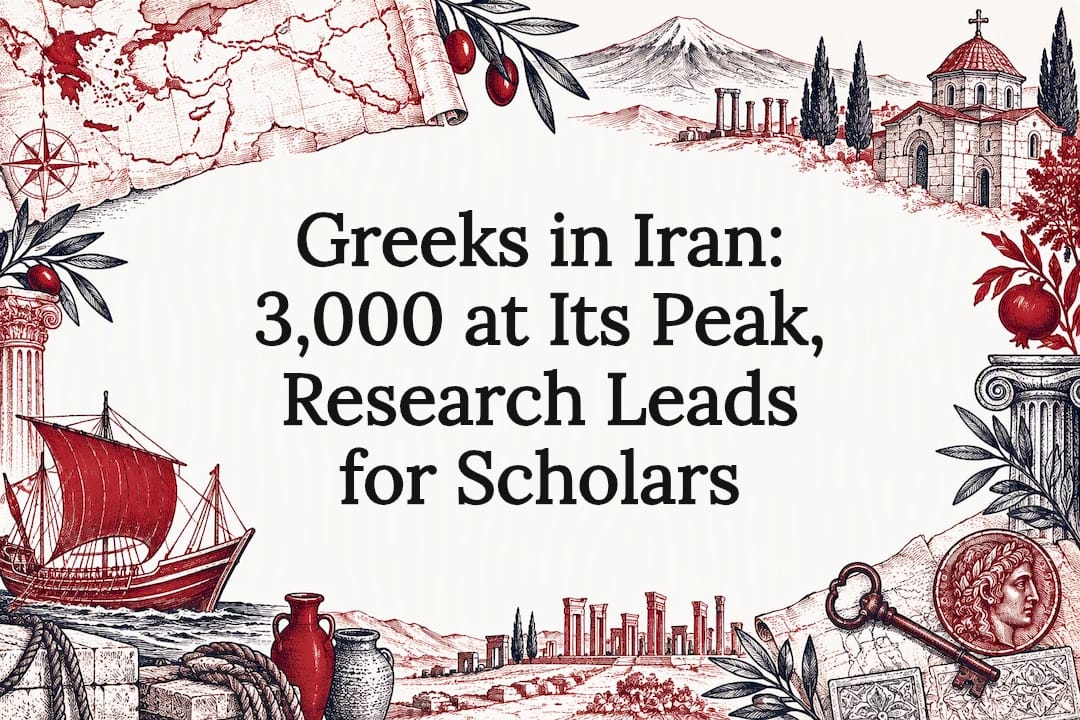
A very small number of Greeks live in Iran today, the remnant of a community that once numbered around 3,000 in the 1960s and 1970s before collapsing after the 1979 revolution. The Encyclopaedia Iranica traces this arc from thriving merchant families and railway workers to a scattered handful of descendants. What follows lays out the sourced timeline, the institutions that held the community together, and what survives of it now.
TL;DR:
- The 2017 estimate of around 100 likely reflects renewed contact and reporting, not population recovery; Iranica estimated fewer than 20 in 2016.
- Researchers should start with Tehran’s church compound, cemetery, burial records, and school archives, which preserve more concentrated evidence than surviving traces in Rasht or Anzali.
- The Aristotle school and Greek language church services once supported language retention, but formal instruction has contracted and family transmission now carries the burden.
- Researchers tracing individuals should consult Evangelos Venetis’s 2014 monograph; surviving evidence more often appears in church, school, merchant, and cemetery records than personal biographies.
Table of Contents
- Historical Overview: 19th Century Arrivals Through the Pahlavi Era
- Community Life and Institutions in Tehran, Rasht, and Anzali
- Demographic Change: A Sourced Population Timeline
- Cultural and Diplomatic Relations Between Greece and Iran
- Legacy on the Ground: Church, Cemetery, and Surviving Traces
- Hellenism Observatory: Research, Monitoring, and How to Use Our Resources
- Pre-Modern Historical Presence of Greeks in Iran
- Hellenistic Influence on Iranian Art, Architecture, and Society
- Personal Stories and Biographies of Notable Greeks in Iran
- Contemporary Challenges and Contributions Today
- Language and Education Within the Greek Community
- Author Perspective: Why This Community Deserves Closer Study
- Where to Find More From Hellenism Watch
- FAQ
- Sources
Historical Overview: 19th Century Arrivals Through the Pahlavi Era
Greek presence in modern Iran took shape through trade long before it became a settled community. Commercial houses, including the Rallis family, worked the Istanbul to Tabriz trade corridor starting in the early 1800s, and the family held a consular role from 1837 onward, a link formalized further by treaty activity in 1861, according to Iranica. Greek merchants dealing in silk, tobacco, and shipping found northern Iran especially hospitable to their business interests.
A second wave arrived for different reasons. Pontic Greeks displaced by the upheavals following World War I resettled in parts of Iran during the 1920s, often turning to agriculture, construction, and trade to rebuild their livelihoods.
The Pahlavi era then pulled in skilled labor and capital as Iran modernized:
- Construction firms and contractors found steady work on infrastructure projects tied to the broader push toward industrial development.
- The Trans Iranian Railway, built between 1927 and 1938, drew Greek engineers and laborers into one of the era’s signature modernization efforts.
- Commercial investment expanded as merchant families reinvested profits into shipping, trade, and urban enterprises.
By the mid 20th century, these overlapping waves, trade migrants, refugees, and modernization workers, had produced a recognizable Greek community with its own institutions and neighborhoods.
Community Life and Institutions in Tehran, Rasht, and Anzali
The heart of Greek community life in Iran sat in a compound in Tehran organized around the Greek Orthodox Church of the Annunciation of the Mother of God, which anchored religious, educational, and social activity for decades. The Aristotle school operated alongside the church, giving children of the community a Greek-language education inside Iran rather than requiring families to send them abroad.
Supporting organizations rounded out daily life:
- The Women’s Charity Sisterhood provided welfare support and coordinated community assistance.
- Youth groups organized social and cultural activities for the next generation.
- An arts center gave the community a venue for performance and gathering outside church functions.
Outside the capital, smaller Greek communities took root in Rasht and Anzali, port towns on the Caspian coast where Greek traders had long been active in the silk and tobacco trade. These northern communities functioned somewhat independently of Tehran, tied more closely to shipping routes than to the capital’s institutional life.
Pro Tip: Researchers starting a project on this topic should treat the Tehran compound, church, school, and charity records together as a single institutional archive rather than separate threads, since they describe the same overlapping social network.
Demographic Change: A Sourced Population Timeline
Sourced estimates from Iranica show a community that grew steadily, then nearly vanished within two generations. The population peaked around 3,000 during the 1960s and 1970s, built up through decades of trade migration and Pahlavi-era modernization work. After the 1979 revolution, the number fell sharply, dropping to fewer than 100 by 1981 as emigration accelerated.
A modest stabilization followed in the 1990s, with small numbers of Greeks returning or reconnecting with the community, though nowhere near prior levels.
| Period | Estimated Greek population in Iran |
|---|---|
| 1960s to 1970s (peak) | Around 3,000 |
| 1981 | Fewer than 100 |
| 2016 | Probably under 20 |
| 2017 | Around 100 |
The 2017 figure likely reflects renewed contact and reporting rather than a genuine demographic recovery, since the underlying community infrastructure had already contracted severely.
Cultural and Diplomatic Relations Between Greece and Iran
Formal ties between Greece and Iran stretch back to the 19th century, when consular representation and commercial treaties gave structure to what had been an informal trading relationship. The Rallis family’s consular role beginning in 1837 and the treaty concluded in 1861 established a diplomatic framework that outlasted individual merchant fortunes, according to Iranica.
That framework carried into the 20th century and persists today through official channels:
- Greece maintains an embassy in Tehran, which lists cultural relations and contact information for bilateral engagement, per the Hellenic Ministry of Foreign Affairs.
- Cultural cooperation programs and embassy-organized activities give the two countries ongoing points of contact beyond trade.
- These official channels also serve as practical entry points for researchers trying to locate archival material or community contacts inside Iran.
The relationship has shifted from merchant-driven diplomacy to a smaller, more institutional connection, but the diplomatic thread never fully broke.
Legacy on the Ground: Church, Cemetery, and Surviving Traces
The clearest physical evidence of this history sits in Tehran. The Greek Orthodox Church of the Annunciation, inaugurated in 1951, remains standing along with its compound and an adjoining cemetery, according to Iranica. These sites are the closest thing the community left to a permanent record once most families had emigrated.
Smaller traces persist in the northern port towns of Rasht and Anzali, where trading families once operated, though far less documentation survives there than in the capital.
For researchers, the Tehran church and cemetery function as a natural starting point: burial records, church archives, and oral histories tied to the compound offer more concentrated material than any other single site connected to the community’s modern history.
Hellenism Observatory: Research, Monitoring, and How to Use Our Resources
We built the Hellenism Observatory to track exactly this kind of diaspora history with full independence from government or party influence, backing every claim with credible sources. We aim to help researchers and analysts locate archival leads, documented timelines, and expert contacts tied to Greek communities abroad, including smaller or historically overlooked populations like the one in Iran.
Pre-Modern Historical Presence of Greeks in Iran
Greek contact with the Iranian plateau predates the modern merchant community by over two thousand years. The Achaemenid era brought conflict first, through the Greco-Persian Wars of the 5th century BCE, as Greek city-states resisted Persian expansion into the Aegean, according to Wikipedia’s overview of Greece-Iran relations.
The relationship transformed entirely after Alexander the Great’s conquest of the Achaemenid Empire in the 4th century BCE. Rather than retreating, Greek settlers, administrators, and soldiers remained across Persian territory, founding cities and garrisons that blended Greek civic forms with local Persian administration. This produced the Seleucid Empire, a Greek-ruled successor state that controlled much of Iran for roughly two centuries before Parthian expansion pushed Hellenistic political control eastward and out of the Iranian heartland.
Even after Parthian and later Sasanian rule replaced Greek governance, Hellenistic cultural and artistic influence lingered in the region for centuries, carried through trade networks, administrative practices, and artistic conventions that had taken root under Seleucid rule. This long pre-modern layer of contact, war followed by centuries of political and cultural fusion, sits apart from the 19th and 20th century merchant migration described elsewhere in this history, but it explains why Greek and Iranian history are so frequently discussed together in academic literature.
Hellenistic Influence on Iranian Art, Architecture, and Society
The cultural fusion that followed Alexander’s conquest left visible marks on Iranian art and architecture that outlasted Greek political control by centuries. Hellenistic artistic conventions, including techniques of sculpture, coinage design, and urban planning, blended with existing Persian traditions under Seleucid and later Parthian rule.
Archaeological and journal literature on Greeks in Persia documents this fusion in coin iconography, architectural ornament, and urban layouts that combined Greek civic models with Persian administrative structures, as recorded in the American Journal of Archaeology. Greek-style colonnades, theater architecture, and figural art appear in excavated sites across the former Seleucid territories, evidence that Hellenistic aesthetic conventions did not vanish when Greek political rule receded.
This influence worked in both directions. Persian artistic and administrative traditions shaped how Greek settlers governed and built in Iran, producing hybrid forms rather than a simple transplant of Greek models onto Persian soil. The result is a layer of shared visual and institutional vocabulary that modern scholars still study when tracing how Hellenistic and Persian civilizations absorbed each other over several centuries, well before the 19th century merchant community that forms the core of this article’s modern focus.
Personal Stories and Biographies of Notable Greeks in Iran
Documentation of individual lives within the modern Greek community in Iran is sparse compared with the institutional record left by the church, school, and merchant houses. Most of what survives comes through family and commercial lineage rather than individual biography. The Rallis family stands out as the best documented case, holding a consular role from 1837 and figuring prominently in the trade networks that connected Istanbul, Tabriz, and the Caspian ports, according to Iranica.
Beyond merchant families, Pontic Greek refugees who resettled in Iran during the 1920s left fewer individual records, their stories folded into the broader pattern of agricultural and construction labor rather than preserved as named biographies. This gap reflects how diaspora communities built around trade and labor, rather than political or literary prominence, tend to leave institutional traces, church records, school rosters, and cemetery inscriptions, instead of personal memoirs.
Scholarly work has started to fill this gap. Evangelos Venetis’ monograph, Greeks in Modern Iran: Discovering the Past of a Prosperous Community (1837-2010), published in 2014, draws on archival and community sources to reconstruct the community’s composition and daily life, according to a summary of his research. His work remains one of the only sustained attempts to move beyond institutional records toward the lived experience of individual families within the community, which makes it a key reference point for anyone trying to reconstruct personal rather than purely demographic history.
Contemporary Challenges and Contributions Today
The Greek community in Iran today is small enough that institutional continuity, rather than growth, is the central challenge. With estimates putting the population at under 20 in 2016 and around 100 in 2017, according to Iranica, the community lacks the critical mass that once supported a school, multiple charities, and an arts center simultaneously.
What remains functions mostly through the surviving church compound in Tehran, which continues to serve as a religious and social anchor even at reduced scale. Diplomatic and cultural channels between Greece and Iran, including embassy-level cultural cooperation described by the Hellenic Ministry of Foreign Affairs, offer one of the few mechanisms still connecting the dwindling local community to the broader Greek diaspora and to Greece itself.
The contribution of this small community is less about current economic or cultural output and more about historical continuity: it represents one of the longest-running Greek diaspora presences in the Middle East, with documented ties stretching back to 19th century trade. Preserving what remains, church records, cemetery inscriptions, and oral histories from descendants, matters more now than at any earlier point in the community’s history, simply because so few primary sources remain to document it firsthand.
Language and Education Within the Greek Community
Greek-language education inside Iran centered on the Aristotle school, part of the Tehran compound built around the Greek Orthodox Church of the Annunciation. For families who remained in Iran through the mid 20th century, the school gave children access to Greek-language instruction without requiring relocation abroad, a significant advantage during the community’s peak population years in the 1960s and 1970s.
Church services conducted in Greek reinforced language retention outside the school setting, giving the compound a dual function as both an educational and liturgical center. This pairing of church and school mirrors how many Greek diaspora communities elsewhere have preserved language, through religious practice and formal schooling operating together rather than separately.
As the population collapsed after 1979, this educational infrastructure almost certainly contracted alongside it, though detailed records on exactly when the school ceased regular operation are not widely documented in available sources. What is clear is that language retention today depends far more on family transmission across generations than on any functioning community school, a shift typical of diaspora communities that have fallen below the population threshold needed to sustain formal institutions.
Author Perspective: Why This Community Deserves Closer Study
The Greek community in Iran compressed an entire diaspora life cycle, growth, institutional peak, and near-collapse, into roughly a century. That speed makes it a sharp case study in how quickly diaspora infrastructure can vanish once political conditions shift. Preserving what remains of its institutional memory deserves more fieldwork, ideally from historians, linguists, and archivists working together rather than in isolation.
— Alexios
Where to Find More From Hellenism Watch
We publish source-backed research on Greek diaspora communities like this one through the Hellenism Observatory, where every claim carries a documented citation rather than assumption. Readers looking to go deeper than this overview can draw on what we make available directly:
- Evidence-backed articles covering diaspora communities across the Balkans and Eastern Mediterranean, including smaller or historically overlooked populations.
- A fellows network connecting researchers with scholars who study Hellenism and diaspora dynamics firsthand.
- An open invitation for academics and analysts to contribute findings from their own areas of expertise.
If you are building a research project around this topic, our fellows page is the fastest way to find a relevant contact or dossier.
FAQ
How many Greeks live in Iran?
Current estimates put the Greek population in Iran at a very small number, probably under 20 as of 2016 and around 100 by 2017, according to Iranica. This is down sharply from a peak of roughly 3,000 in the 1960s and 1970s.
Is Greece an ally to Iran?
Greece and Iran maintain formal diplomatic relations rather than a military alliance, supported by an embassy in Tehran and ongoing cultural cooperation, according to the Hellenic Ministry of Foreign Affairs. The relationship today centers on cultural and diplomatic contact rather than the trade-driven ties that once dominated it.
Why is Greek DNA so unique?
This question falls outside what the sources behind this article address, since none of them cover genetic research on Greek populations. Readers interested in Greek genetic ancestry should consult population genetics research directly rather than diaspora history sources like this one.
Did the Greeks and Persians get along?
The relationship moved between conflict and cooperation over different eras. The Achaemenid period brought the Greco-Persian Wars, but centuries of Hellenistic rule following Alexander’s conquest produced lasting cultural fusion, according to Wikipedia’s overview of Greece-Iran relations, and the modern-era trading relationship from the 19th century onward was largely cooperative.
Sources
- GREEKS IN MODERN IRAN - Encyclopaedia Iranica
- Cultural Relations and Greek Community - Greece and Iran
- Evangelos Venetis: Greeks in Modern Iran – Dr. Kaveh Farrokh