
90,000 to 110,000 Greeks in Italy: What Those Numbers Mean
Greeks in Italy today are the living continuation of a presence that began nearly 2,800 years ago, spanning ancient colonists in Magna Graecia, Byzantine-era migrants, Venetian merchant communities, and today’s Griko speakers in Apulia and Calabria alongside modern Greek expatriates in Rome and Milan. Estimates put people with Greek heritage or historical ties at roughly 90,000 to 110,000, though the Griko language itself is severely endangered. The sections below trace that history, map where these communities live now, and point to the research behind the numbers.
TL;DR:
- Most Greek communities in Italy today stem from ancient Magna Graecia and Byzantine rule, with only a small percentage actively speaking Griko or Calabrian Greek.
- Active Griko speakers are estimated to be between a few hundred and 20,000, concentrated mainly in Apulia’s Grecia Salentina and Calabria’s Bovesia regions.
- Preservation efforts rely heavily on grassroots cultural associations, language courses, and local festivals, with funding often limited and inconsistent.
- Modern Greek populations in Italy, including urban expatriates, are distinct from historically rooted Griko enclaves, both linguistically and culturally.
- Genetic studies show layered Greek influences in East Sicily, but they do not confirm an unbroken ancestral bloodline to ancient Greek settlers.
Table of Contents
- The Ancient Roots: Magna Graecia in Sicily and Southern Italy
- How Byzantine Rule Reshaped Greek Presence in Medieval Italy
- Venetian Ports and Modern Migration Waves
- Who Are the Griko People and Where Do They Live?
- How Endangered Is the Griko Language Today?
- Where Do Greeks Live in Italy? Population by Region
- What Genetic and Archaeological Research Reveals
- Notable Griko Towns and Cultural Landmarks Worth Knowing
- The Hellenism Observatory’s Approach to Documenting Hellenism
- Why Documenting These Communities Still Matters
- Free Research on Greek Heritage Communities Worldwide
- Sources
- FAQ
The Ancient Roots: Magna Graecia in Sicily and Southern Italy
Greek settlers began colonizing southern Italy and Sicily in the 8th century BC, driven by land shortages, trade ambitions, and political exile back home. Within two centuries, Greek city-states had planted so many colonies across the region that Romans called it Magna Graecia, or “Great Greece.” By the 6th century BC, some of these colonies had grown wealthier and more populous than the mainland cities that founded them.
The colonization wasn’t a simple transplant of Greek life onto empty land. Recent scholarship frames it as an ongoing cultural negotiation between settlers and the indigenous Italic and Sicilian populations already living there, producing hybrid urban cultures rather than pure Greek outposts. That nuance matters, because it explains why so much local material culture blends Greek forms with native techniques and motifs.
Several colonial cities became major powers in their own right:
- Taranto (Taras), founded by Spartan colonists, grew into one of the wealthiest cities in the ancient Mediterranean.
- Syracuse, on Sicily’s east coast, rivaled Athens and Carthage militarily and became a center of philosophy and drama under rulers like Dionysius I.
- Catania, founded by settlers from Naxos, developed into a key agricultural and trading hub near Mount Etna.
- Reggio (Rhegion), guarding the strait between Sicily and the mainland, controlled crucial maritime traffic for centuries.
The archaeological footprint is still visible. Greek temples at Paestum and Agrigento, theater complexes at Syracuse and Taormina, and grid-based urban layouts across the region all trace directly back to these colonial foundations. Greek inscriptions, pottery styles, and coinage from this period remain among the richest archaeological records in the Mediterranean, and they form the physical baseline against which every later wave of Greek presence in Italy gets measured.
How Byzantine Rule Reshaped Greek Presence in Medieval Italy
Greek language and religious rite didn’t fade after Rome absorbed Magna Graecia. They resurfaced, and in some places strengthened, once the Byzantine Empire took control of much of southern Italy starting in the 6th century AD. Byzantine administrators governed parts of Calabria, Apulia, and Sicily for centuries, reintroducing Greek as an administrative and liturgical language in regions where Latin had already made inroads.
This Byzantine period is arguably more important to the survival of Greek culture in Italy than the ancient colonization itself. Byzantine monks, officials, and settlers arrived in successive waves between the 6th and 11th centuries, often resettling depopulated areas or reinforcing existing Greek-speaking enclaves. Monasteries following Greek Orthodox liturgical practice spread through Calabria and Sicily, and Greek remained the language of the church in many communities long after political control shifted.
Key developments from this period include:
- Byzantine Calabria and Sicily functioned as semi-autonomous Greek-speaking provinces for extended stretches, with their own administrative structures and Greek-language documentation.
- Waves of migrants and refugees from the wider Eastern Roman world settled in southern Italy during periods of instability, adding fresh Greek-speaking population to older colonial-era communities.
- The Norman conquest of southern Italy in the 11th century brought aggressive Latinization: Norman rulers favored the Latin rite and gradually replaced Greek bishops and Greek-language administration with Latin equivalents.
Local resistance to this Latinization was uneven. Some Greek-rite communities negotiated protections and persisted for generations under Norman and later Angevin rule, while others assimilated quickly. The pockets of Greek language and Orthodox or Greek-Catholic practice that survived into the modern era, particularly in the mountainous interior of Calabria, owe their durability largely to this medieval period of reinforcement rather than to unbroken continuity from antiquity alone.
Venetian Ports and Modern Migration Waves
Greek communities didn’t stay confined to the south. Starting in the late medieval period, Greek merchants, sailors, and refugees settled in Venice and other northern Italian port cities, drawn by trade routes connecting the Adriatic to the Aegean and the eastern Mediterranean.
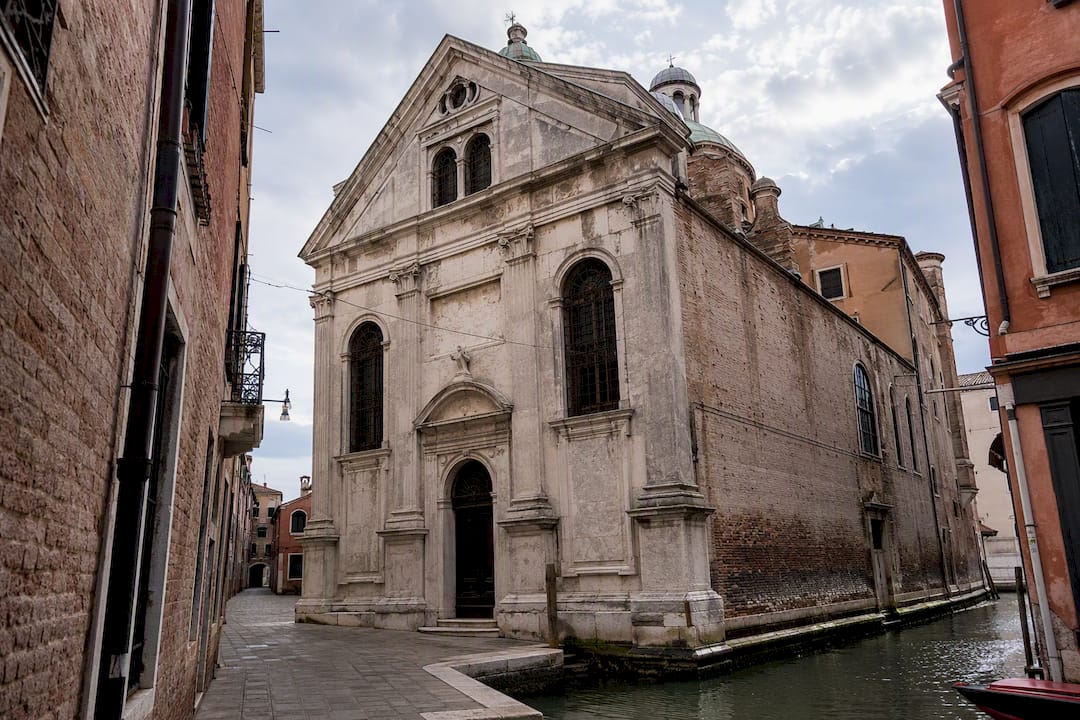
Venice became the most significant of these northern Greek footholds. The Republic of Venice, which controlled Greek-speaking territories like Crete and the Ionian Islands for centuries, granted its Greek residents formal privileges and religious autonomy. The church of San Giorgio dei Greci, established in the 16th century, still stands as the historic center of Venice’s Greek Orthodox community and remains a reference point for anyone researching the Greek diaspora in northern Italy.
The fall of Constantinople in 1453 and subsequent Ottoman expansion into Greek lands pushed additional waves of refugees toward Venetian territory. These refugees brought scholars, printers, and clergy who helped establish Greek Orthodox institutions with legal standing under Venetian law, a very different pattern from the older, rural Greek-speaking enclaves in the south.
Modern migration looks different again:
- Post-Byzantine refugees who settled under Venetian protection built formal community institutions, including churches, schools, and confraternities, distinct from the informal survival of Griko-speaking villages further south.
- Nineteenth and twentieth century Greek migrants to Italy tended to settle in major cities rather than rural enclaves, drawn by commerce, shipping, and later diplomatic and professional opportunities.
- Contemporary Greek expatriate communities in Rome and Milan function as urban, professionally oriented populations, largely disconnected from the historical Griko villages of Apulia and Calabria.
That split, old rural Griko enclaves versus newer urban expatriate populations, is essential to understanding “Greeks in Italy” as a category. They aren’t one group with one story. They’re at least two distinct populations with different origins, different languages, and almost no overlap in daily life.
Who Are the Griko People and Where Do They Live?
The Griko people represent the clearest living link to Italy’s ancient and Byzantine Greek past. They inhabit two geographically separate enclaves in the south, and despite sharing a common origin story, their dialects and cultural practices have diverged enough that linguists treat them as related but distinct.
- Grecia Salentina, in the Apulia region near Lecce, is a cluster of towns where the Griko dialect historically dominated. Towns here include Calimera, Martignano, Martano, Sternatia, Zollino, Corigliano d’Otranto, Soleto, Melpignano, and Castrignano dei Greci. This flatter, more accessible region sits close to Lecce and coastal tourist routes, which has shaped how quickly Italian has displaced Griko in daily use.
- Bovesia, in the mountainous Aspromonte region of Calabria, centers on towns like Bova Superiore, Bova Marina, Roccaforte del Greco, Condofuri, Palizzi, Gallicianò, and Melito di Porto Salvo. The area’s isolation slowed language loss compared to Salento, and Gallicianò in particular is still described as one of the few villages where Greko is spoken with anything close to daily fluency.
The two dialects, Salentine Griko and Calabrian Greko (also called Grecanico), share Byzantine Greek roots but have absorbed different amounts of Italian and regional dialect vocabulary over the centuries. Linguists studying Calabrian Greek note that Bovesia’s mountain geography produced a different preservation trajectory than Salento’s flatter, more connected terrain, and that difference still shows up in fluency rates between the two regions today.
Culturally, both enclaves share overlapping traditions layered onto distinct local color. The pizzica, a folk dance and musical style associated with Salento, often incorporates Griko lyrics in Grecia Salentina performances, blending Italian tarantella tradition with Greek linguistic heritage. Religious festivals in both regions frequently retain Byzantine-influenced elements, a direct echo of the Greek Orthodox and Greek-Catholic liturgical practice that persisted through the medieval period even after Latin rite became dominant elsewhere. Local cultural associations organize annual festivals, sometimes tied to patron saints’ feast days, where Griko songs and dances are performed publicly, functioning as much as language preservation efforts as religious observance.
How Endangered Is the Griko Language Today?
Griko and Calabrian Greek are both classified as severely endangered languages, and the numbers behind that classification vary widely depending on how “speaker” gets defined. The World Directory of Minorities and Indigenous Peoples put the combined speaker population across Puglia and Calabria at somewhere between 2,— and 20,000 people, a spread wide enough to tell you something important on its own: nobody has a precise count, and definitions of fluency differ enormously from one survey to another.
That range gap comes down to methodology. Some counts include anyone with partial comprehension or passive knowledge of Griko phrases learned from grandparents. Others restrict the figure to people who can hold a fluent conversation. Field researchers generally treat ethnic-heritage counts and active-speaker counts as separate metrics entirely, since census-style totals routinely exceed genuine fluent-speaker numbers by an order of magnitude.
UNESCO’s endangered-languages documentation, often referenced as the Red Book listing, includes Griko and Calabrian Greek among languages facing serious intergenerational transmission problems. Italy responded with formal legal protection through Law no. 482 of 1999, which recognized historic Greek-speaking territories as protected linguistic minority areas and opened the door to state-supported education and cultural funding.
| Protection or effort | What it covers |
|---|---|
| Law no. 482/1999 | Formal recognition of Greek-speaking areas as linguistic minorities, enabling education and cultural funding |
| UNESCO Red Book listing | Documents Griko and Calabrian Greek as endangered, informing academic and policy attention |
| Local cultural associations | Run Griko-language courses, publish periodicals such as I Riza, organize cultural festivals |
| Regional funding programs | Sporadic and often limited, dependent on regional budget cycles rather than guaranteed allocations |
Pro Tip: If you’re researching or visiting either enclave, don’t rely on ethnic-population figures as a proxy for how many people you’ll actually hear speaking Griko. Ask local cultural associations directly, since they track active speakers far more precisely than national censuses do.
Local revitalization runs mostly through grassroots channels rather than a centralized national program. Cultural associations in towns like Calimera and Bova offer language classes, and periodicals keep the written form alive, but funding is inconsistent and tied to shifting regional political priorities rather than a permanent budget line.
Where Do Greeks Live in Italy? Population by Region
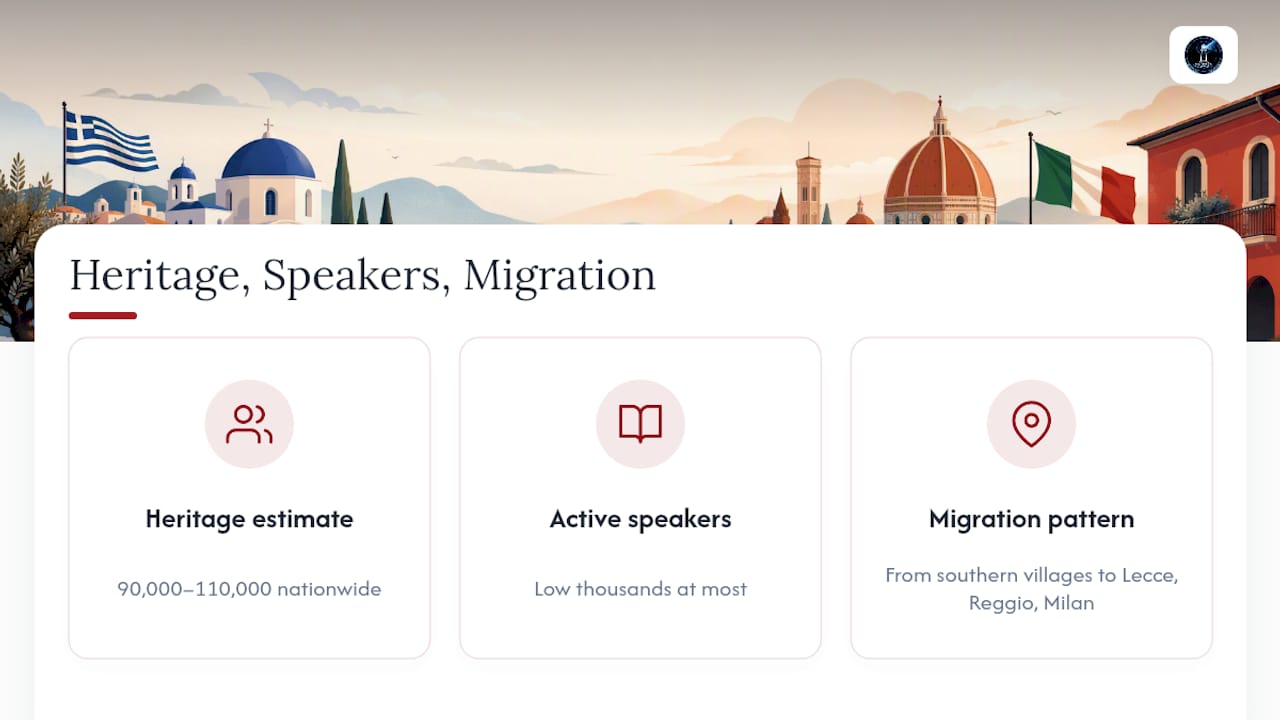
Regional counts for people of Greek heritage in Italy come from different years and different methodologies, which is worth keeping in mind before treating any single figure as definitive. The most commonly cited aggregate estimate places the total population with Greek heritage or historical ties at 90,000 to 110,000 nationwide.
Apulia and Calabria carry the largest concentrations by far, which tracks with the location of Grecia Salentina and Bovesia. Lombardy’s smaller, more recent figure reflects a different population entirely: modern Greek migrants and their descendants settled in Milan and other northern industrial cities for work rather than historical continuity with ancient or Byzantine communities.
That regional gap points to a bigger methodological issue. Ethnic-heritage totals count anyone with documented Greek ancestry or community affiliation, regardless of whether they speak a word of Griko. Active-speaker counts, by contrast, run in the low thousands at most. Urban migration has pulled younger generations out of Griko-speaking villages toward Lecce, Reggio Calabria, and northern cities for decades, which shrinks daily language use even where ethnic identification with the community remains strong.
What Genetic and Archaeological Research Reveals
Genetic studies add a layer of physical evidence to the historical record, but they come with real limits worth understanding before citing them as proof of anything definitive. A 2015 study published in the European Journal of Human Genetics found a detectable Greek-related genetic signature concentrated in East Sicily, consistent with Archaic-period settlement patterns linked to Euboea.
That finding lines up neatly with the historical record of colonization from Euboean city-states like Chalcis, which founded some of Sicily’s earliest Greek settlements. But the study’s own authors flagged important caveats:
- Sample sizes and geographic sampling density limit how confidently regional signals can be generalized across the whole of East Sicily.
- Later migrations, including Byzantine-era resettlement and centuries of subsequent admixture, complicate any attempt to draw a clean genetic line back to the original Archaic colonists.
- Alternative explanations for the observed genetic pattern can’t be fully ruled out given the data available.
Archaeological evidence tells a more concrete story. Excavated temple complexes, urban grids, pottery kilns, and inscribed dedications across Sicily and southern Italy confirm sustained Greek material culture over centuries, not just brief trading contact. The problem comes when people try to connect that ancient material record directly to modern populations through DNA alone. Researchers studying the East Sicily signal are explicit that regional genetic markers reflect a layered history of multiple migrations, not a single unbroken bloodline from 8th century BC colonists to residents living there today. Treat genetic findings as one data point among several, not a verdict.
Notable Griko Towns and Cultural Landmarks Worth Knowing
A handful of towns anchor most serious research into living Greek heritage in Italy. In Calabria’s Bovesia, Bova (often called Bova Superiore) functions as the symbolic capital of Calabrian Greek culture, while Gallicianò is frequently cited as the enclave where Greko fluency has held on most stubbornly.
In Apulia’s Grecia Salentina, Calimera, Martano, and Melpignano stand out as centers of cultural activity, hosting festivals, language courses, and the annual Notte della Taranta music festival that draws on the region’s blended Griko and Italian folk traditions.
Outside the south, Venice’s San Giorgio dei Greci remains the most significant cultural landmark tied to the later, urban chapter of Greek presence in Italy, serving as both an active Greek Orthodox parish and a historical archive for the community that settled there after the fall of Constantinople.
For readers looking to go deeper on any individual town or historical figure, academic sources and regional cultural association websites generally offer far more detailed local histories than general encyclopedias can provide in a single overview.
The Hellenism Observatory’s Approach to Documenting Hellenism
Hellenismwatch approaches topics like this one as a research and monitoring problem, not a promotional one. The Observatory operates as an independent, non-profit initiative tracking the state, threats, and opportunities facing Greek diaspora communities across the Balkans and Eastern Mediterranean, and Italy’s Griko enclaves fall squarely within that scope.
Every claim in this article traces back to a named source rather than a vague appeal to “research shows.” That standard matters more in minority-language topics than almost anywhere else, since population figures and speaker estimates get repeated uncritically across the web without anyone checking the original methodology.
Readers can expect the Observatory to keep producing evidence-based reports, source bibliographies, and periodic assessments of diaspora conditions rather than one-off content. The initiative’s collaborative model invites contributions from a global network of scholars, meaning academics and analysts working on Griko language documentation, Byzantine-era migration history, or genetic studies of southern Italy are welcome to bring their expertise into the broader Hellenism monitoring effort rather than publishing in isolation.
Why Documenting These Communities Still Matters
Continuity is easy to state and hard to prove, which is exactly why sloppy sourcing does real damage to minority communities like the Griko. Every inflated speaker count or vague “ancient Greek colony” claim that skips the Byzantine reinforcement period erases the actual reason these dialects survived as long as they have.
I think the genetic research deserves more public attention than it gets, precisely because it’s so often misused. A signal in East Sicily consistent with Euboean settlement is a genuinely interesting data point. It is not proof of an unbroken bloodline, and treating it that way does a disservice to both the science and the community.
What would help most now is more community-led documentation, recorded interviews with remaining fluent speakers in Gallicianò and Calimera, digitized local archives, and closer coordination between regional cultural associations and academic linguists. If you’re a scholar, diaspora member, or local researcher sitting on unpublished data about Griko communities, that information has more value shared than archived.
— Alexios
Free Research on Greek Heritage Communities Worldwide
Hellenismwatch exists precisely for readers who just finished an article like this one and want more than a single overview. Where academic papers stay locked behind paywalls and most general encyclopedias stop at population totals, the Observatory publishes free, source-backed research on Greek diaspora communities, including monitoring reports, bibliographies, and periodic assessments of language and cultural preservation efforts.
Independence from government or party funding is a core goal for observatories like Hellenismwatch, and factual claims in their publications aim to carry traceable sources. Some initiatives operating in this field encourage contributions from scholars working on Griko documentation, Byzantine migration history, or diaspora demographics across the Balkans or Eastern Mediterranean. Visit the Hellenism Watch homepage to browse current reports or reach out about contributing research or requesting data on a specific region.
Sources
The claims in this article draw on a small set of high-authority sources, each covering a different angle of the topic:
- Greeks in Italy — Wikipedia
- World Directory of Minorities and Indigenous Peoples — Greek-speakers in Italy (Refworld)
- The Greeks in the West: genetic signatures of the Hellenic colonisation in southern Italy and Sicily — European Journal of Human Genetics (Tofanelli et al., 2015)
FAQ
Are Sicilians Closer to Greeks or Italians?
Sicilians are culturally and administratively Italian today, but the island carries a documented layer of Greek heritage from Magna Graecia colonization and later Byzantine rule. A 2015 genetic study found a Greek-related signature concentrated in East Sicily, though the researchers stress this reflects layered history rather than a simple either/or identity.
What Parts of Italy Were Greek?
Greek colonization concentrated on southern Italy and Sicily, an area the Romans called Magna Graecia, including major cities like Taranto, Syracuse, Catania, and Reggio. Byzantine rule later extended Greek administrative and religious influence through much of Calabria, Apulia, and Sicily for several more centuries, while Venice hosted a separate Greek merchant and refugee community starting in the late medieval period.
Where Is Greek Still Spoken in Italy?
Griko survives in two enclaves: Grecia Salentina in Apulia and Bovesia in the mountains of Calabria. Speaker estimates across both regions range from roughly 2,— to 20,000, with towns like Gallicianò and Calimera among the most active centers of remaining fluency.
Do Italians Have Greek Heritage?
Some Italians, particularly in Apulia, Calabria, Lombardy, and Sicily, have documented Greek heritage or historical community ties, with an aggregate estimate of 90,000 to 110,000 people nationwide. That figure covers ethnic and historical affiliation broadly, not the much smaller number of people who actively speak Griko or Calabrian Greek today.