
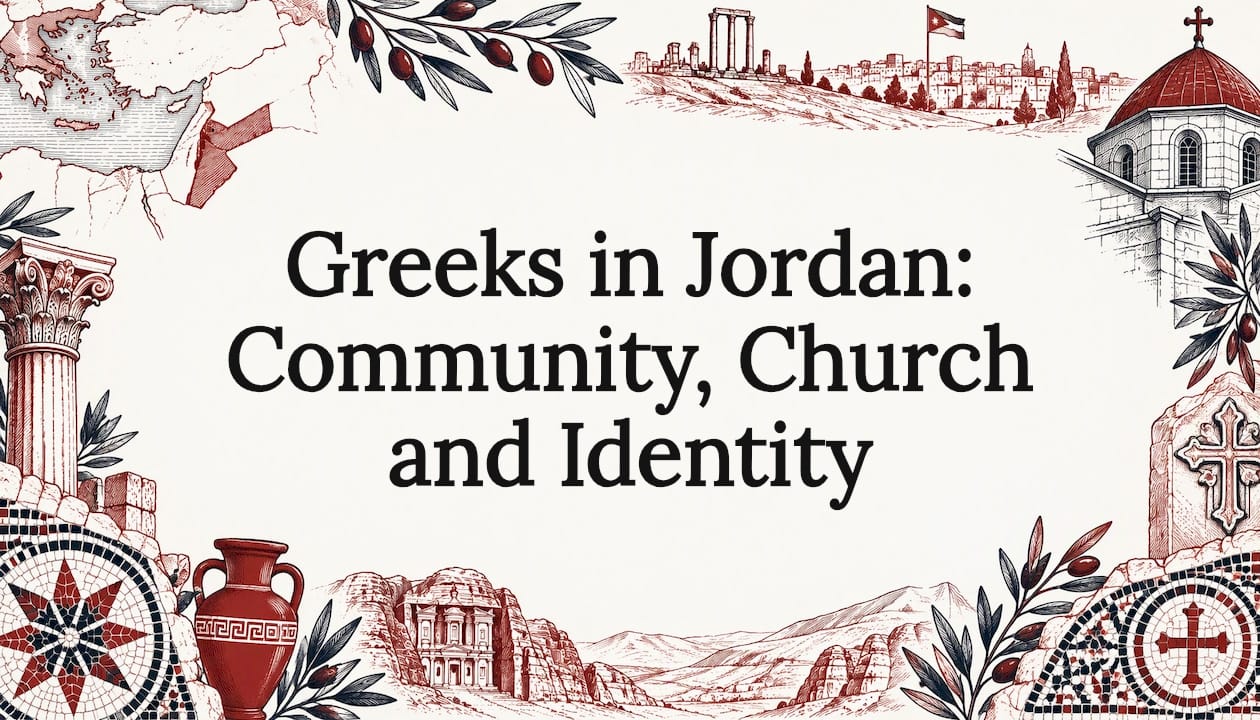
Greeks in Jordan: Community, Church and Identity
There are two different groups behind the phrase “Greeks in Jordan”. The first is a small expatriate community of about 500 people, mostly Greek women who married Jordanians. The second is a far larger Arabic-speaking Greek Orthodox flock of roughly 120,000 that belongs to a Greek-led patriarchate. This guide explains who each group is, how they differ, and why the difference matters for anyone studying Hellenism in the Eastern Mediterranean.
TL;DR
- Greece’s Ministry of Foreign Affairs counts some 500 Greeks in Jordan, mostly Greek women married to Jordanian nationals.
- Around 120,000 Greek Orthodox faithful live in Jordan. Most speak Arabic and belong to 29 churches under the Patriarchate of Jerusalem.
- Culture survives mainly through families, women’s networks, schools and church life, not through large formal institutions.
- The Patriarchate has long been a point of tension between Greek clergy and Arab laity, so “Greek” in Jordan can mean a nationality, a church or a heritage.
Table of Contents
- How many Greeks live in Jordan?
- Who the Greeks of Jordan are
- An older story: Greek Orthodoxy in the Ottoman Levant
- The Greek Orthodox Church: the largest Hellenic institution
- Schools: where Greek institutions meet Jordanian society
- Language and culture in daily life
- The Orthodox issue: Greek clergy and Arab laity
- What this means for research on Hellenism
- Contribute to the research
- FAQ
- Sources
How many Greeks live in Jordan?
The best official figure comes from Athens. The Greek Ministry of Foreign Affairs says there are some 500 Greeks living in Jordan. Most are Greek women married to Jordanian nationals, and in many cases those women studied at Greek educational institutions. The same page puts the number of families where both partners are Greek at about 15.
Other reports use different wording. A 2012 GreekReporter feature repeats the figure of about 500 Greeks in greater Jordan, citing the Ministry, but speaks of close to 150 families with two Greek partners, settled through intercultural marriage or business. A 2017 Neos Kosmos report quotes a community member who speaks of up to 500 families of Greek descent in Amman and Jordan.
These numbers do not conflict as much as they seem to, because they count different things:
| Figure | What it counts | Source |
|---|---|---|
| About 500 people | Greeks resident in Jordan | Greek Ministry of Foreign Affairs |
| Up to 500 families | People and households of Greek descent, including Jordanian husbands and children | Neos Kosmos, 2017 |
| About 120,000 | Greek Orthodox faithful, mostly Arabic speakers | Greek Ministry of Foreign Affairs |
For research, the practical rule is to state which of the three populations you mean. Citizens of Greece, people of Greek descent and Orthodox Christians in Jordan are overlapping but separate groups.
Who the Greeks of Jordan are
This is not a classic diaspora of emigrant workers or merchants that settled in one neighborhood. It formed mostly through education and marriage. According to Neos Kosmos, many Jordanian men studied in Greece, predominantly in Thessaloniki in the 1970s. Most of the women who married them moved to Jordan around 1980.
That origin shapes the community in three ways.
- It is small and dispersed. Families live mainly in Amman and are not clustered around a Greek quarter.
- It is bicultural from the start. Children grow up with a Jordanian father and a Greek mother, so Greek is often a home language rather than a public one.
- It depends on women. The same Neos Kosmos piece describes Greek women as the key drivers of culture. Young people interviewed said the culture would survive because of strength at home, and that their mothers pushed them to learn Greek as children.
There is also a business thread. In late 2020 the Jordanian-Greek Business Association was founded to strengthen trade and entrepreneurial ties between the two countries. Its board of seven met the Greek ambassador at the embassy in Amman.
An older story: Greek Orthodoxy in the Ottoman Levant
Greeks in Jordan are not only a post-1970s story. The ELIAM research center describes how, at the dawn of the 19th century, populations who identified as Greeks or Romaioi and as Greek Orthodox Christians lived across the Eastern Mediterranean, including the area of today’s Jordan. They were industrialists, large-scale merchants, clerks, craftsmen and unskilled laborers, most of them in the middle and lower classes. ELIAM also stresses that Greek identity was often fluid, shaped by communal and religious organizations as well as by institutions tied to the Greek state.
That fluidity is the key to reading Jordan today. For centuries, “Greek” in this region pointed to a church and a community as much as to a nation. The modern split between Greek expatriates and Arab Orthodox citizens is a product of that history, not a break from it.
The Greek Orthodox Church: the largest Hellenic institution
By numbers, the Church dwarfs every other Greek institution in the country. The Greek Ministry of Foreign Affairs estimates the Greek Orthodox faithful at some 120,000, most of them Arabic speaking. It lists 29 Greek Orthodox churches, a number it says is increasing, under the Jerusalem Patriarchate, with its seat in the Metropolis of Philadelphia, Amman.
Academic work gives a more cautious share. Paolo Maggiolini, citing the Pew report, notes that Christians make up 2.2 percent of Jordan’s population, including about 90,000 Greek Orthodox. Counts differ depending on the survey and on who is counted as a member, so any citation should name its source.
Madaba and its mosaic map
The best-known Greek Orthodox site is St. George’s in Madaba. GreekReporter notes that construction began in 1884 on top of a Byzantine church dating to the 3rd century. Its floor held the earliest extant map of Palestine, a Greek-captioned mosaic made in AD 560. Few places in the Middle East show so plainly that Greek language and Christianity were embedded here long before modern states existed.
Lay associations
Orthodox laymen organized themselves early. A Springer chapter on Orthodox clubs between Palestine and Transjordan explains that since the late nineteenth century Orthodox Arab laymen formed associations, and the model spread to Transjordan with local committees in most parishes. The Orthodox Club in Amman today counts around 2,700 member families, or about 11,000 individual members. The authors argue that the laity played a pivotal role in cultural, intellectual and political life.
Schools: where Greek institutions meet Jordanian society
The Patriarchate also runs schools, and these may be the most visible Greek Orthodox presence in daily Jordanian life. According to GreekReporter, the Greek Orthodox School of St. George in Madaba is ranked among the top ten private schools in Jordan, with a waiting list of 540 students, only a third of whom could be admitted at the time. It belongs to a wider network of 13 schools with 6,000 students and 800 teaching staff.
These figures date from 2012, so treat them as a snapshot and not as current enrollment. What they show is a structural point: these schools serve Jordanian families, Christian and Muslim, in Arabic. They carry a Greek Orthodox institutional identity, but they do not primarily teach Greek as a language.
Language and culture in daily life
For Greek expatriates, culture is kept alive through small networks. Neos Kosmos reports that the Greek Ladies of Jordan, led at the time by Flora Varnali, promote Greek culture, social gatherings and the Greek language. Greece’s embassy in Amman also has a public presence on social media, and Greek Orthodox pilgrimage tours include Jordan on their routes.
Litsa Karathanassis, a Greek professional married to a Jordanian, told OrthoChristian that Greeks must keep their heritage alive and also work hard today to remain worthy of it, instead of living in past glories. That mix of pride and realism is common among small communities abroad.
The practical challenges are familiar to anyone who studies diasporas:
- Few Greek-language schools or classes outside the home
- A small number of Greek-Greek families, which makes transmitting the language harder
- Dependence on a few volunteer leaders and associations
- A younger generation that is Jordanian first and Greek second
The Orthodox issue: Greek clergy and Arab laity
No account of Greeks in Jordan is complete without the tension inside the Patriarchate. Maggiolini explains that since the mid-19th century the Arab laity has periodically pushed to take control of ecclesiastical institutions and Arabize them, while the high-ranking Greek clergy in Jerusalem sought to preserve the Greekness of the Patriarchate. A 1958 patriarchal statute required the Patriarch and his suffragan bishops to be citizens of the Kingdom able to speak and write Arabic, and it increased Arab Christians’ rights over finances, schools and charities.
Anna Hager’s study of the so-called Orthodox issue describes an ongoing conflict between church leadership of Greek extraction and Arab clergy and laity. She shows that in a 2014 protest over the relocation of a reform-minded cleric, Greek Orthodox Jordanians asserted their identity as Christians, as Arabs and as loyal Jordanians.
For analysts, the lesson is that Hellenism in Jordan is not one thing. Two readings coexist:
- Greek view: the Patriarchate is historically Greek and its heritage is worth preserving.
- Arab Orthodox view: the community is Arab and local, and its leadership should reflect that.
A responsible assessment avoids choosing a side by default and records both, with sources.
What this means for research on Hellenism
Jordan is a useful test case for anyone mapping the Greek world beyond Greece and Cyprus. Four lessons stand out.
- Define the population. Greek citizens, descendants and Orthodox Arabs call for different methods and different data.
- Treat the Church as an institution of Hellenism and of local society. It is both at once.
- Follow the women. Marriage migration is a primary channel of Greek presence here.
- Date your figures. Many public numbers are a decade old or more.
Our perspective
Jordan shows why Hellenism cannot be measured with a single headcount. Five hundred Greeks, a few hundred mixed families and 120,000 Arab Orthodox faithful are three different realities, and policy built on only one of them will miss the others.
We believe the Greek world needs an independent, source-based way to track places like this, free of government and party influence. Small communities rarely appear in headline analysis, yet they hold knowledge about language transmission, institutions and representation that larger diasporas can learn from.
That is why we invite scholars with local knowledge to contribute data and analysis. Every claim should be documented, and every number should say who counted what.
Alexios
Contribute to the research
Hellenism Watch is an independent, non-profit observatory that monitors the state, threats and opportunities of Greek communities across the Balkans and the Eastern Mediterranean. Our publications are free, and we run an open fellowship for scholars who want to contribute data and analysis from their own fields. If you work on Jordan, the Levant or the Orthodox world, see our fellows page or start from the Hellenism Watch homepage.
FAQ
How many Greeks live in Jordan?
The Greek Ministry of Foreign Affairs gives a figure of some 500 Greeks, mostly women married to Jordanian nationals. Community sources speak of up to 500 families of Greek descent, which counts relatives as well. Both figures are older estimates, not census data.
How many Orthodox Christians are there in Jordan?
The Greek Ministry of Foreign Affairs estimates about 120,000 Greek Orthodox faithful, while a 2015 academic article citing Pew gives about 90,000. The gap reflects different counting methods. Most are Arabic speakers, not Greek nationals.
Is there a Greek-speaking community in Amman?
Yes, though it is small. It consists largely of Greek women, their Jordanian families and a few business people, connected through groups such as the Greek Ladies of Jordan and the Greek embassy’s activities. Greek is mostly kept alive at home.
Why is there tension between Greeks and Arabs in the Orthodox Church?
The Patriarchate of Jerusalem has historically had Greek leadership, while most of its laity and lower clergy are Arab. This has produced disputes since the 19th century over language, governance and control of church institutions. A 1958 statute in Jordan requires the Patriarch and bishops to be Jordanian citizens who speak Arabic.
Sources
- Cultural Relations and Greek Community, Greece and Jordan (Greek Ministry of Foreign Affairs)
- Greek speakers of Jordan: Ramadan and a Hellenic spirit (Neos Kosmos, 2017)
- An Insight into the Greek-Orthodox Community of Jordan (GreekReporter, 2012)
- An Insight into the Greek-Orthodox Community of Jordan (OrthoChristian)
- The Greek Worlds of the Eastern Mediterranean (ELIAM)
- Christian Churches and Arab Christians in the Hashemite Kingdom (Maggiolini, 2015)
- Orthodox Clubs and Associations between Palestine and Transjordan (Springer)
- The Orthodox Issue in Jordan (Hager, 2018)
- Jordanian-Greek Business Association takes flight (Greek City Times)