
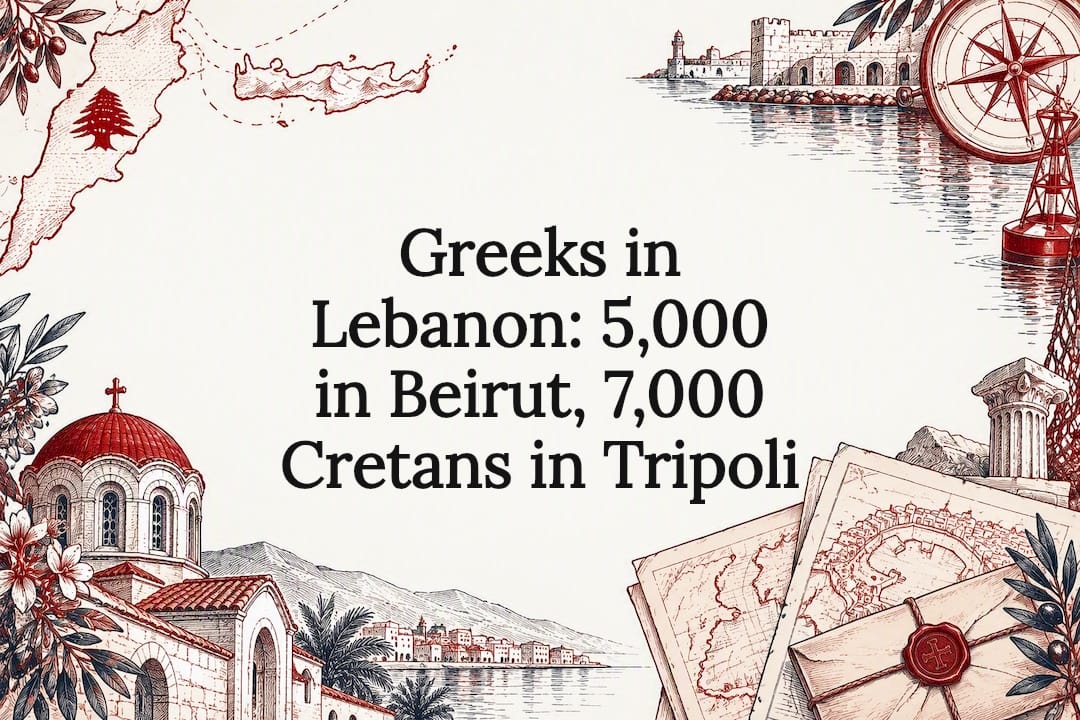
Greeks in Lebanon today make up two overlapping groups: a small ethnic Greek diaspora, most visibly a Cretan-speaking enclave in Tripoli’s El Mina district, and the far larger Lebanese Greek Orthodox community centered in Beirut. Community leadership puts the ethnic Greek population at roughly 5,000, sustained mainly by the Greek Community of Beirut, the Greek Orthodox Archdiocese, and a handful of institutions still standing after the 2020 port blast.
TL;DR:
- The ethnic Greek population in Lebanon is around 5,000, with most living in Beirut, while the Cretan-speaking enclave in Tripoli has about 7,000 members and remains linguistically distinct.
- The community’s older demographic and emigration trends mean fewer Greek-speaking children and weakened language transmission, especially outside Beirut.
- The Cretan enclave in El Mina relies on a social association and lacks a dedicated Greek-language school, leading to language attrition among youth.
- Greek religious institutions, especially the Greek Orthodox Archdiocese and Saint George Cathedral, are central to maintaining Greek identity more than ethnicity alone.
- Beirut’s 2020 port explosion and economic collapse have damaged community infrastructure and accelerated emigration, threatening long-term community continuity.
Table of Contents
- The History of Greeks in Lebanon, From Antiquity to the 1900s
- Greeks in Lebanon: Population Numbers and Where They Live
- Inside the Cretan-Speaking Enclave of Tripoli and El Mina
- Greek Orthodox Institutions Keeping Identity Alive
- How the Beirut Blast and Emigration Tested the Community
- What Hellenism Watch Tracks in Lebanon’s Greek Community
- Notable Greeks and Greek-Descended Figures in Lebanese Life
- How Greeks and Other Lebanese Communities Get Along
- The Trades and Professions Greeks Built in Lebanon
- Greek Traces in Lebanese Food, Festivals, and Buildings
- How Lebanon’s Political Turmoil Shapes the Greek Community
- Why This Small Community Deserves Careful Documentation
- Where to Find Hellenism Watch’s Research and Get Involved
- Sources
- FAQ
The History of Greeks in Lebanon, From Antiquity to the 1900s
Greek presence in the eastern Mediterranean did not start with a migration wave. It started with Alexander’s armies and lasted through Byzantine rule, when Greek was the language of the church, the courts, and much of the coast. That inheritance is why Antiochian Orthodox liturgy still carries Greek vocabulary and why Beirut’s oldest Orthodox families trace cultural, not necessarily ethnic, lines back to that era.
The modern ethnic Greek presence is younger and more specific. Three moments shaped it:
- 1866 to 1897: Cretan families fled repeated uprisings and Ottoman reprisals on Crete, settling in the port district of El Mina near Tripoli, where fishing and trade offered familiar work.
- After 1922: The Asia Minor catastrophe pushed Greek-speaking refugees from the Anatolian coast into Beirut, where they founded the Greek Club and early community schools.
- Mid-20th century: Consolidation under formal associations gave the scattered arrivals a shared civic identity, distinct from the Greek Orthodox Lebanese majority around them.
The Cretan migrants and the Asia Minor refugees never fully merged into one community. They settled in different cities, spoke different registers of Greek, and built separate institutions. That split still defines how the community is mapped today.
Greeks in Lebanon: Population Numbers and Where They Live
Community leadership cites a figure of about 5,000 ethnic Greeks living in Lebanon today, with roughly 85% concentrated in Beirut, according to Panagiotis Andriotis, president of the Greek Community of Beirut. That figure sits alongside the separate Cretan-origin enclave in Tripoli and El Mina, estimated at around 7,000 people by ethnographic sources, a group counted apart from the Beirut-centered ethnic Greek population because its identity and institutions developed independently.
A few patterns stand out:
- Beirut holds the institutional core: the cathedral, the community’s cultural center, and most language programming.
- Tripoli and El Mina hold the linguistic core: the Cretan dialect survives there in ways it does not in the capital.
- Both populations skew older. Younger members increasingly move to Greece, Cyprus, or the Gulf for work, leaving fewer households actively raising Greek-speaking children.
- Passive bilingualism is common among the young. They understand more Greek than they speak, a pattern documented in fieldwork on the region’s Greek-speaking enclaves.
No census tracks ethnic Greeks separately from Lebanon’s broader Orthodox population, so every number here is a community or academic estimate, not a state statistic.
Inside the Cretan-Speaking Enclave of Tripoli and El Mina
This is the most distinct Greek-speaking group in Lebanon, and the one most likely to surprise readers who assume “Greek in Lebanon” means Beirut’s Orthodox elite.
- Origins: Families arrived between 1866 and 1897, fleeing unrest tied to Crete’s struggle against Ottoman control, and settled in El Mina because its harbor resembled the villages they left.
- Language: The community still speaks a Cretan dialect at home, alongside Arabic and, for the educated, French or English. Fieldwork on the enclave describes genuine bilingual fluency in older generations and weaker Greek retention among the young.
- Social structure: The group was historically endogamous, marrying within the community to preserve language and custom, though that pattern has loosened over recent decades as intermarriage with Lebanese neighbors became more common.
- Civic life: The Cretan Social and Benevolent Association, founded in Tripoli in 1996, anchors community events and mutual aid, filling a role that a formal school system never fully covered.
- Schooling gap: Academic accounts of the enclave note the community never sustained a dedicated Greek-language school the way Beirut did, which accelerated language attrition among children raised after the 1990s.
Greek Orthodox Institutions Keeping Identity Alive
Religious infrastructure is what has kept Greek identity organized in Lebanon, arguably more than ethnicity has. Lebanese Greek Orthodox Christians are a separate, much larger group from the ethnic Greek diaspora. They belong to the Antiochian Orthodox Church rather than the Church of Greece, yet Greek liturgical heritage runs through their worship, their cathedrals, and their theological training.
Key institutions include:
- Saint George Greek Orthodox Cathedral in downtown Beirut, one of the oldest active churches in the city and a landmark for the wider Orthodox community, not only ethnic Greeks.
- The Greek Orthodox Archdiocese of Beirut, which maintains diocesan structures with named metropolitans in both Beirut and Tripoli, giving the community formal points of institutional contact documented on the Antiochian Patriarchate’s own registry.
- The St. John of Damascus Institute of Theology at Balamand, which trains Orthodox clergy across the region and keeps Greek theological scholarship connected to Lebanon.
- The Greek Community of Beirut, which runs a cultural center, a language department, and annual festivals that double as outreach to the Greek embassy and visiting diaspora groups.
Around 85% of Lebanon’s roughly 5,000 ethnic Greeks live in Beirut, which is why the capital carries almost all the institutional weight, from the cathedral to the classroom.
How the Beirut Blast and Emigration Tested the Community
The 2020 Beirut port explosion did not spare the Greek community’s physical footprint. Blast damage hit the Greek Club and other gathering venues hard, and reporting from the period describes a community already thinned by emigration now losing the spaces where it gathered.
- The Greek Club, a social anchor for decades, suffered structural damage that disrupted regular programming.
- Filmmaker George Eid responded by documenting community memory on camera, a project covered by regional press as an attempt to preserve stories before they disappear with the oldest generation.
- A Greek festival in Byblos became a recovery gesture, drawing diaspora attendance and signaling that the community intended to keep gathering publicly.
- Economic collapse alongside the blast pushed more young Lebanese Greeks toward emigration, compounding a decline already underway.
Pro Tip: If you’re researching a specific family or parish record from this era, contact the Archdiocese directly rather than relying on secondhand accounts. Beirut’s institutional records survived the blast better than the physical venues did.
What Hellenism Watch Tracks in Lebanon’s Greek Community
Some independent organizations track communities like this one, providing sustained, nonpartisan attention even outside crisis periods and treating Lebanon’s Greek population as a live case study in diaspora fragility, not a historical footnote.
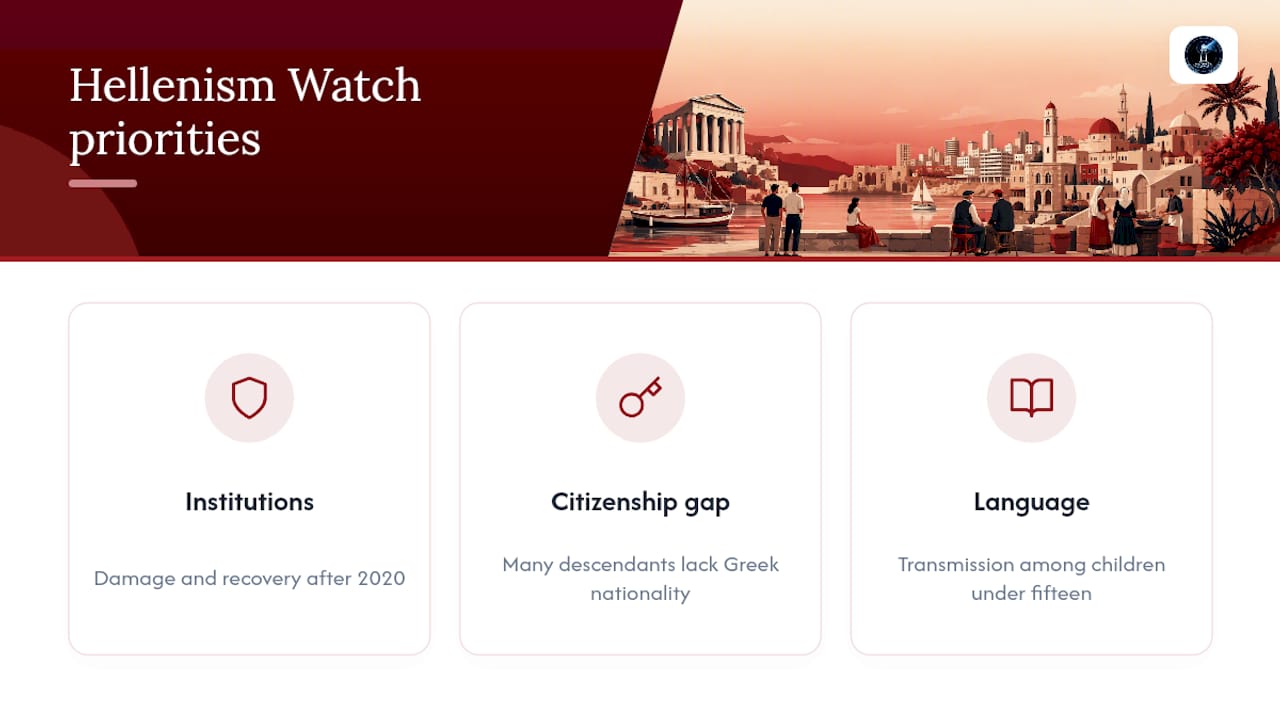
Three monitoring priorities matter most here: institutional damage and recovery after 2020, the citizenship gap that leaves many ethnic Greek descendants without formal Greek nationality, and language transmission rates among children under fifteen. Each of those data points shifts fast and rarely gets documented consistently.
Scholars, clergy, and community members with verifiable records, parish archives, enrollment figures, migration data, are sometimes invited to contribute to open fellowship structures, crediting contributors by name and discipline.
Notable Greeks and Greek-Descended Figures in Lebanese Life
Individuals of Greek or Greek Orthodox heritage have shaped Lebanese public life well beyond the community’s small numbers. Much of this influence runs through the Greek Orthodox confessional structure rather than ethnic Greek ancestry specifically, a distinction worth holding onto given how often the two get conflated.
Lebanon’s Greek Orthodox community has produced generations of merchants, physicians, and civil servants whose family names remain fixtures in Beirut’s professional class. Political representation for Greek Orthodox Christians is written into Lebanon’s confessional power-sharing system, which reserves parliamentary seats for the sect, giving it formal influence disproportionate to raw population size.
Within the smaller ethnic Greek diaspora itself, community leadership figures carry outsized weight simply because the population is so compact. Panagiotis Andriotis, president of the Greek Community of Beirut, functions as both cultural custodian and informal diplomat, coordinating with the Greek embassy, church leadership, and Lebanese officials to keep programming alive through repeated national crises.
Clergy trained at the St. John of Damascus Institute of Theology at Balamand have gone on to serve parishes across the Levant and abroad, extending Lebanese Greek Orthodox influence well past the country’s borders. That academic pipeline matters more to the community’s long-term visibility than any single celebrity name would, because it produces institutional continuity rather than one-off recognition.
How Greeks and Other Lebanese Communities Get Along
Lebanon’s confessional system means every religious and ethnic group operates inside a framework built for coexistence, sometimes uneasy, sometimes genuinely warm. Greek Orthodox Christians have generally maintained cordial relations with Maronite, Sunni, Shia, and Druze neighbors, partly because the sect has stayed politically moderate rather than aligning aggressively with any single bloc during Lebanon’s recurring conflicts.
Community leadership treats nonpartisanship as a survival strategy, not just a preference. Andriotis has described staying above factional politics as essential to keeping Greek cultural programming running through Lebanon’s instability, a stance that lets the community maintain working relationships across sectarian lines other groups sometimes cannot cross.
The smaller Cretan-speaking enclave in Tripoli tells a similar story on a local scale. Decades of coexistence with Sunni Muslim neighbors in El Mina produced everyday bilingualism and shared commercial life, even as the community kept its own language and church separate. Intermarriage between the Cretan community and surrounding Lebanese families has increased in recent decades, a shift that has both diluted linguistic isolation and deepened social integration at the same time.
Tension, where it exists, tends to trace back to Lebanon’s broader instability rather than any specific friction with Greek residents. Economic collapse, the 2020 blast, and repeated political paralysis have strained every community’s resources, and Greeks in Lebanon have felt those pressures as Lebanese citizens first, ethnic minority second.
The Trades and Professions Greeks Built in Lebanon
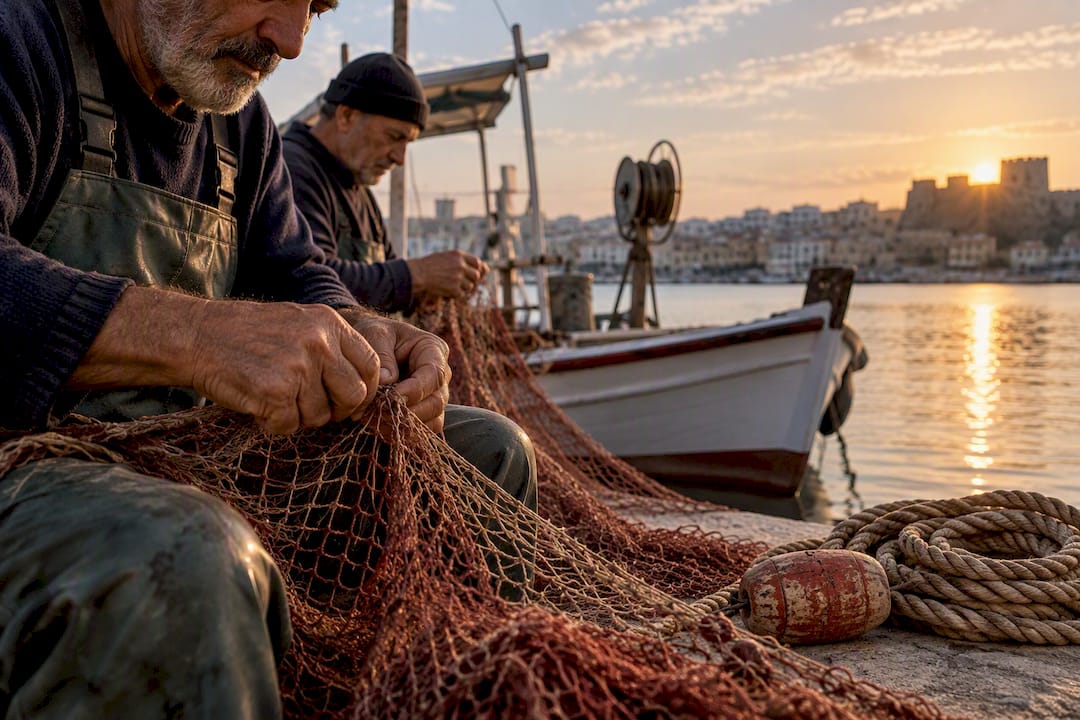
Greek migrants who arrived in the late 19th and early 20th centuries gravitated toward work tied to the sea and to trade networks connecting Lebanon with the wider Mediterranean. In El Mina, Cretan families built livelihoods around fishing and small-scale maritime commerce, work that matched the skills they brought from Crete’s coastal villages and gave the enclave an early economic identity separate from Tripoli’s Lebanese majority.
Beirut’s Asia Minor refugee arrivals after 1922 moved into different lanes entirely. Many built businesses in textiles, import trade, and skilled crafts, professions that let newcomers establish themselves quickly in a port city already organized around Mediterranean commerce. Greek merchants became familiar names in Beirut’s downtown trading district for decades, their shops operating alongside Armenian, Lebanese, and Syrian-owned businesses in the same commercial quarter.
The broader Lebanese Greek Orthodox population followed a different economic trajectory, shaped less by recent migration and more by generations of embedded presence in Lebanon’s professional class. Physicians, lawyers, bankers, and civil servants from Greek Orthodox families became disproportionately represented in Beirut’s educated elite, a pattern reinforced by the community’s historical access to French and American mission schools during the mandate era.
Today, the ethnic Greek population’s economic footprint has narrowed considerably. Emigration has pulled younger workers toward Greece, Cyprus, and Gulf states offering more stable currencies and job markets, leaving the remaining community skewed toward small business, church-affiliated employment, and retirement-age professionals who chose to stay.
Greek Traces in Lebanese Food, Festivals, and Buildings
Greek cultural influence on Lebanon runs deeper than the small ethnic population would suggest, largely because Byzantine and Orthodox heritage shaped the eastern Mediterranean long before modern Greek migration began. Shared dishes are the clearest everyday evidence: preparations built around olive oil, phyllo pastry, and grilled meats appear on both Greek and Lebanese tables, a culinary overlap rooted in centuries of Levantine and Aegean trade rather than any single migration wave.
Architecturally, Beirut’s Orthodox churches, including Saint George Cathedral, carry Byzantine design elements, domed forms, iconostasis screens, and mosaic traditions, that trace directly back to Greek ecclesiastical building practice. These structures predate the modern Greek community by centuries but remain the most visible physical link between Greek Orthodox tradition and Lebanese civic architecture.
Festivals offer the most active, ongoing exchange. The Greek Community of Beirut’s annual cultural events and the Byblos Greek festival draw mixed Lebanese and Greek attendance, blending Greek music and dance with Lebanese hospitality customs. These gatherings function as much as community fundraising and morale efforts as they do cultural showcases, particularly in years following the 2020 blast when public gathering itself carried symbolic weight.
Language has left smaller but persistent marks too. Greek liturgical vocabulary embedded in Orthodox worship has seeped into everyday religious Arabic among Lebanon’s Orthodox population, a linguistic residue of the Byzantine centuries that outlasted the empire itself.
How Lebanon’s Political Turmoil Shapes the Greek Community
Regional political upheaval has hit Lebanon’s ethnic Greek community harder than its size would suggest, precisely because the group has so little institutional buffer against national-level shocks. Lebanon’s currency collapse beginning in 2019, compounded by the 2020 port explosion, pushed the community’s economic base and its social infrastructure into crisis simultaneously.
Citizenship status compounds the vulnerability. Many ethnic Greek descendants in Lebanon lack formal Greek citizenship, which limits their options for relocation or formal diaspora support even as conditions in Lebanon deteriorate. That mismatch between cultural identity and legal nationality leaves families culturally Greek but administratively without a fallback.
Regional instability beyond Lebanon’s borders adds another layer. Visa restrictions and shifting embassy policy have at times constrained travel and direct contact with Greece and Crete, according to fieldwork on the community, weakening the informal ties, family visits, remittances, satellite media, that once kept the diaspora connected to its origin points.
Every political disruption in Lebanon accelerates the same underlying trend: younger community members leaving for Greece, Cyprus, or the Gulf, and the population left behind skewing older with each passing crisis. Community leadership’s insistence on nonpartisan positioning is, in this light, less a philosophical choice than a practical necessity for staying functional through cycles of instability no single group can control.
Why This Small Community Deserves Careful Documentation
Small diaspora communities disappear quietly. No dramatic event marks the moment a language stops passing to children or a parish register goes uncatalogued, which is exactly why nonpartisan documentation work matters more here than in communities backed by state resources or large populations.
What would help most now: recorded oral histories from the Cretan enclave’s oldest speakers, sustained support for Greek-language instruction in Beirut and Tripoli, and closer coordination with Archdiocese records before institutional memory fades further. Readers with family ties, academic access, or community connections can contribute meaningfully by documenting what they know before it’s lost.
— Alexios
Where to Find Hellenism Watch’s Research and Get Involved
Some independent alternatives to scattered, one-off reporting on diaspora communities maintain ongoing, evidence-backed dossiers that scholars and community members can add to over time.
There are websites that publish free assessments on Hellenism across the Balkans and Eastern Mediterranean, discussing institutional pressures, citizenship gaps, and language transmission challenges facing communities like the Greeks of Lebanon. These assessments aim to use credible sources and avoid government or party funding to remain unbiased and useful for academics, policymakers, and diaspora members.
Open fellowships sometimes invite contributions from scholars and community researchers worldwide, with credit given by name and discipline, when verifiable records, parish archives, migration data, or enrollment figures are available. Visit the Hellenism Watch homepage to read current publications or submit documentation toward the next update on Lebanon’s Greek community.
Sources
- Greeks in Lebanon — Wikipedia
- Spotlight on the President of the Greek Community of Beirut — The National Herald
- Greeks in Lebanon devastated after Beirut apocalypse — Greek Reporter
- Greek-speaking enclaves in Lebanon and Syria — Tsokalidou
- Tripoli, Al-Koura, and Dependencies — Antiochian Orthodox Archdiocese
FAQ
Are There Greek Orthodox Christians in Lebanon?
Yes, and they form a much larger group than the ethnic Greek diaspora. Lebanese Greek Orthodox Christians belong to the Antiochian Orthodox Church and hold reserved seats in Lebanon’s parliament, with institutional life centered around the Greek Orthodox Archdiocese and Saint George Cathedral in Beirut.
Do Lebanese People and Greeks Get Along?
Generally, yes, and the Greek community’s leadership treats nonpartisanship as central to keeping cultural life running through Lebanon’s instability. Relations with Sunni, Maronite, Shia, and Druze neighbors have stayed largely cordial, with tension typically tracing back to national-level crises rather than friction specific to Greek residents.
Who Are Greeks Genetically Closest To?
Population genetics is outside what this article’s sources address directly, and any specific genetic-distance claim would need dedicated population-genetics research rather than community or historical sources. What the record does show clearly is centuries of Greek, Levantine, and Byzantine population overlap across the eastern Mediterranean, which is the cultural and historical link discussed throughout this piece.
How Many Greeks Live in Lebanon Today?
Community leadership estimates roughly 5,000 ethnic Greeks in Lebanon, with about 85% in Beirut. A separate Cretan-origin enclave in Tripoli and El Mina numbers around 7,000 and is counted apart from the Beirut-based community.
Does Hellenism Watch Cover Communities Outside Lebanon?
Yes. Hellenismwatch monitors Hellenism across the Balkans and Eastern Mediterranean broadly, not just Lebanon, publishing free research and inviting scholarly contributions through its open fellowship program.