
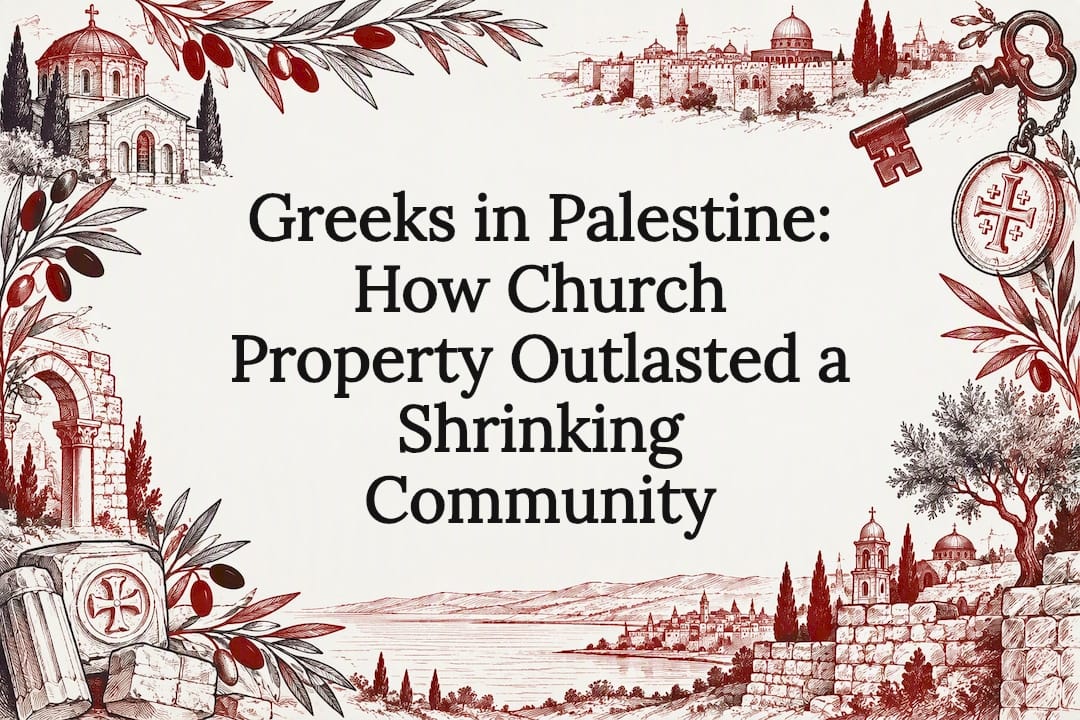
Greeks in Palestine are a historically rooted community whose visible presence today centers on ecclesiastical institutions, above all the Greek Orthodox Patriarchate of Jerusalem, while the resident Greek-speaking population has shrunk since the early twentieth century. The Patriarchate’s jurisdiction still reaches across Israel, the Palestinian Territories, and Jordan, even as local households dwindle.
TL;DR:
- The Patriarchate serves an estimated 200,000 to 500,000 Orthodox Christians across Israel, the Palestinian Territories, and Jordan, most of them Arab rather than ethnic Greek.
- Its Brotherhood of the Holy Sepulchre has 120 monks, traditionally almost all Greek, and elects the Patriarch while controlling assets and holy site rights.
- Monastic services are typically conducted in Greek, while parish worship is generally in Arabic, reflecting Greek monastic leadership over predominantly Arab congregations.
- The Arab Orthodox movement seeks local representation and fairer control of church property, while disputes over land deals and clergy appointments keep reform tensions alive.
- Jerusalem’s Greek residential community has fallen from thousands to a small fraction, with community leaders citing displacement, economic pressure, and emigration.
Table of Contents
- Historical Origins: From Hellenistic Conquest to Byzantine Consolidation
- Ottoman Rule and Twentieth-Century Community Life
- The Greek Orthodox Patriarchate: Hierarchy, Brotherhood, and Property
- Language, Liturgy, and Who Counts as Greek
- Contemporary Presence: Decline and What Remains
- Arab Orthodox Movement and Church Leadership Tensions
- Hellenism Watch Analysis: Clarity Through Independent Monitoring
- Why This History Deserves Careful Documentation
- Where to Find Our Research and Fellows Program
- FAQ
- Sources
Historical Origins: From Hellenistic Conquest to Byzantine Consolidation
Greek presence in the region began with Alexander the Great’s conquests in the fourth century BCE, which brought coastal cities into a wider Hellenistic world of civic councils, gymnasiums, and Greek-style urban planning. Cities like Gaza, Ashkelon, and later the Decapolis became outposts of Hellenistic culture, blending local populations with Greek settlers and administrators.
Attic koiné, the common Greek dialect that spread after Alexander’s campaigns, became the language of administration, trade, and inscriptions throughout the eastern Mediterranean. Local elites in Palestine adopted it for public life even while Aramaic and Hebrew remained the languages of daily speech and religious practice among Jewish communities.
The Byzantine period deepened this institutional footprint. As Christianity became the empire’s official religion, monasteries, episcopal sees, and pilgrimage infrastructure multiplied across Jerusalem, Bethlehem, and the Judean desert. This Byzantine-era network of bishoprics and monastic houses laid the organizational groundwork for what would become the Greek Orthodox Patriarchate of Jerusalem, an institution that has preserved elements of that late antique structure into the present day.
Ottoman Rule and Twentieth-Century Community Life
Under Ottoman administration, Orthodox Christians were organized through the millet-i-rum system, which granted religious communities a degree of legal and administrative autonomy, including control over property, marriage, and internal governance. This framework reinforced the Patriarchate’s authority over Orthodox affairs and allowed it to accumulate significant landholdings across the region.
By the late Ottoman and British Mandate periods, a distinct Greek civic presence had taken shape in Jerusalem. The Greek Colony neighborhood, now part of the Katamon and Baqa areas, housed Greek merchants, clergy-linked families, and consular staff. Greek clubs, schools, and social associations supported a community life that extended beyond church walls into commerce and education.
The 1922 Palestine census recorded Greek speakers by locality, including Jerusalem, Jaffa, Haifa, and Bethlehem, offering one of the earliest reliable snapshots of the community’s distribution. The upheavals of 1948 and 1967, which displaced and reshaped populations across the region, further altered where and how many Greek-identified residents remained in Palestinian and Israeli localities.
The Greek Orthodox Patriarchate: Hierarchy, Brotherhood, and Property
The Greek Orthodox Patriarchate of Jerusalem stands as the central institutional expression of Greek presence in the region. Its jurisdiction extends over an estimated 200,000 to 500,000 Orthodox Christians across Israel, the Palestinian Territories, and Jordan, the large majority of them Palestinian and Jordanian Arabs rather than ethnic Greeks, according to CNEWA’s institutional overview.
Senior governance within the Patriarchate rests with the Brotherhood of the Holy Sepulchre, a monastic order traditionally composed almost entirely of ethnic Greeks and numbering about 120 monks. This Brotherhood elects the Patriarch and controls the church’s most significant assets, including custodial rights over sites such as the Church of the Holy Sepulchre.
Those custodial rights trace back to property titles and privileges established under Ottoman rule, which the Patriarchate has defended through centuries of political change. This history of landholding shapes contemporary diplomacy as well. In June 2026, Greece’s education minister met with Patriarch Theophilos III to discuss cooperation on the Patriarchate’s schools and theological institutions, a sign of Greece’s continued diplomatic interest in protecting this ecclesiastical heritage. The Patriarchate’s custodial role over holy sites remains a recurring factor in regional religious politics.
Language, Liturgy, and Who Counts as Greek
Greekness in this context is not a single identity but a layered one. Monastic liturgy within the Patriarchate is typically celebrated in Greek, preserving the Brotherhood’s linguistic and cultural character, while most parish liturgies serving local congregations are conducted in Arabic. This split reflects the underlying demographic reality: a Greek-speaking monastic hierarchy overseeing a predominantly Arabic-speaking laity, most of whom are served by local married priests rather than Greek monks.
A separate thread involves Romaniote and other Greek-Jewish communities, whose migration histories connect Greek-speaking Jewish populations to broader patterns of movement across the eastern Mediterranean into Palestine and later Israel. Their cultural legacy, including distinct liturgical traditions, adds another dimension to the region’s Greek-linked heritage, separate from the Orthodox Christian institutional story.
Readers interested in the material culture tied to this heritage, including iconography connected to saints venerated across these Christian communities, can find museum-grade prints through Saint Cyril of Jerusalem art, which depicts figures central to the region’s Orthodox tradition.
Contemporary Presence: Decline and What Remains
Journalistic coverage over the past decade has documented a marked shrinkage of the Greek residential community in Jerusalem specifically, with reporting describing a population that once numbered in the thousands now reduced to a small fraction of that figure. Community leaders interviewed in this coverage point to conflict-related displacement, economic pressures, and steady emigration as the primary drivers.
Despite this decline, institutional and cultural markers persist. The Greek Colony’s communal spaces, including the Greek Club, have functioned as gathering points even as membership thins, and disputes over who holds the keys to such spaces have become symbolic of the community’s fragile continuity. Liturgical preservation within the Patriarchate and periodic cultural festivals keep a visible Greek thread alive even where household numbers have fallen sharply.
Arab Orthodox Movement and Church Leadership Tensions
The Arab Orthodox movement emerged in the nineteenth century as Arabic-speaking congregants began pressing for greater representation within a hierarchy dominated by Greek monastics. Its core demands, as described in overviews of the movement, include nationalizing church leadership, more equitable management of property and revenues, and a stronger voice for local Orthodox communities in institutional decisions.
These tensions continue to shape parish life today, surfacing periodically in disputes over land deals, clergy appointments, and the pace of reform within a structure that has remained largely unchanged for centuries.
Hellenism Watch Analysis: Clarity Through Independent Monitoring
There are organizations that monitor the state of Hellenism across the Balkans and Eastern Mediterranean. Their work includes collecting institutional records, diplomatic statements, and oral histories to document how church governance, property disputes, and demographic trends evolve over time without governmental or party influence. Published claims are supported by credible sources, allowing researchers and diaspora communities to track institutional continuity rather than relying on impressions.
Why This History Deserves Careful Documentation
Institutional continuity, measured in schools, clubs, and ecclesiastical governance, tells us more about Hellenism’s durability than population counts alone. We see oral histories and archival records as urgent to preserve, and we welcome scholars who want to contribute that work.
— Alexios
Where to Find Our Research and Fellows Program
We publish our research on the Greek diaspora free of charge and welcome contributions through an open fellows program. Visit our landing page for publications, or explore the fellows program to collaborate with us.
FAQ
Do the Greeks support Palestine?
Greek government policy has historically focused on supporting the Greek Orthodox Patriarchate of Jerusalem and its institutions rather than taking a broad political stance on the Palestinian cause. The June 2026 ministerial meeting centered on protecting Orthodox Christian presence and educational institutions in the region.
What did the Jews think of the Greeks?
Historical relations between Jewish communities and Greek culture in the ancient Levant were complex, ranging from cultural exchange under Hellenistic rule to resistance against forced Hellenization, as seen in events like the Maccabean revolt. In later periods, Romaniote and other Greek-Jewish communities maintained distinct cultural ties connecting Greek and Jewish heritage.
Is Greece an Israeli ally?
Greece maintains diplomatic relations with Israel alongside its longstanding institutional ties to the Greek Orthodox Patriarchate of Jerusalem, which operates across Israeli, Palestinian, and Jordanian jurisdiction. These relationships are distinct: one is state-to-state diplomacy, and the other centers on ecclesiastical heritage and education, as reflected in recent ministerial engagement with the Patriarchate.
How many Greeks live in Israel?
Precise figures for ethnic Greeks residing in Israel are not consistently published, though the Greek Orthodox Patriarchate’s jurisdiction covers an estimated 200,000 to 500,000 Orthodox Christians across Israel, the Palestinian Territories, and Jordan, most of them Arab rather than Greek. The ethnically Greek population, concentrated mainly within the Patriarchate’s Brotherhood of the Holy Sepulchre, numbers around 120 monks.
What is the Greek presence in Palestine today?
The Greek presence in Palestine today is primarily institutional, centered on the Greek Orthodox Patriarchate of Jerusalem and its Brotherhood of the Holy Sepulchre, rather than a large resident population. Local Greek-speaking communities, once concentrated in areas like Jerusalem’s Greek Colony, have declined substantially since the early twentieth century due to displacement and emigration.
Sources
- The Patriarchate of Jerusalem — CNEWA
- Ministry of Culture / Greek government statement (June 8, 2026)
- Archive