
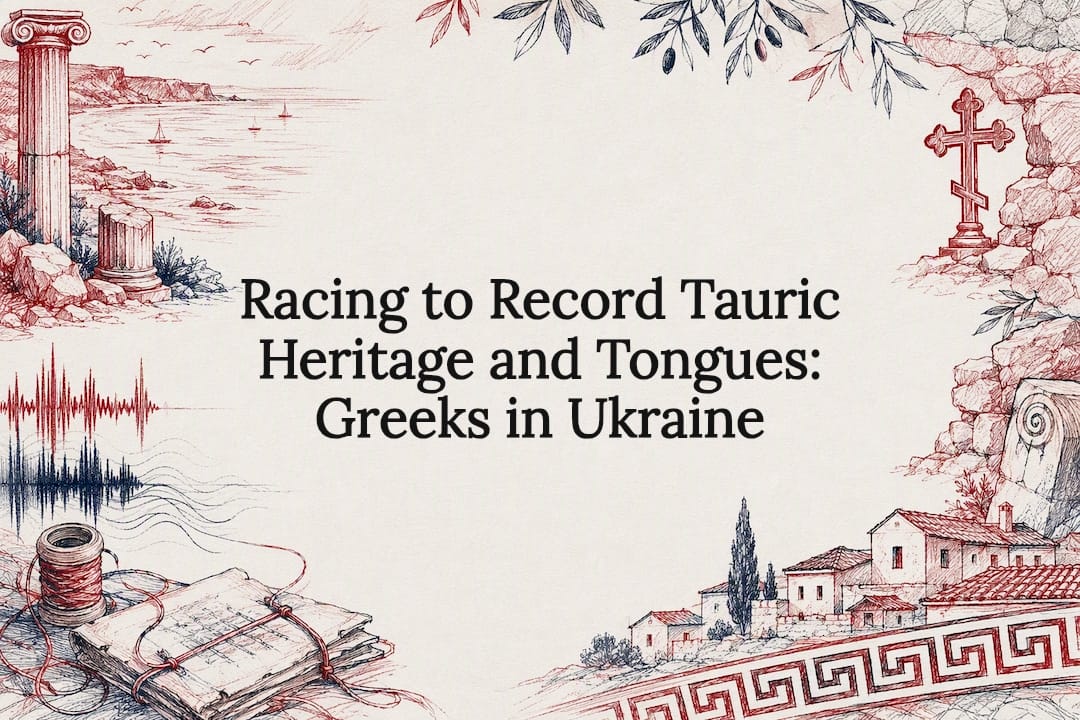
Greeks in Ukraine today number in the tens of thousands, concentrated in Donetsk Oblast around Mariupol, according to the 2001 census, which counted 91,548 ethnic Greeks nationwide, though later displacement means the real figure is now unclear. Most speak Russian as a native language, while a shrinking number still use the community’s own Roumean or Urum tongues. War since 2014, and especially since 2022, has turned a slow demographic decline into an active crisis of displacement and cultural erasure.
TL;DR:
- The Greek community in Ukraine is heavily concentrated in Donetsk Oblast around Mariupol, with 84.6% of the 2001 census population living there, but displacement since 2014 has drastically altered this distribution.
- Over 80% of ethnic Greeks in Ukraine speak Russian as their native language, reflecting a century of Russification pressure, with only 6.4% still speaking Greek languages in 2001.
- War since 2014, especially after the 2022 invasion, has caused severe displacement, cultural site damage, and the loss of community institutions, accelerating language and cultural decline.
- Documentation efforts like audio recordings, standardization projects, and diaspora support are crucial to preserving Roumean and Urum languages amid accelerated displacement and aging communities.
- Significant archaeological heritage like Tauric Chersonese remains at risk due to conflict and occupation, with digital archiving and diaspora engagement becoming vital for cultural preservation.
Table of Contents
- From ancient colonies to modern resettlement: how today’s communities formed
- Population numbers, census caveats and where Greek communities live
- Roumean and Urum: languages, faith and daily traditions
- Ancient heritage under threat: Tauric Chersonese and other sites
- Federations, societies and schools sustaining Greek identity
- Documented wartime impacts since 2014 and the 2022 invasion
- Preserving what remains: documentation, standardization and advocacy
- Cultural contributions that outlasted displacement
- Why this community’s survival depends on independent documentation
- Where to find research and how to get involved
- Sources
- FAQ
From ancient colonies to modern resettlement: how today’s communities formed
The Greek presence on the northern shore of the Black Sea did not begin with a single migration. It built up over roughly 2,500 years through waves of colonization, conquest and forced relocation, each leaving a layer still visible in the community today.
Greek city-states began settling the region in antiquity, founding trading colonies along the coasts of what is now southern Ukraine and Crimea. These poleis, including Tauric Chersonese near modern Sevastopol, connected the Black Sea grain trade to the wider Greek and later Roman world. Greek populations in Crimea persisted through the Byzantine period, absorbing Gothic, Slavic and Tatar influences while maintaining Orthodox Christianity and elements of Greek language, a continuity documented in historical overviews of Greek settlement in the region.
The decisive break came in 1778, when Catherine II ordered the forced resettlement of Christian Greeks and other groups out of Crimea, then under threat from the collapsing Crimean Khanate. Tens of thousands were marched north to the Azov Sea coast, where they founded Mariupol and a ring of surrounding villages that would remain the community’s heartland for the next two centuries. This single event explains why Mariupol, not Crimea, became the historic and administrative center of Ukrainian Hellenism.
Later centuries added smaller but significant layers to the population:
- Nineteenth-century Pontic Greek migrants arrived from northeastern Anatolia, drawn by Black Sea trade and, later, fleeing instability in the Ottoman Empire.
- Refugees from the Greek Civil War of the late 1940s settled in parts of Soviet Ukraine after being resettled or exiled from Greece.
- Soviet-era industrialization drew Greek families into Donetsk Oblast’s mining and steel towns, embedding the community in the region’s economic base.
- Post-Soviet emigration to Greece in the 1990s thinned some village populations even before the current wars began.
By the early twenty-first century, this layered history had produced a community split between two distinct linguistic groups descended from the 1778 resettlement, a scattering of Pontic-descended families, and a majority who had shifted to Russian as an everyday language while retaining Greek identity through religion, surname and memory.
Population numbers, census caveats and where Greek communities live
The 2001 census remains the standard demographic baseline for Ukraine’s Greek minority, and its figures are more revealing in their language data than in the headline population count.
91,548 ethnic Greeks were recorded in the 2001 census, representing 0.2% of Ukraine’s total population. That number should be read as a floor rather than a precise count: no comparable national census has been conducted since, and two decades of emigration, aging populations and now war have almost certainly changed it, though no updated official figure exists.
The language data from that same census is arguably more important than the population total. Of the 91,548 people identifying as ethnically Greek, 88.5% reported Russian as their native language, while only 6.4% reported the language of their own nationality, meaning Greek in its various forms, as native. That gap, more than 80 percentage points, captures a century of Russification pressure inside a community that had already lost fluency in Modern Greek generations earlier.
Geographically, the population is heavily concentrated in one region:
- Donetsk Oblast held 84.6% of Ukraine’s ethnic Greek population as of the 2001 census, centered on Mariupol and its surrounding villages.
- Smaller historic communities existed in Odesa and Zaporizhzhia oblasts, tied to earlier trade and settlement patterns.
- A residual Greek presence remained in Crimea even after the 1778 deportations, though far smaller than the Donetsk cluster.
- Since 2014, and sharply since 2022, this geography has been scrambled by occupation and flight, with residents of Greek villages joining the broader flow of Ukraine’s internally displaced people and refugees.
The practical result is that any current population estimate has to be treated as provisional. A community that was already concentrated in a single conflict zone before 2014 has spent the past decade being pushed out of that same zone.
Roumean and Urum: languages, faith and daily traditions
What sets Ukraine’s Greek minority apart from other diaspora communities is that it is not linguistically Greek in the modern sense at all. The population descended from the 1778 Crimean resettlement split, generations ago, into two separate language groups that share ancestry but not grammar.
Roumean, sometimes called Rumeic, descends from Medieval Greek and is close in structure to dialects once spoken in the Pontic region. Urum, by contrast, is a Turkic language, absorbed by Greek Orthodox communities during centuries of contact with Tatar and Ottoman populations in Crimea, and it carries heavy Greek lexical influence despite its grammatical roots. Both languages were historically confined to oral transmission within villages rather than written or formally taught, which left them vulnerable the moment village life was disrupted.
Orthodox Christianity anchors community identity across both language groups. Local parishes, often the only remaining Greek-language religious spaces in the region, function as much as cultural centers as places of worship, particularly where language schools have closed.
Cultural life outside the church includes a set of recognizable practices:
- The haitarma, a fast circle dance shared with Crimean Tatar tradition, remains a fixture of weddings and festivals in Greek villages.
- Kourés, communal wrestling contests tied to seasonal festivals, survive in some Mariupol-area villages as a marker of local identity.
- Distinct Greek-Ukrainian cuisine blends Black Sea, Tatar and Slavic influences in dishes rarely found outside the Donetsk region.
- Community newspapers and local cultural societies had, before the war, begun recording festivals and oral traditions for archival purposes.
Pro Tip: If you want to hear Roumean or Urum spoken naturally rather than reconstructed from textbooks, look for community audio archive projects rather than academic transliterations, since oral recordings capture pronunciation and idiom that written grammars miss.
Intergenerational transmission was already fragile before the war, since most fluent speakers were elderly and most younger community members had shifted to Russian or Ukrainian in daily life. Displacement since 2022 has removed many of those elderly speakers from the villages where the languages were still spoken, accelerating a decline that revival projects are now racing to document.
Ancient heritage under threat: Tauric Chersonese and other sites
Ukraine’s Greek history is not only a story of the 1778 resettlement. It also includes some of the most significant Greek archaeological remains outside Greece itself, chief among them Tauric Chersonese.
Tauric Chersonese and its chora cover 42.8 hectares with a 207.2 hectare buffer zone, and the site was inscribed by UNESCO in 2013 for its testimony to exchange between Greek, Roman and Byzantine civilizations. The property includes both the urban core of the ancient city near Sevastopol and its surrounding chora, the divided agricultural plots that supported the polis, a rare combination that lets archaeologists study both city and countryside from the same ancient settlement.
Chersonese was not alone. Other notable colonies shaped the region’s ancient economy and culture:
- Olbia, on the Southern Buh estuary, was a major trading hub linking Greek city-states to Scythian territory.
- Feodosia, known in antiquity as Theodosia, served as a Black Sea port with continuous settlement from the Greek period onward.
- Kerkinitis, near modern Yevpatoria, was a smaller colony that illustrates the density of Greek settlement along the Crimean coast.
The complication for Chersonese specifically is political rather than archaeological. UNESCO decision documents note that occupation and conflict have introduced new risks to heritage properties in the region since 2022, and legal protections under both Ukrainian law and UNESCO’s framework carry far less weight when a site sits under contested control. Advocacy groups increasingly argue that digital archiving and diaspora museum partnerships matter as much as formal listing when physical access is restricted.
Federations, societies and schools sustaining Greek identity
Before 2014, the community’s institutional backbone ran through a network of local societies loosely coordinated by a national federation, most of it centered on Mariupol.
The Federation of Greek Communities of Ukraine historically united dozens of local societies, coordinated language education, and organized cultural programming across Donetsk Oblast. After Russian-backed forces seized parts of the region in 2014, the Federation’s activities were sharply reduced, and after the full occupation of Mariupol in 2022 it relocated its headquarters to Kyiv, operating since then with a fraction of its former societies.
That institutional contraction shows up at every level:
- Village-level cultural societies that once ran festivals and language classes in the Mariupol area have largely stopped functioning where their home villages are occupied.
- University-level Greek studies programs, where they existed, lost access to community partners and student populations tied to Donetsk Oblast.
- Diaspora organizations in Greece have stepped in with educational support, evacuation assistance and cultural programming for displaced families.
- Physical infrastructure, including the Federation’s original Mariupol offices, was lost or rendered inaccessible after the city’s occupation.
The result is an organization still operating, but from exile, serving a population that is now scattered across Ukraine and beyond rather than concentrated in the villages it was built to serve.
Documented wartime impacts since 2014 and the 2022 invasion
The war’s effect on Ukraine’s Greek minority breaks into two phases, each of which hit the same geography from a different direction.
The first phase began in 2014, when Russian-backed separatist forces seized parts of Donetsk and Luhansk oblasts, cutting off some Greek villages from Ukrainian government control years before the wider invasion. The second and far more destructive phase began with Russia’s full-scale invasion in February 2022, which included the siege and eventual occupation of Mariupol itself, the historic center of Ukrainian Hellenism.
Community and reporting sources describe severe displacement and cultural loss among the North Azovian Greek population since 2022, including occupied villages and damaged or looted cultural sites, according to community accounts gathered by NV English. The siege of Mariupol alone displaced much of the city’s population, Greek and non-Greek alike, and cut off the community from its central administrative and cultural hub for the first time since the city’s founding in 1780.
Beyond displacement, activists and cultural workers report a specific pattern of institutional loss:
- Museum exhibits and archives documenting Greek village life in the Mariupol area were reportedly damaged or looted during the occupation.
- Ukrainian-language education, and by extension any minority-language programming that had existed alongside it, faces restrictions in occupied territory.
- Villages that once anchored Roumean and Urum speakers have been emptied or occupied, breaking the direct link between language and place that oral traditions depended on.
- Diaspora organizations in Greece and elsewhere have organized evacuation support and refugee assistance for displaced Greek-Ukrainian families, though the scale of need has outpaced most existing programs.
The deeper concern voiced by community advocates is not simply population loss but the loss of the physical villages where Roumean and Urum were spoken daily. Legal recognition of a minority language means little once the places where it was transmitted between generations no longer function as communities.
Preserving what remains: documentation, standardization and advocacy
Saving Roumean and Urum from extinction now depends less on legal status than on speed of documentation, since the community’s oldest fluent speakers are also its most displaced generation.
Concrete preservation work is already underway in several forms:
- Audio recording projects have begun capturing fluent Roumean and Urum speakers before further displacement or aging removes that generation entirely.
- Textbook and orthography projects aim to standardize written forms of languages that were historically oral only.
- Museum exhibits and diaspora-run festivals in Greece and elsewhere keep Mariupol-area traditions visible outside Ukraine.
- Community advocates argue that legal language protections under European minority frameworks matter less than replacing lost in-village schooling with diaspora-based education.
Pro Tip: Rapid documentation, audio, photo and digitized archives, should happen before standardization, since a recording of a fluent speaker preserves detail no textbook can reconstruct later.
This is precisely the gap that independent, systematic monitoring is meant to fill: turning scattered community reports and academic fieldwork into a documented evidentiary record that funders, researchers and advocacy groups can actually use. Without that kind of consolidation, individual preservation projects tend to stay isolated, duplicating effort rather than building toward a coordinated response.
Cultural contributions that outlasted displacement
Ukraine’s Greek minority has produced figures whose influence reaches far beyond Donetsk Oblast. Arkhip Kuindzhi, the nineteenth-century landscape painter born to a Greek family near Mariupol, remains one of the most significant artists to emerge from the community, and his work is still studied within Ukrainian art history.
Beyond individual figures, the community’s cultural output lives largely in collective form:
- Folk music ensembles from Mariupol-area villages recorded traditional Roumean and Urum songs before the war disrupted local performance groups.
- Literary translation projects have rendered small collections of Roumean oral poetry into Ukrainian and Greek for wider academic use.
- Local historians and cultural workers, largely uncredentialed but deeply embedded in village life, carried oral history and folklore forward for generations before formal archiving began.
Why this community’s survival depends on independent documentation
Ukraine’s Greek minority sits at the intersection of two things that rarely get studied together: classical archaeology and live wartime displacement. That combination is exactly why independent, evidence-based monitoring matters here more than in most diaspora contexts. Government bodies on either side of this conflict have obvious incentives to shape the narrative, and academic attention tends to arrive years after the damage is done.
Our priorities are straightforward: standardizing what little written material exists for Roumean and Urum, rescuing archives before they are lost to occupation or displacement, and supporting community-led education rather than top-down programs designed elsewhere. We invite scholars and diaspora contributors who work on this community to share data and analysis directly.
— Alexios
Where to find research and how to get involved
Independent research initiatives exist to do exactly the kind of consolidation this community needs: turning scattered reporting, census data and academic fieldwork into a documented record that researchers, journalists and advocacy groups can rely on.
What you will find on the site and how to engage with it:
- Reports and assessments on Hellenism across the Balkans and Eastern Mediterranean, including diaspora communities under active threat.
- Opportunities inviting scholars and researchers to contribute data, fieldwork or analysis on Greek diaspora issues.
- Publications documenting foreign influence networks, diaspora institutions and strategies for Greek representation.
- A commitment to independence from government or party influence, with claims supported by credible sources.
If you research, write about or work directly with Greek diaspora communities facing displacement or cultural loss, visit Hellenism Watch to read current reports or apply to contribute as a fellow.
Sources
- All-Ukrainian Population Census 2001 — Nationality results
- Ancient City of Tauric Chersonese and its Chora — UNESCO World Heritage Centre
- Federation of Greek Communities of Ukraine — FUEN member profile
FAQ
Do Ukrainians have Greek ancestry?
Some Ukrainians, particularly in Donetsk Oblast around Mariupol, descend from Greek communities resettled from Crimea in 1778 or from later Pontic and Greek Civil War migrations. These communities were officially recorded as ethnic Greeks in the 2001 census, though many had already shifted to Russian as a native language by then.
Do Greeks support Ukraine?
Greece has provided diplomatic and humanitarian support to Ukraine since 2022, and diaspora organizations in Greece have specifically organized evacuation and cultural support for displaced Greek-Ukrainian families. Public opinion and government positions on the broader conflict vary and are not tracked in this article’s sources.
Which country has the biggest Greek diaspora?
Historic Greek diaspora populations are commonly associated with the United States, Australia and countries across the Balkans and Eastern Mediterranean, though comprehensive comparative population figures are not covered by the sources used here. Ukraine’s Greek community, numbering 91,548 in the 2001 census, is one of several historic diaspora populations rather than the largest.
Are there any ancient Greek ruins in Ukraine?
Yes, Tauric Chersonese near Sevastopol is the most significant, inscribed by UNESCO as a World Heritage site covering 42.8 hectares with a 207.2 hectare buffer zone. Other ancient colonies, including Olbia and Feodosia, also left archaeological remains along Ukraine’s Black Sea coast.