
Run SIFT (Stop, Investigate, Find better coverage, Trace) for anything you need to check in minutes, and escalate to CRAAP when a claim will anchor published, reproducible work. The rule of thumb: if you have five minutes or less, do the SIFT quick moves; if the claim needs citable evidence, trigger CRAAP plus primary-source tracing. Organizations like Hellenism Watch build their research practice around exactly this layered approach.
TL;DR:
- Use a five-minute SIFT process to quickly verify claims by checking the source, finding better coverage, and tracing back to the original context or data.
- Reserve deeper evaluations like CRAAP for sources that support academic or policy work, focusing on authority, accuracy, and relevance.
- Verify visual content with reverse image searches, metadata analysis, and content credentials to detect recycled or manipulated media.
- Always trace quotes and statistics to primary sources or official records, avoiding reliance on secondary reports or summaries.
- Match your verification effort to your deadline, with quick checks for social media and more in-depth research reserved for formal publications or critical claims.
Table of Contents
- 1. The five-minute SIFT checklist for quick claims
- 2. Deeper evaluation frameworks: CRAAP, TRAAP, RADAR, and the 5Ws
- 3. Verifying photos, video, and social posts with digital tools
- 4. Tracing claims back to primary sources and public records
- 5. Matching verification depth to your deadline
- 6. Building a reproducible verification workflow into your research
- 7. Red flags that signal a source needs more scrutiny
- 8. How Hellenism Watch applies verification in practice
- 9. Verification as a professional discipline
- Hellenism Watch: a resource for evidence-backed research
- FAQ
- Sources
1. The five-minute SIFT checklist for quick claims
SIFT was built for speed. It gives you four moves that take minutes, not hours, and it works whether you are checking a tweet, a forwarded screenshot, or a claim in a press release. The SIFT method breaks down into Stop, Investigate the source, Find better coverage, and Trace claims, quotes, and media back to their original context.
- Stop. Before you share or cite anything, pause. Note the exact claim, save the URL, and capture a timestamp.
- Investigate the source. Open three tabs: one for the author, one for the publisher, and one for past coverage of the same outlet or person.
- Find better coverage. Search Google Scholar or Google News for the same claim; look for an organizational report or a peer-reviewed source that covers the same ground.
- Trace to the original. Run a reverse image search, check the citations in the piece, and find the original dataset, press release, or statement the claim is built on.
A few tool commands make this faster. Use a site: search to confine results to a specific domain, check the Wayback Machine for a cached version of a page that may have been edited, and keep a permalink rather than a live link that could change later.
Pro Tip: Keep a running notes file with the claim, the first source, and the timestamp of your check. It turns a one-off verification into a reusable record.
2. Deeper evaluation frameworks: CRAAP, TRAAP, RADAR, and the 5Ws
SIFT is fast but shallow by design. When a source will support an academic paper, a policy brief, or a published report, switch to a checklist framework that forces a slower, more structured read. The CRAAP test evaluates Currency, Relevance, Authority, Accuracy, and Purpose, and it remains a standard tool for assessing long-form academic and professional sources.
Applied as questions, CRAAP looks like this:
- Currency: When was this published or last updated, and does the topic change quickly enough that age matters?
- Relevance: Does this source actually address your research question, or just adjacent material?
- Authority: Who wrote it, what are their credentials, and who published it?
- Accuracy: Can you verify the claims against other sources, and are citations present and checkable?
- Purpose: Why was this written, who funded it, and what does the author gain from persuading you?
CRAAP earns its extra time on academic, policy, and long-form sources where a wrong citation can propagate for years. For quick social-media claims, it is overkill, which is where SIFT’s lateral reading wins instead: leaving the page itself to check what others say about the author or publisher is a professional practice that protects you from being misled by a well-designed but unreliable page.
Related frameworks exist for specific contexts. TRAAP swaps Currency for Timeliness and suits fast-moving science topics. RADAR adds Relevance, Authority, Date, Appearance, and Reason for writing, useful for grey literature. The 5Ws (who, what, when, where, why) work as a fast mental check before you commit to a full CRAAP pass. For academic or professional sourcing, a combined checklist, SIFT first to triage, CRAAP second to confirm, catches the most problems with the least wasted time.
3. Verifying photos, video, and social posts with digital tools
Visual content needs its own verification path because images and video travel faster than text and carry less context. A reverse image search is the first move: upload the image or paste its URL into a search engine’s image tool and see where else it has appeared. A wide footprint across unrelated stories or dates is a strong signal the image is recycled or mislabeled.
- Reverse image search: Check the earliest appearance date and compare captions across sites to spot reused or relabeled photos.
- Metadata inspection: EXIF data can show capture date, device, and GPS coordinates, but it is easily stripped or edited, so absence is not proof of anything.
- Content credentials: Content credentials built on the open C2PA standard embed provenance metadata from capture through publication, letting you trace an asset’s editing history when the publisher supports it.
- Video verification: Extract individual frames for reverse image search, check on-screen timestamps against weather or shadows, and use visible landmarks to attempt geolocation.
- OSINT tool categories: Archival tools capture a page before it changes, public registries confirm organizational identity, and social-account checks reveal account creation date and posting history.
Content credentials conform to the open C2PA standard and let you inspect an asset’s provenance when the originating platform or camera supports the standard, which is a meaningful limit worth checking before you rely on it.
4. Tracing claims back to primary sources and public records
A quote or statistic is only as good as the document it came from. Citation chasing means following every reference backward until you hit the original report, dataset, or statement, rather than trusting whoever quoted it last.
- Search for the exact phrase in quotation marks to find where a quote or statistic first appeared.
- Check government and institutional portals such as court databases, business registries, and FOIA request systems for primary filings.
- Go to data portals directly rather than relying on summaries, since aggregators sometimes round or recontextualize figures.
- Contact the creator or institution when the public record is unclear, and ask specifically for raw data and methodology, not just a summary statement.
- Rank intermediaries below originals every time: a news article citing a report is one step removed from the report itself, and each step adds a chance for distortion.
Professionals who do this for a living treat primary sources as the baseline and intermediaries as a convenience, not a substitute, prioritizing contact with original creators whenever the record itself is ambiguous.
5. Matching verification depth to your deadline
Not every claim deserves the same amount of time, and treating a casual social post like a legal filing wastes hours you do not have.
- Five minutes: Capture the URL, timestamp, and claim; run one SIFT pass; decide whether to hold, cite cautiously, or discard.
- One to three hours: Map who has a stake in the claim, skim the core documents behind it, and check whether independent outlets have covered it the same way.
- Days to weeks: File records requests, audit the underlying data for consistency, and attempt to reproduce any calculation or methodology described.
- Decision rule: Publish or cite only when you can name the primary source; otherwise mark it unverified and say so plainly.
Risk exposure should drive the tier. A claim headed into a policy brief or an academic citation warrants the deep dive; a passing reference in casual writing rarely does.
6. Building a reproducible verification workflow into your research
Verification that lives only in your head disappears the moment someone asks you to defend it. Lateral reading starts the process: before reading a source closely, open separate tabs for the author’s background, the publisher’s track record, and any prior coverage of the same claim.
- Capture everything: Save permalinks, archived snapshots, and annotated screenshots the moment you check a source, since pages change or disappear.
- Log provenance: Record the date you checked, the URL, your capture method, and the result of your author or publisher check.
- Practice citation hygiene: Link to primary sources wherever possible, and flag uncertainty explicitly rather than smoothing it over.
- Treat the log as an asset: A reproducible record protects your credibility and saves the next researcher from repeating your work.
Pro Tip: Build your verification log as a simple spreadsheet with columns for claim, source, capture date, archive link, and confidence level. It takes seconds to update and saves hours during review.
7. Red flags that signal a source needs more scrutiny
Certain patterns should slow you down immediately. Anonymous authorship with no verifiable publisher, visibly manipulated media, and claims with no upstream source to trace are the clearest warnings.
- Anonymous or unverifiable authorship: No named author, no publisher contact information, and no organizational history.
- Manipulated or recontextualized media: Images or video that reverse-search to a different event, date, or location.
- Missing upstream sources: A statistic or quote with nothing behind it when you trace it back.
- Context traps: Technically accurate facts arranged to imply something false, or cherry-picked data that omits contradicting figures.
- Confirmation bias: Catch it by deliberately searching for counter-evidence before you accept a claim that confirms what you already believed.
When none of these checks resolve cleanly, label the claim unverified and say so in your own words rather than letting silence imply confidence you do not have.
8. How Hellenism Watch applies verification in practice
Our research practice rests on three commitments: independence from government or party influence, documented sourcing on every claim we publish, and collaboration with a network of scholars rather than a closed editorial team. We maintain contribution guidelines that ask contributors to show their sourcing before a claim goes live, and keep a verification log alongside published assessments so readers can trace claims back to their origin.
You can mirror this in your own work with a simple rule: never publish a claim you cannot trace to a primary source, and keep the trail visible rather than buried in private notes. Our contribution and publication model is built around that same standard.
9. Verification as a professional discipline
Verification is not a formality before publication, it is the thing that separates informed analysis from rumor amplification. A single unverified claim, repeated often enough, can shape policy decisions or inflame a community dispute long before anyone corrects it. The discipline matters most when the subject is contested, which is exactly when the temptation to skip steps is strongest.
Sharing verification methods openly, rather than treating them as a competitive secret, makes the whole field more resistant to manipulation.
— Alexios
Hellenism Watch: a resource for evidence-backed research
We built this as an independent, non-profit research initiative focused on the Greek diaspora, free of government or party influence, with every claim tied to a documented source. If you research Hellenism, diaspora institutions, or foreign influence networks in the Balkans and Eastern Mediterranean, our published assessments and open fellowship give you a place to check documented findings or contribute your own.
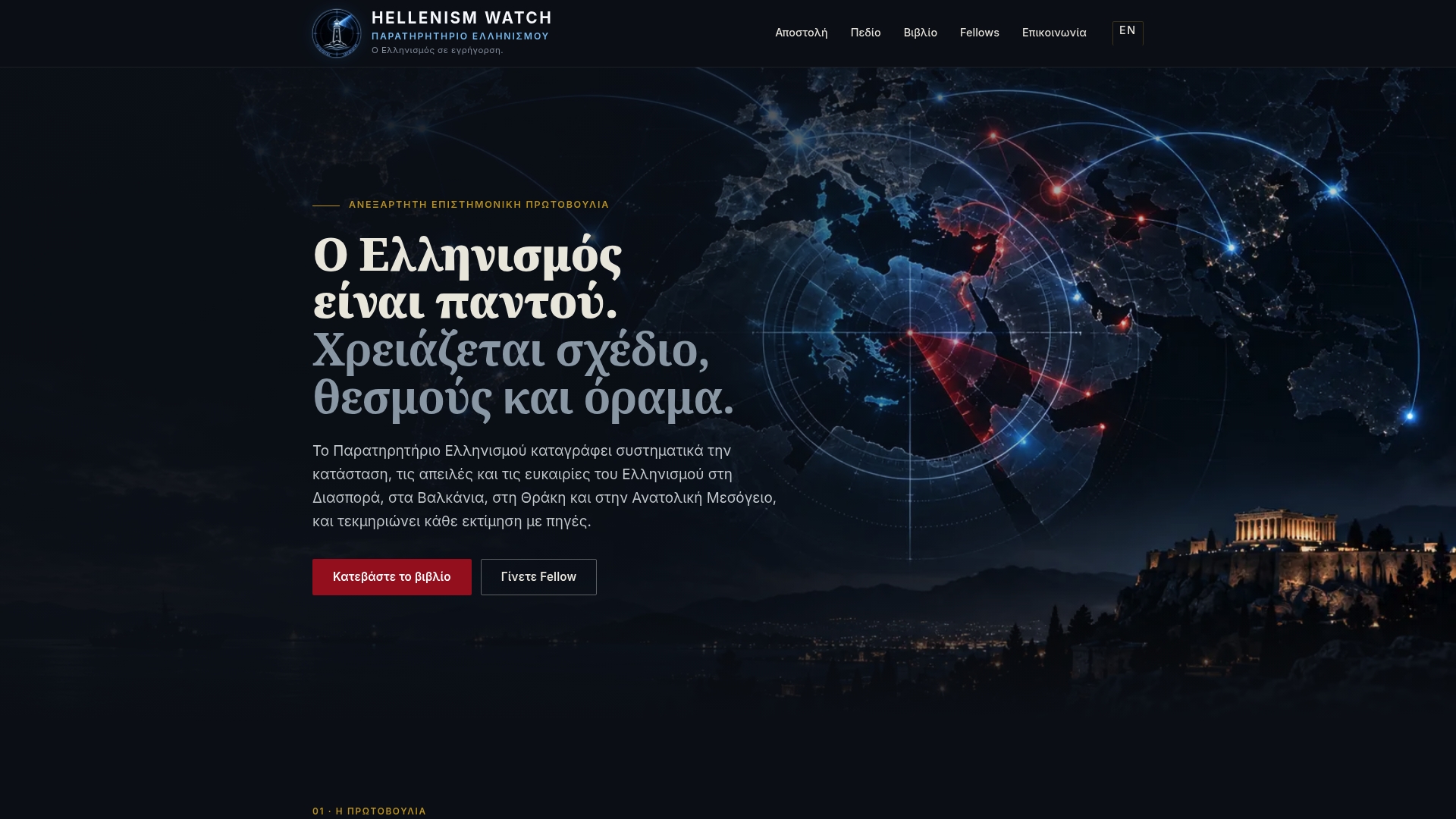
We welcome scholars who want to contribute data, analysis, or regional expertise under a sourcing standard we hold ourselves to. Visit our English landing page to read our publications or apply to contribute.
FAQ
What are the four main types of verification methods?
A common framework is SIFT: Stop, Investigate the source, Find better coverage, and Trace claims to the original context, which covers rapid online verification. For longer-form evaluation, CRAAP (Currency, Relevance, Authority, Accuracy, Purpose) covers a complementary set of checks suited to academic and professional sources.
How do you verify sources?
Start by pausing and checking the author and publisher through lateral reading rather than reading the page itself closely first. Then search for independent coverage of the same claim and trace any quote, statistic, or image back to its original document or creator.
What is source verification?
Source verification is the process of confirming that a claim, document, image, or quote is authentic, correctly attributed, and accurately represented in its original context. It typically combines a quick framework like SIFT with a deeper checklist like CRAAP depending on how much the claim will be relied on.
What are verification methods?
Verification methods include lateral reading, reverse image search, metadata and content-credential checks, citation chasing to primary documents, and structured checklists like CRAAP or TRAAP. Choosing between them depends on the time available and how much weight the claim will carry once published.
Sources
Claims tied to contested regional history or diaspora politics need extra weight on tracing primary documents and checking funding or affiliation behind a source, since framing bias is common on all sides. Organizations that document Hellenism and diaspora issues, including our own published assessments, apply the same sourcing standard: trace every claim to a document you can name, and disclose when a claim cannot be independently confirmed.