
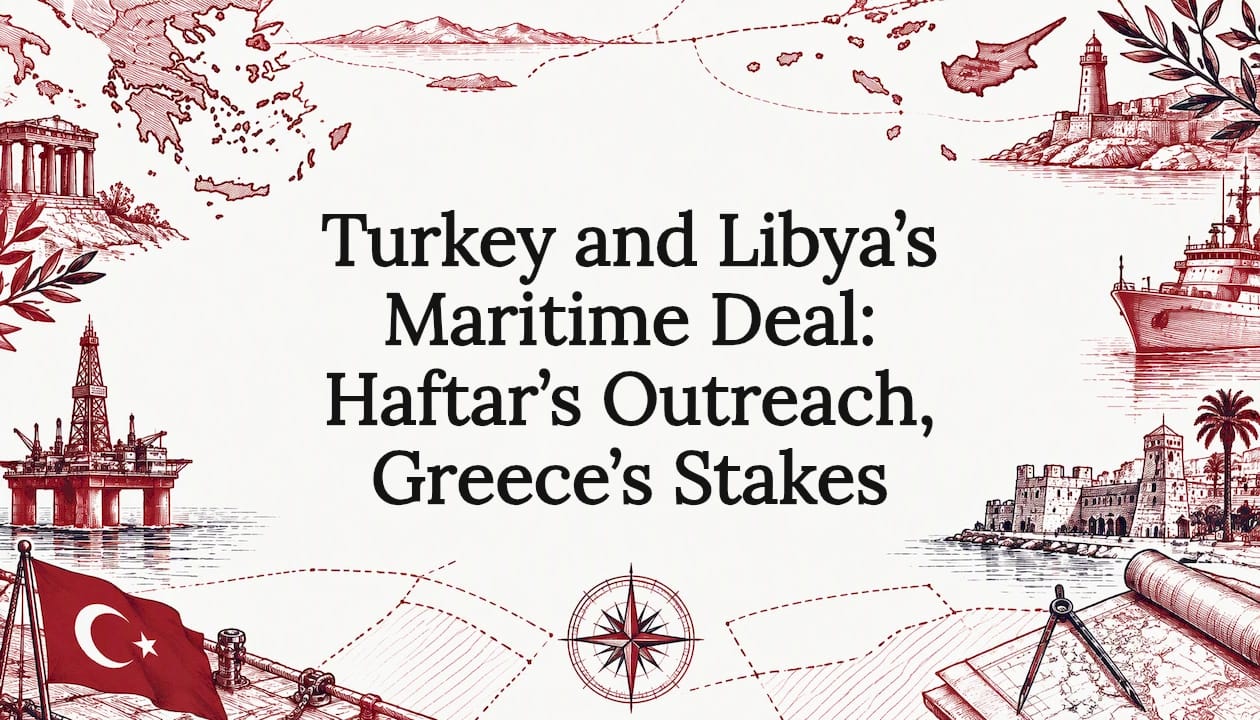
The 2019 Turkey–Libya maritime deal is a memorandum that purports to delimit maritime jurisdiction between the two states. The EU and several coastal states say it ignores islands such as Crete and cannot produce legal effects for third states under the Law of the Sea. The real stakes are contested exclusive economic zone claims that shape access to offshore hydrocarbons and feed regional tension.
TL;DR:
- The UN Secretariat registered the memorandum as number 56119, but registration confirms its filing only and does not validate the disputed maritime boundary.
- The EU says the deal disregards Greek islands such as Crete, infringes third states’ sovereign rights, and cannot create legal consequences for countries that never signed.
- Eastern Libyan authorities had not ratified the memorandum as of 2026; broader support could strengthen its domestic standing without resolving Greece, Cyprus, or EU objections.
- Track published maritime coordinates, licensing rounds, and naval activity, since these can signal de facto control before courts or negotiations settle the competing claims.
Table of Contents
- 1. What the Turkey Libya maritime agreement actually says
- 2. UN registration and what it does and does not prove
- 3. The EU, Greece, and Cyprus: legal objections in detail
- 4. Is the deal secure inside Libya?
- 5. What the delimitation means for energy and regional alignments
- 6. How earlier boundary agreements shaped the dispute
- 7. Where Egypt, Israel, and Lebanon stand
- 8. Why this matters to Greek diaspora communities
- 9. International law beyond UNCLOS
- 10. Maritime security and military posture
- 11. Scenarios for what happens next
- 12. Our view: what Greek and diaspora audiences should watch
- 13. Follow our ongoing coverage
- FAQ
- Sources
1. What the Turkey Libya maritime agreement actually says
On 27 November 2019, Turkey and Libya’s Tripoli-based Government of National Accord (GNA) signed a memorandum of understanding on the delimitation of maritime jurisdiction areas in the Mediterranean, according to the UN treaty record. Understanding the claim means keeping a few features in view:
- Parties: Turkey and the Tripoli-based GNA.
- Form: a memorandum of understanding on maritime delimitation.
- Purpose: it concerns maritime jurisdiction areas in the Mediterranean.
- Dispute: the EU says the memorandum infringes the sovereign rights of third states and cannot produce legal consequences for them.
The EU objects that the memorandum does not account for the presence of Greek islands such as Crete. Readers who want to assess the dispute can start with the UN filing and compare it with the EU’s stated position.
2. UN registration and what it does and does not prove
The memorandum was registered by the UN Secretariat under registration number 56119, and the UN record remains central to the dispute. Supporters of the deal point to that entry as if it were a stamp of approval. It is not.
The UN record establishes that the memorandum was registered. Registration alone should not be described as an endorsement of the delimitation.
The legality of the delimitation is disputed. The EU states that the arrangement does not comply with the Law of the Sea and says the memorandum infringes third states’ sovereign rights. The filing therefore proves the document exists and is on record. It says nothing about whether the claimed boundaries hold up.
3. The EU, Greece, and Cyprus: legal objections in detail
The European Union has been consistent. On 12 December 2019 the European Council stated that the memorandum infringes the sovereign rights of third States, does not comply with the Law of the Sea, and cannot produce legal consequences for third States. The EEAS spokesperson statement repeats the reasoning and singles out the effect on Greece and Cyprus.
The core objections run as follows:
- Islands are ignored. Greece argues that Crete and neighboring islands generate maritime zones, and a line that skips them cannot validly divide waters they border.
- Third states are bound by nothing. A bilateral memorandum cannot carve up entitlements belonging to states that never signed it.
- Cyprus shares the concern. Nicosia sees the claimed zone as cutting into rights it exercises in the Eastern Mediterranean.
- Good faith comes first. EU documents urge negotiation in good faith as the proper way to settle overlapping claims.
- Courts exist for this. The same documents point to adjudication before the International Court of Justice or arbitration as lawful routes, alongside diplomatic pressure from EU bodies and member states.
The EU has also promoted political solutions and urged adherence to UN-led mediation in Libya. The memorandum remains disputed, with the EU rejecting its legal effect for third states.
4. Is the deal secure inside Libya?
The memorandum was signed by the Tripoli-based GNA. As of 2026, eastern Libyan authorities had not ratified the agreement, which leaves ratification as a central political hurdle. The lack of ratification by eastern Libyan authorities remains a political hurdle for the memorandum.
Ankara appears to understand this. Turkey has pursued diplomatic outreach to eastern Libyan actors, including reported contacts with Khalifa Haftar, to broaden political support for the memorandum. Analysts read these moves as a strategic effort to widen the deal’s legitimacy and to hedge Turkish bets across Libya’s divided power centers. Commentary on a pragmatic Libya reset describes Ankara engaging both Tripoli and eastern actors to protect its maritime agreement and economic interests.
A broader Libyan political backing could strengthen the memorandum’s domestic standing, but would not resolve the objections raised by Greece, Cyprus, and the EU. Whether eastern Libya embraces, ignores, or rejects the text remains a development to watch.
5. What the delimitation means for energy and regional alignments
The memorandum is linked to competing claims over maritime jurisdiction and potential access to offshore resources. The consequences for exploration and licensing in contested areas depend on how the competing claims develop.
The consequences ripple outward:
- Turkey defends the memorandum.
- Greece, Cyprus, and Egypt are among the states described as opposing it.
- Companies and governments may take account of the dispute when considering activity in the region.
Analysts document that Turkey has anchored its Libya policy through military cooperation and maritime agreements that strengthen Ankara’s leverage in Eastern Mediterranean resource contests. Regional commentators describe the deal as a lightning rod for broader tensions, with Turkey defending the text while Egypt, Greece, and Cyprus view it as provocative and exclusionary.
Pro Tip: Track published maritime coordinates, licensing rounds, and naval operations. Any of them can signal de facto control long before a court or a treaty settles the legal question.
6. How earlier boundary agreements shaped the dispute
The Turkey–Libya text did not arrive in a vacuum. The Eastern Mediterranean has long been a patchwork of overlapping claims, because its coastlines face one another across narrow seas and dozens of inhabited islands generate their own entitlements. Many neighbors have never completed full delimitations, so the region carries a backlog of unresolved lines.
The dispute concerns differing positions on the role of islands in maritime delimitation. The sources cited here do not establish the details of earlier bilateral agreements or Turkey’s status and arguments concerning UNCLOS.
The EU objects that the 2019 memorandum does not account for Greek islands such as Crete. The sources cited here do not establish how earlier agreements treated island coasts. Readers should therefore see the 2019 text less as a first move and more as the sharpest expression of a standing disagreement about method. The precise history of each earlier bilateral deal is documented in the treaty record and in specialist legal literature, and anyone building a serious case should read those texts directly rather than rely on summaries, including this one.
7. Where Egypt, Israel, and Lebanon stand
Beyond Athens and Nicosia, other regional actors watch the corridor closely because their own claims sit nearby. Regional commentators describe Egypt, Greece, and Cyprus as viewing the deal as provocative and exclusionary.
The sources cited here do not establish Egypt’s specific legal or strategic concerns, or the positions of Israel and Lebanon on this dispute.
Official positions vary in tone and are not all publicly detailed in the sources we rely on here, so we avoid putting words in any government’s mouth. What can be said is that the memorandum has become a reference point in a wider contest over how Eastern Mediterranean waters will be divided and who gets a seat at the table when they are. Diplomatic alignments, including energy forums and defense partnerships among the states that reject the memorandum, form in part as a response to it.
8. Why this matters to Greek diaspora communities
For Greeks abroad, the dispute over the memorandum and the EU’s objections may be of particular interest because they concern Greece’s stated maritime rights and regional relations.
The Observatory’s mission is to monitor exactly this kind of development: what changes for Hellenism, who is exposed, and what responses are available. The dispute concerns regional relations and Greece’s position in international forums. Readers can follow how EU institutions and national governments address it.
The diaspora is not a bystander. Scholars, community institutions, and individual advocates can supply expertise, translate legal arguments for wider audiences, and keep the issue visible. A well-sourced public understanding of the Law of the Sea claims at stake makes it harder for any party to blur the difference between a filed document and a valid delimitation. The strongest contribution readers can make is accuracy: knowing what the memorandum says, what registration means, and what the EU has actually stated.
9. International law beyond UNCLOS
The EU says the memorandum does not comply with the Law of the Sea. The sources cited here do not establish the parties’ broader arguments about customary international law or Turkey’s status regarding UNCLOS.
The EU states that the memorandum cannot produce legal consequences for third states. The legal reasoning beyond that stated position is not detailed in the sources cited here.
The sources available to us do not set out a detailed African Union position, and we do not claim one here. Anyone researching that angle should check primary African Union statements directly before drawing conclusions. What remains clear is that the legal contest is not only about where the line falls but about who is entitled to draw it and whose consent it needs.
10. Maritime security and military posture
Policy analyses describe Turkey’s Libya strategy as involving military cooperation and maritime agreements, which they say help anchor Ankara’s position in regional resource disputes.
Naval deployments, exercises, and survey activity may become relevant to how states express or contest maritime claims. The sources cited here do not document specific incidents or establish their effects.
We stay cautious here, because specific deployment details change quickly and are not all documented in the sources used for this article. The reliable principle is that enforcement and contestation happen through visible activity: who surveys, who drills, who patrols, and who is allowed to do so. Readers can use the pro tip above as a practical filter. Vessel activity or licensing announcements in contested areas may draw attention to the dispute. The sources cited here do not establish how often they lead to diplomatic protests or increased risk of miscalculation.
11. Scenarios for what happens next
No one can forecast this dispute with confidence, but the realistic paths are limited, and each depends on identifiable signals.
Status quo. The memorandum stays on the UN record, the EU keeps rejecting it, and Libya’s factions remain divided. Claims persist without adjudication, and tension rises and falls with energy activity and Libyan politics.
Broader Libyan buy-in. Turkey’s outreach to eastern authorities succeeds, and a wider Libyan consensus forms around the text. That would strengthen its political standing, though not its legal acceptance by Greece, Cyprus, or the EU.
Libyan repudiation. A future Libyan government or parliament rejects or renegotiates the memorandum, which would undercut the basis of Turkey’s claim and reopen the question.
Possible legal proceedings. The parties could consider a judicial or arbitral route. The sources cited here do not establish whether the parties have agreed to pursue one.
Negotiated delimitation. The EU has promoted political solutions and urged adherence to UN-led mediation. The sources cited here do not establish the likelihood or form of a negotiated outcome.
The most useful forecasting habit is to watch for concrete moves rather than rhetoric: ratification votes, new filings, changes in EU Council language, and licensing activity.
12. Our view: what Greek and diaspora audiences should watch
We built the Observatory to be independent of governments and parties, and to stand behind every claim with a source. On this dispute, that discipline matters most. The filing proves the memorandum exists, not that it is lawful. Watch Libyan parliamentary moves, any UN filings or corrigenda, the wording of EU Council statements, and Turkey’s next diplomatic steps toward eastern Libya. Our takeaway: broader Libyan support could strengthen the deal politically, but it would not resolve the EU’s objections to its legal effect for third states.
— Alexios
13. Follow our ongoing coverage
We publish evidence-backed assessments on Greek and Eastern Mediterranean geopolitics, and we welcome your engagement. For continuing coverage of the memorandum and its fallout, start with these pages:
- Our main site carries our regular analysis and monitoring.
- Our fellows page introduces the researchers and experts behind our work, and explains how scholars can collaborate with us.
Visit the main site now to read our latest assessments, and write to us if you can contribute data or expertise.
FAQ
What is the Turkey Libya maritime deal?
It is a memorandum of understanding signed on 27 November 2019 between Turkey and Libya’s Tripoli-based GNA on the delimitation of maritime jurisdiction areas in the Mediterranean. It was registered by the UN Secretariat under registration number 56119. Registration records the document. The UN record itself does not establish whether the delimitation is lawful.
Is the Turkey Libya agreement legal?
Its legality is disputed. The EU states that it does not comply with the Law of the Sea and says it infringes the sovereign rights of third states.
Why do Greece and Cyprus object to the memorandum?
The EU says the memorandum infringes the sovereign rights of third states and cannot produce legal consequences for them.
Has eastern Libya accepted the deal?
Not as of the latest reporting. Eastern authorities had not ratified it, and Turkey has pursued outreach to eastern figures, including Haftar, to broaden support.
How could the dispute be resolved?
The cited EU material promotes political solutions and urges adherence to UN-led mediation.
Sources
- Libya/Türkiye: Statement by the Spokesperson on a reported agreement on hydrocarbons | EEAS
- Turkey, Haftar, and Libya: From Proxy War to Competitive Diplomacy – Libya Tribune
- Parliamentary question | Answer for question E-004522/19 | E-004522/2019(ASW) | European Parliament
- Türkiye Expands its Security Strategy in Libya - Jamestown